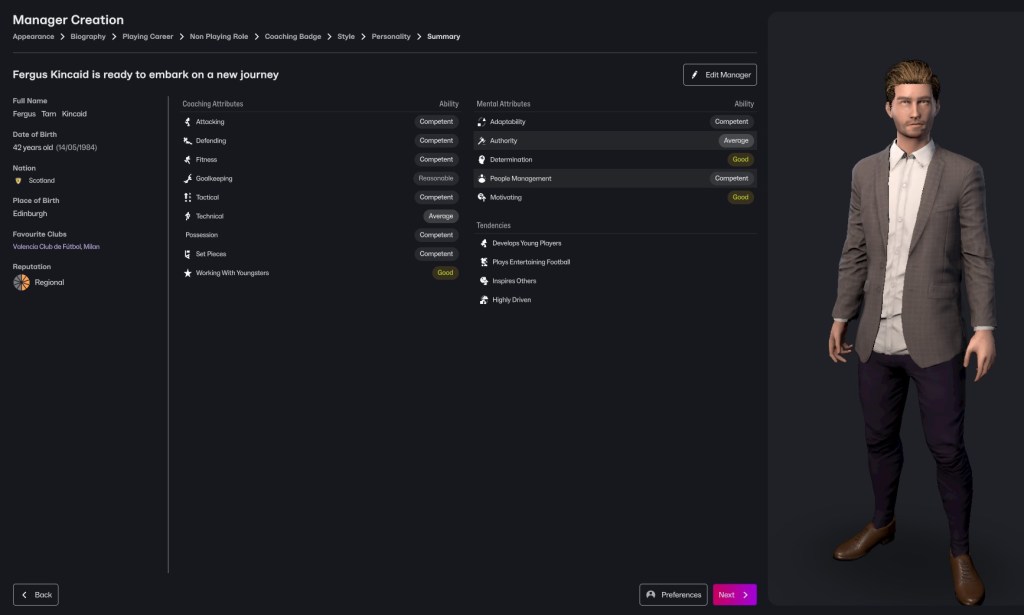
As a football-mad youngster, Fergus Kincaid grew up in a family split by sporting loyalties. His father, Tam, was the staunchest of Hibernian supporters, in stark contrast to his mother, Fiona, coming from a long line of Hearts fans, including a grandfather who played for the Jambos back in the 1960s. Fergus, always keen to avoid controversy, stayed well away from choosing between green and white or maroon, paid more attention to continental football, watching Italy’s Serie A and Spain’s La Liga, developing a love for AC Milan and Valencia during his formative years of the 1990s and 2000s.
That said, Fergus felt a strong connection to his home city and, having given up on an unlikely playing career in his teens, his focus quickly shifted to coaching. Fuelled by a long-term desire to improve Scotland’s footballing fortunes, he honed his skills working with junior teams while gaining his coaching badges. His big break followed as, much to his father’s delight and his mother’s dismay, he was recruited to coach various Hibs youth sides, starting at under-11s and working his way through the ranks up to the under-18s.
But, as much as he’d loved his time working with the Edinburgh youth, Fergus had loftier ambitions. He began circulating his CV among Scottish lower league clubs across Scotland and eventually got some responses. The most exciting came from John Dickson, the Chairman at League Two side Edinburgh City FC who, after seeing the club suffer a series of financial issues, was keen to bring stability and positivity to the club. And, despite Fergus Kincaid’s complete lack of managerial experience, Dickson decided he was the catalyst that Edinburgh needed.
Kincaid’s mission was simple yet sizeable. He intended to transform the capital minnows’ fortunes with the eventual aim of upsetting both his father and his mother by overthrowing their big city rivals, Hearts and Hibs. Beyond that, the extremely ambitious objective was to reach the second tier for the first time, gain promotion to the Scottish Premiership, and lead Edinburgh City to becoming champions of Scotland.
Who are FC Edinburgh?
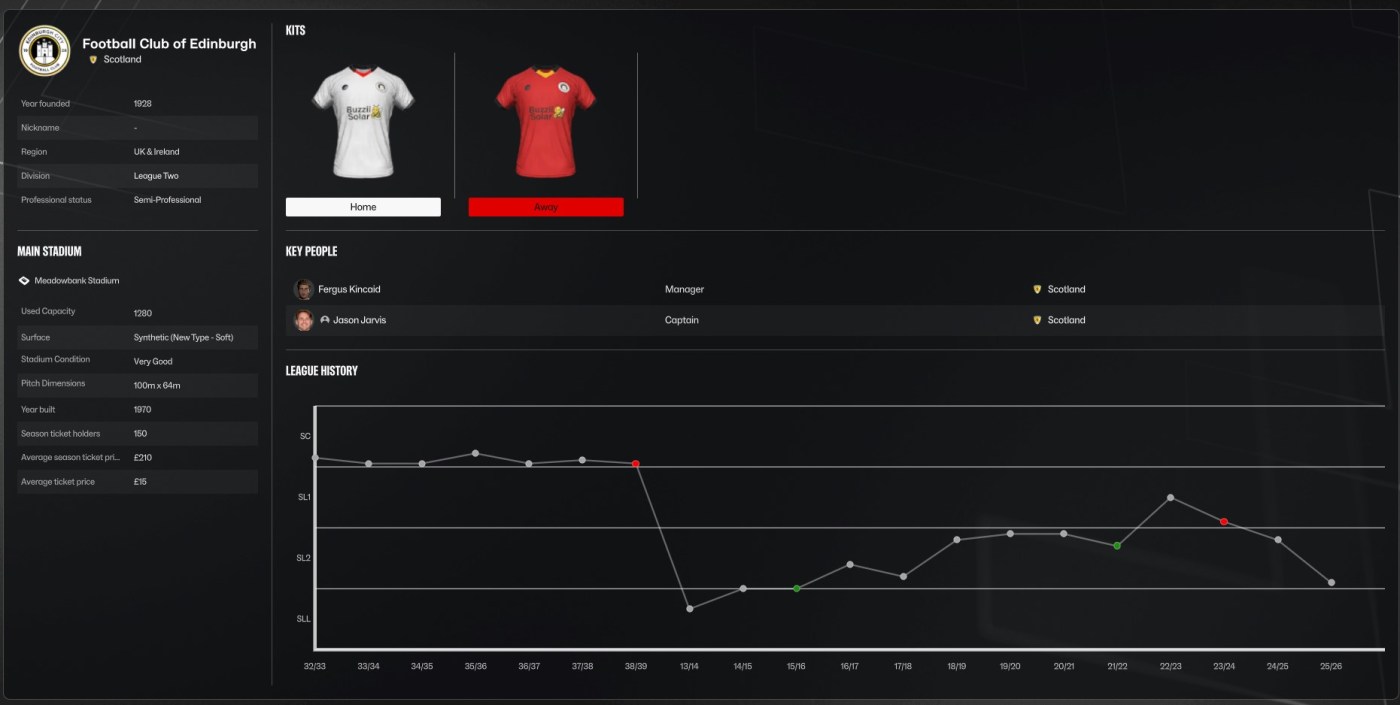
Edinburgh City FC, known in-game as Football Club of Edinburgh, is a semi-professional club based in the Scottish capital and plays in Scottish League Two. Edinburgh City was first founded in 1928 as an amateur club, with ambitions of becoming the city’s equivalent of Glasgow’s Queen’s Park. The club joined the Football League in 1931 but switched to junior status and ceased activity in 1955, when the council refused the lease on its home ground. It reformed as Postal United FC in 1966, joining the East of Scotland League, before becoming Edinburgh City in 1986. The club applied to reach the Football League in 2002, after Airdrieonians went bankrupt, but lost a vote to Gretna and then applied to join again after Gretna was liquidated in 2008, this time losing out to Annan Athletic.
Edinburgh City finally reached the Football League again in 2016, becoming the first club to gain promotion to the professional leagues through the newly established non-league pyramid system. It finished 7th in its first season and reached Scotland’s third tier for the first time in 2022. But a tumultuous period has followed, including the board making some controversial name-based decisions, before a series of financial struggles saw it relegated back to League Two and handed a series of points deductions.
Edinburgh City only avoided relegation out of the Football League last season by winning a playoff against Highland League champions Brora Rangers. However, the struggles continue into this season as they kick off the campaign with another 5-point deduction.
The club’s biggest rivals are not the Premiership pair of Hearts and Hibs but fellow League Two side Spartans, along with recently promoted League One side East Kilbride and lower league clubs Civil Service, Edinburgh Uni, Hutchison Vale, Leith and Whitehill Welfare. It plays at the 1,280-capacity Meadowbank Stadium, which was rebuilt in 2022 and is supported by below average training and youth facilities, good academy coaching and fairly basic youth recruitment. And, potentially crucially, the club also has an affiliate partnership with Hearts to get players on loan for free.
Kicking off the Turf Wars Mission
Kincaid sat down with Dickson on day one to receive the board’s long-term vision and expectations, which were to avoid relegation and work towards being self-sustainable, while aiming for the League Two playoffs by 2031. To achieve that, Kincaid had very little backing, with £25k in the bank, £20k to spend on transfers and £650 going spare in a weekly wage budget of £5k.
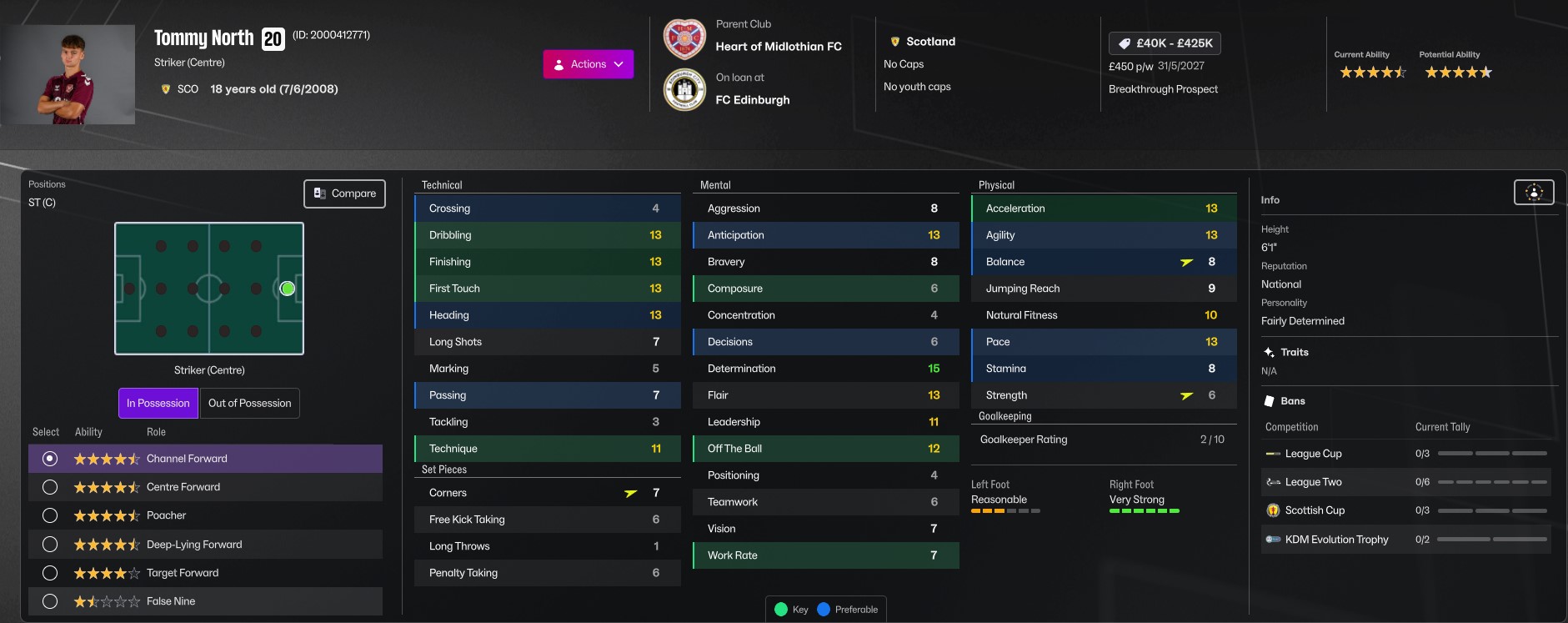
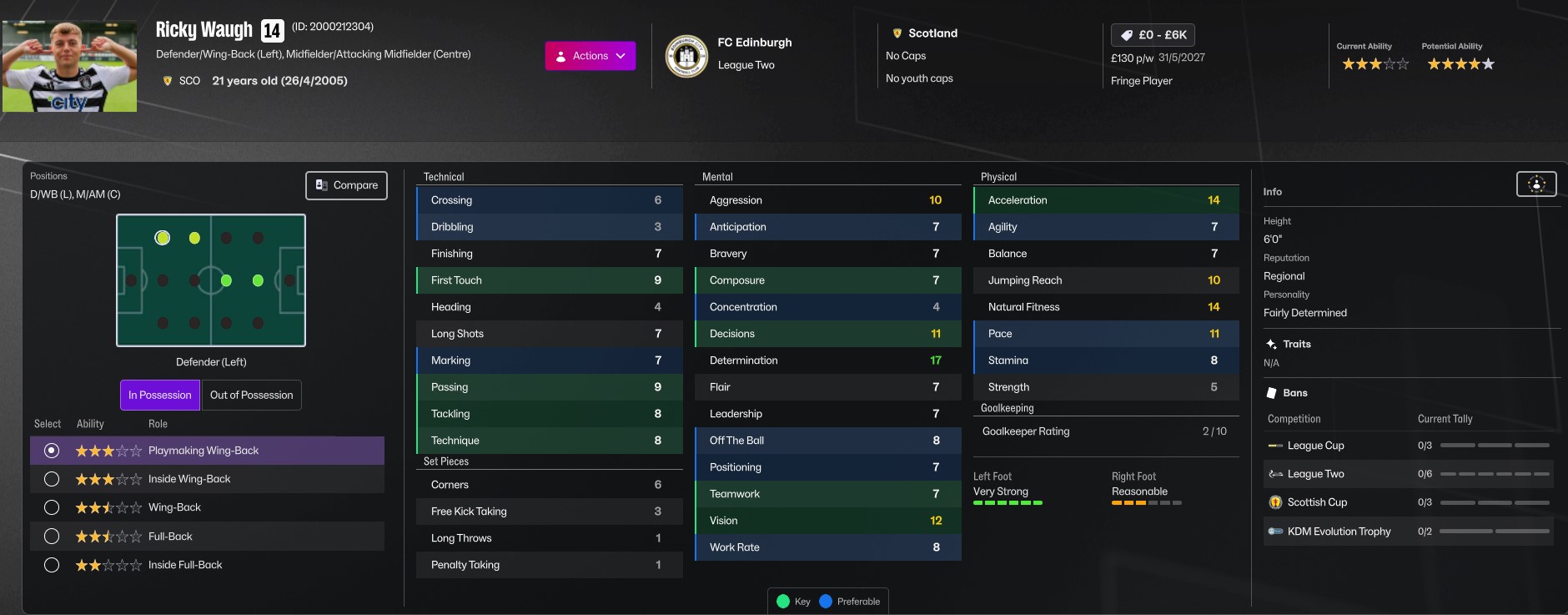
The best player at the club was striker Tommy North, who was on loan from Hearts, along with midfielders Murray Aiken, Innes Lawson, Jack Leitch and Jason Jarvis, centre backs Jordan McGregor and Josh Grigor, full back Jamie Walker and winger Lennon Walker. There were also a few youngsters to get excited about in 21-year-old left back Ricky Waugh and winger Keir Foster, 18-year-old midfielder Lucas Quinn, goalkeeper Tom Lang, midfielder Callum Brodie and defenders Callum Law and David Grant. Kincaid added one player to the squad, bringing in free agent former Rangers right back Jack Harkness on deadline day.
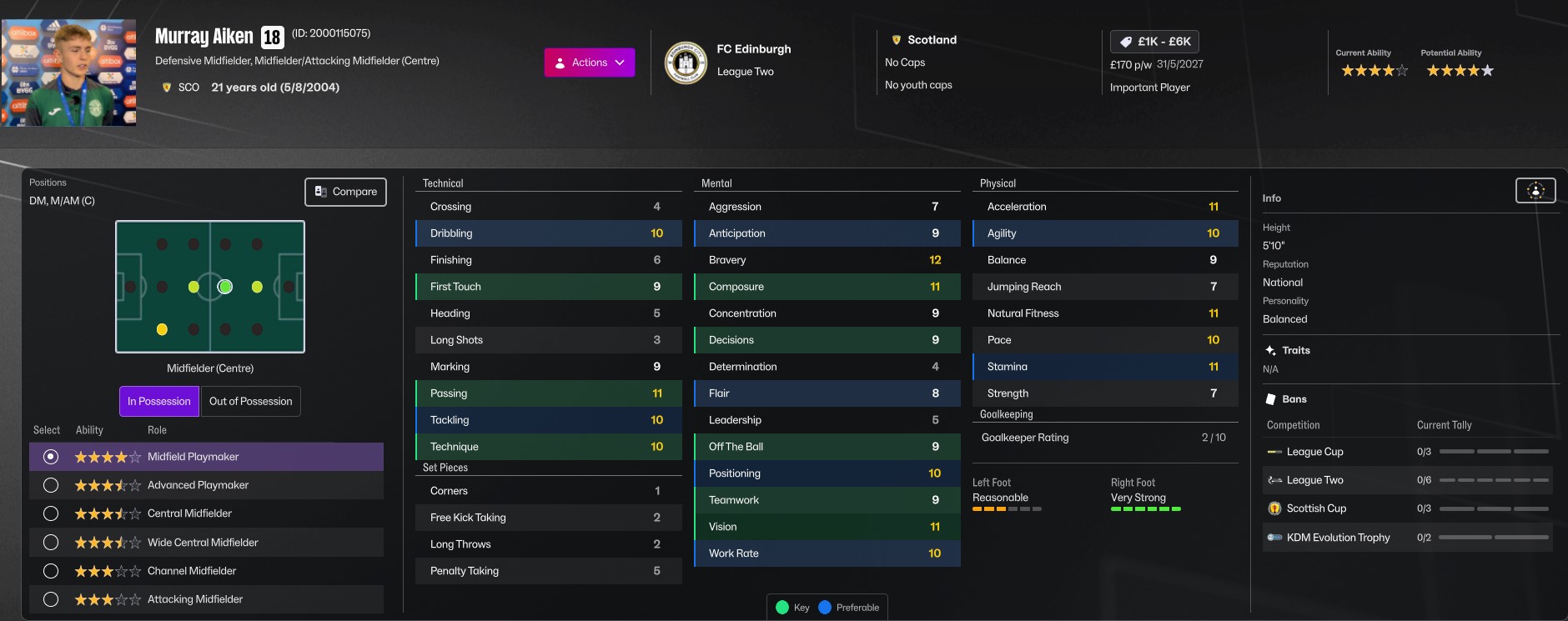
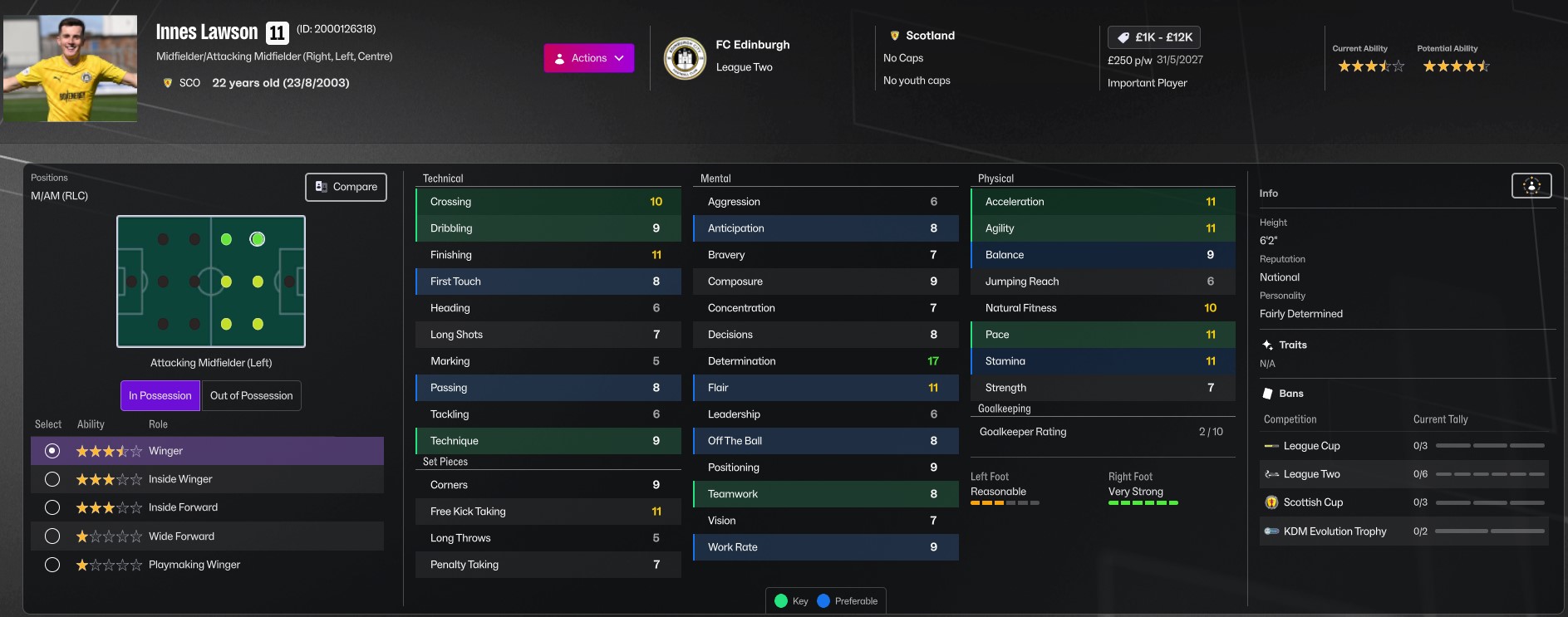
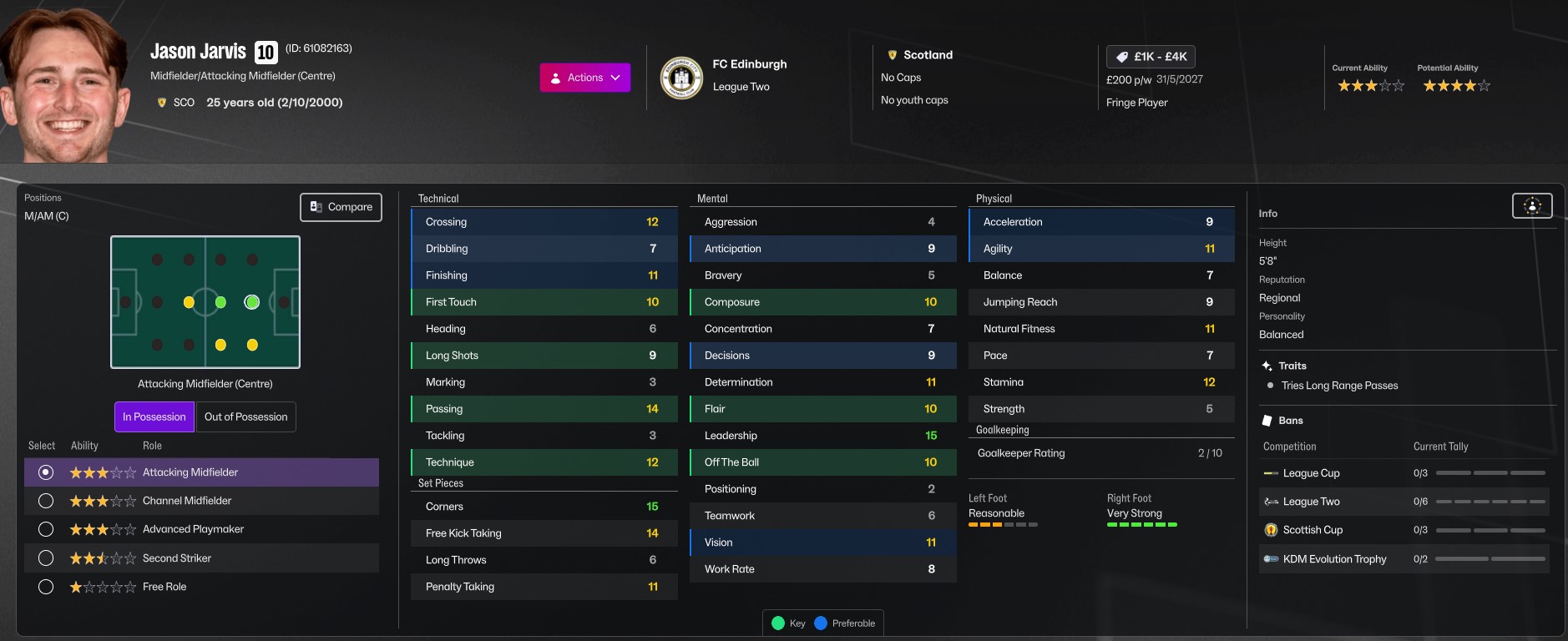
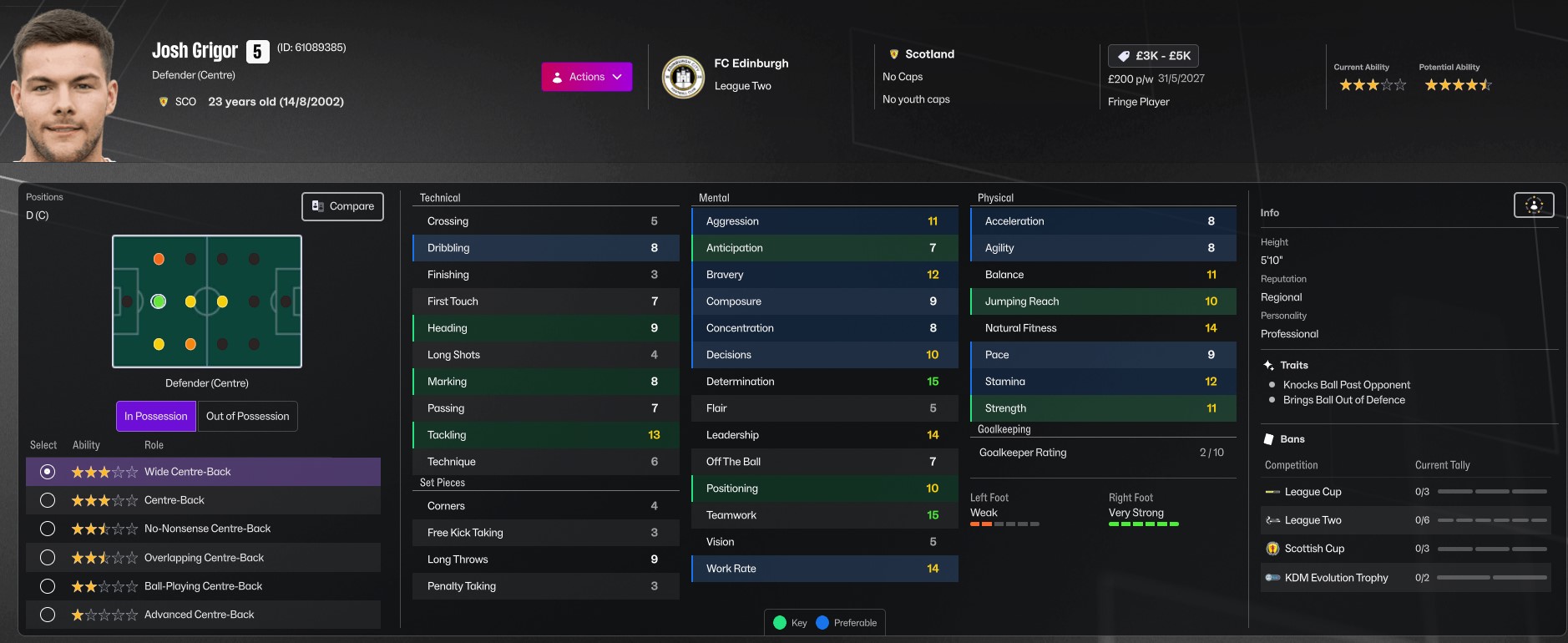
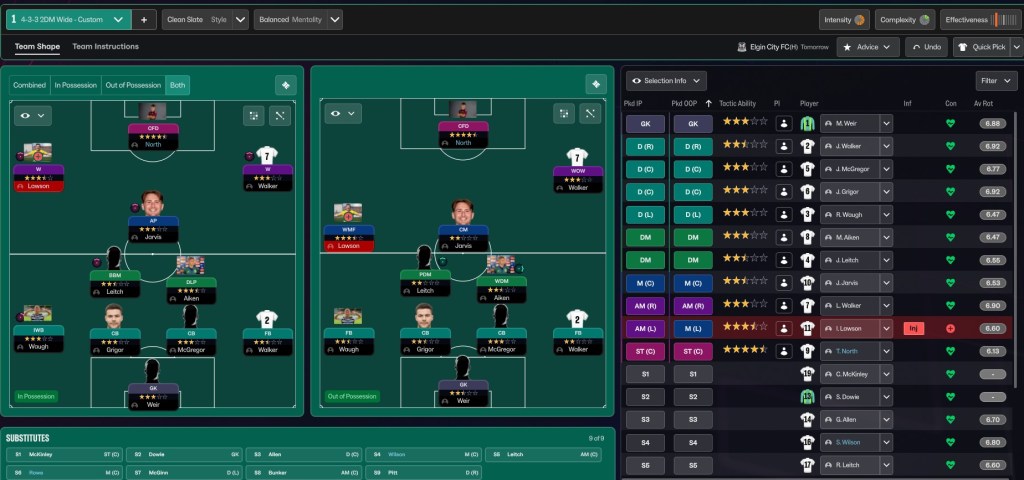
Kincaid opted to go with a 4-3-3 that looked to play wide while deploying a deep-lying defence that looks to regroup given a significant lack of pace. However, given the club is semi pro and only has up to two days of training per week, gaining tactical effectiveness looks like a near-impossible task.
Getting Started in Edinburgh
Kincaid’s reign began with the Premier Sports Cup, in which they were drawn in a tough group alongside League One Alloa and Queen of the South, Championship side Queen’s Park and Premiership club St Mirren. They began at Aloa and the cautious approach worked well as on-loan midfielder Freddie Rowe scored the only goal after replacing Lawson with sprained knee ligaments. They looked equally solid in holding Queen of the South to a 0-0 at home before losing 5-3 on penalties. But a rotated side lost 3-0 at Queen’s Park before being lucky to only lose 2-0 at home to St Mirren. They also had to play KDM Evolution Trophy games among the early league games, which let’s be honest, is equally pointless for League Two sides, so Kincaid opted to completely rotate the team and they lost five out of six.
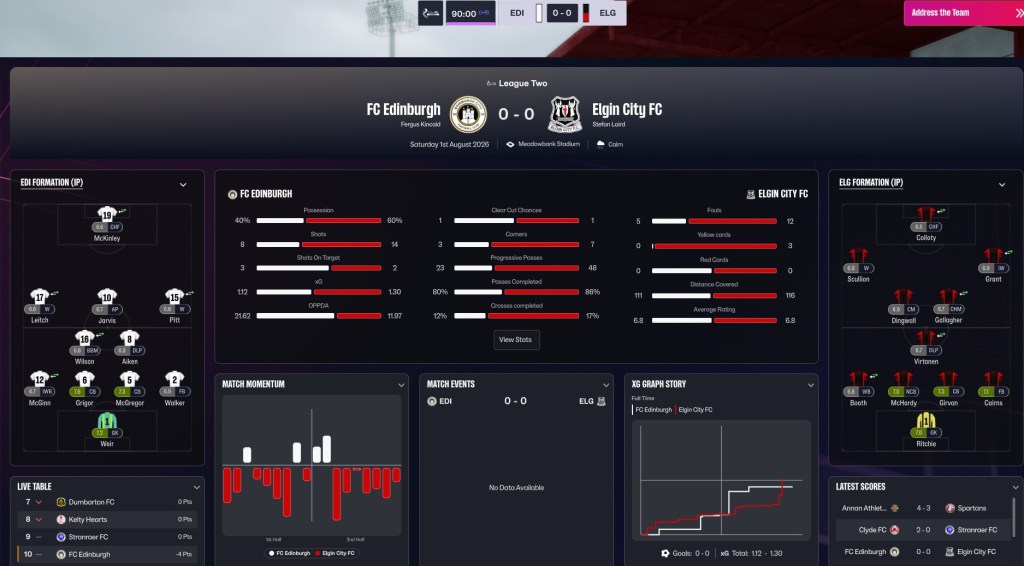
Edinburgh were fancied to finish 10th and last in William Hill League Two, with Dumbarton, rivals Spartans, Stirling Albion, Stranraer and Kelty Hearts leading the way for the title. Kincaid’s league career began at home to Elgin City, whose players all had faces in the game, which felt scary. Edinburgh started brightly as North crashed a 20-yard shot off the bar before getting outplayed in the first half. North looked to have broken the deadlock after an hour only for the flag to go up and nothing else happened in a pretty poor game. But a 0-0 at least ate into the 5-point deficit.
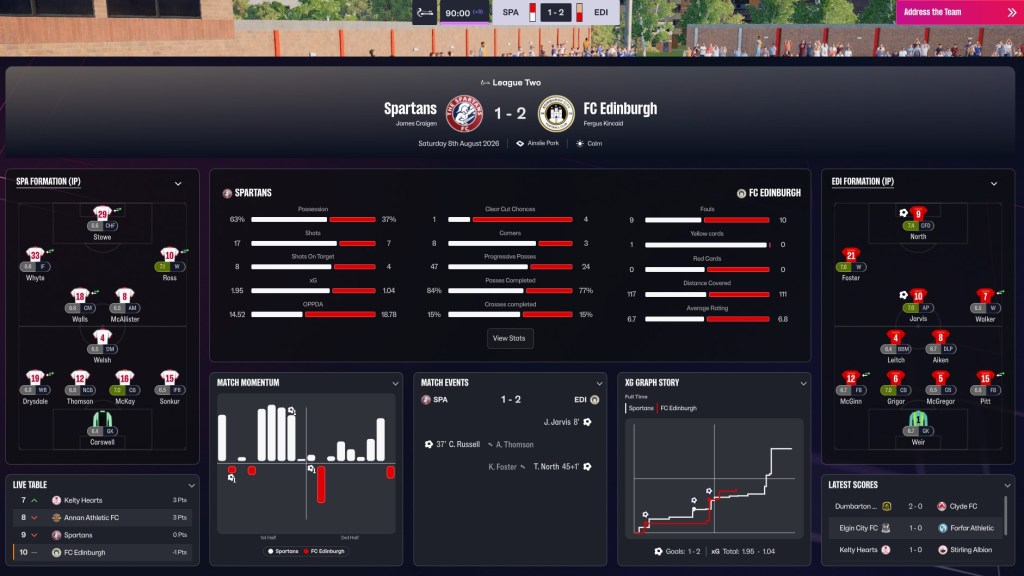
A huge game followed as they travelled to rivals Spartans for the first time. The first goal of the season came after 8 minutes as North was brought down on the edge of the box and Jarvis whipped it into the top corner. North had another goal ruled out 3 minutes later… another after 15 minutes… and, unbelievably, another on 24 minutes. He was punished as Spartans equalised after 37 minutes, but North finally stayed onside to restore the lead in first half injury time. They restricted Spartans to long range efforts as they dominated the second half, but held on to a huge 2-1 win.
They fell behind early at title favourites Dumbarton, but the approach worked well as they restricted them to long shots and North converted another Foster cross to earn a point. And, after three games, they’d already wiped out the points deduction. They then moved off the bottom of the league for the first time at Spartans’ expense as, after Kincaid had “thrown the kitchen sink,” and having the best of a match for the first time, striker Cammy McKinley came off the bench to nick a late equaliser at home to Annan.
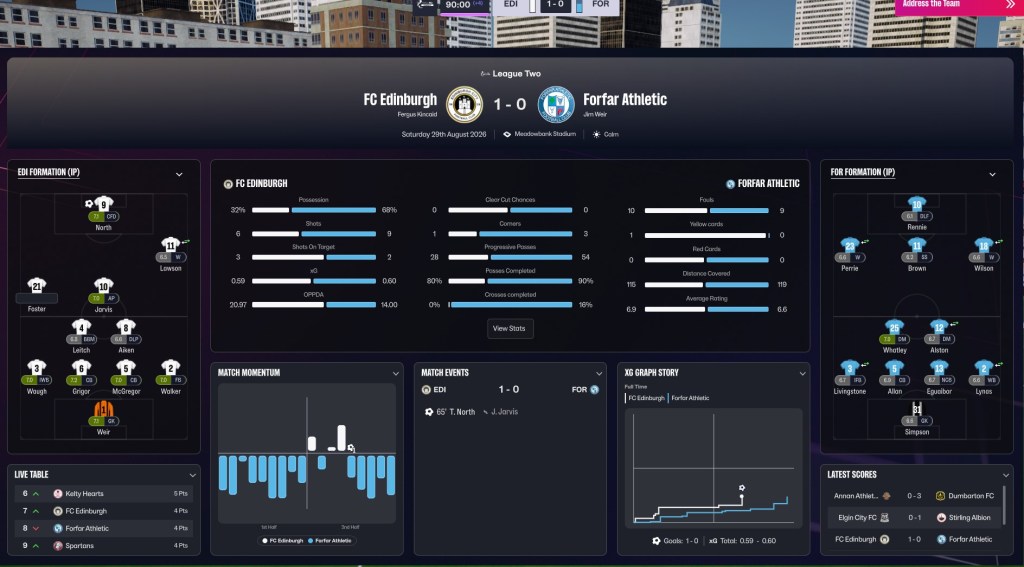
They hosted Forfar next, and North rattled the crossbar adter 10 minutes as Ediburgh bossed the first half to no avail. The striker had yet another goal ruled out for offside after the break, but made up for it two minutes later as Jarvis sent him through for the opener. Forfar stepped up some pressure, but they held on for a 1-0 win that moved them up to 6th. North hit the bar again and had another goal disallowed before deservedly equalising with a cheeky chip at leaders Clyde. They went behind to a free kick and fell to an unlucky 2-1 defeat.
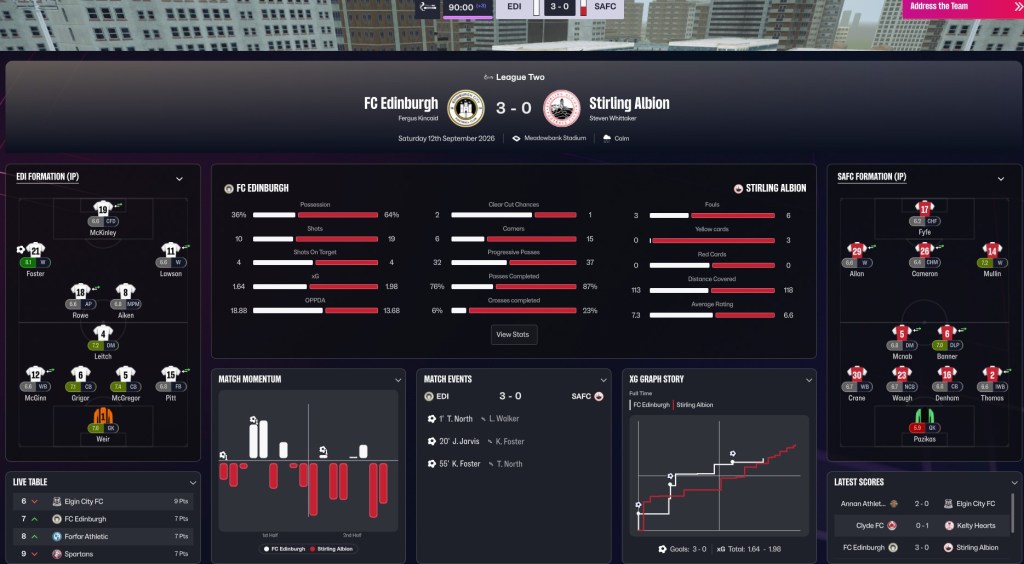
But the best performance of the season followed, started by North scoring after 24 seconds at home to Stirling. But Foster, who was keeping Lawson out of the team early in the season, stole the show as he teed up Jarvis for a second before latching onto North’s header to emphatically crown a 3-0 win, despite giving up 19 shots to 10. That was backed up by North and Jarvis earning a 2-0 victory at bottom side Kelty before North scored twice to seal a surprise win at 2nd place Stranraer.
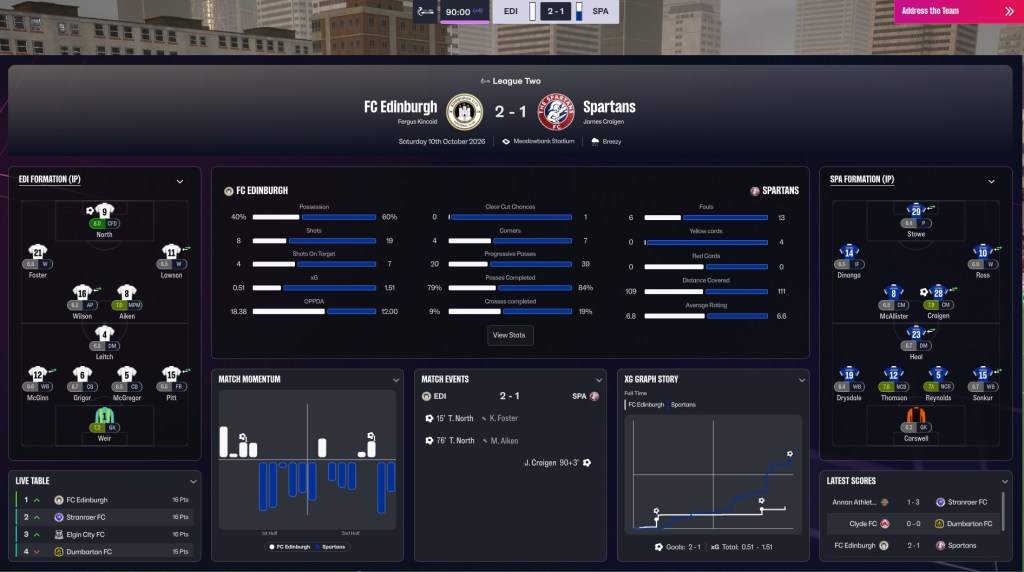
A first home derby with Spartans followed and North converted another Foster cross to put them in front after 15 minutes. He learned the offside rule to latch onto Aiken’s pass and double the lead on 76 minutes and, despite a late 30-yard freekick making it nervy, a 2-1 win sent Edinburgh City top of the league after 10 games!
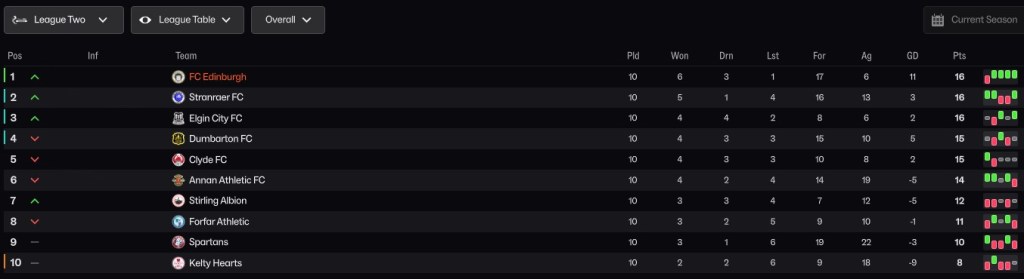
Just over a quarter of the way into Kincaid’s debut season, Edinburgh City sat pretty at the top of the League Two table with the league’s joint-best defence. However, they had easily the highest xG overperformance 5.35 (1.5 more than anyone else) and the lowest pass completion ratio (79%) and passes completed (3,133, over 1,000 less than any other team). If they hadn’t been docked 5 points they’d be 5 points clear, and they had a nice 8-point cushion over bottom side Kelty. While North’s 10 goals led the way by 3, and Foster topped the league with 5 assists.
Could Kincaid maintain Edinburgh’s surprisingly strong start with his defensive approach? Join us on Friday to find out!


Leave a Reply