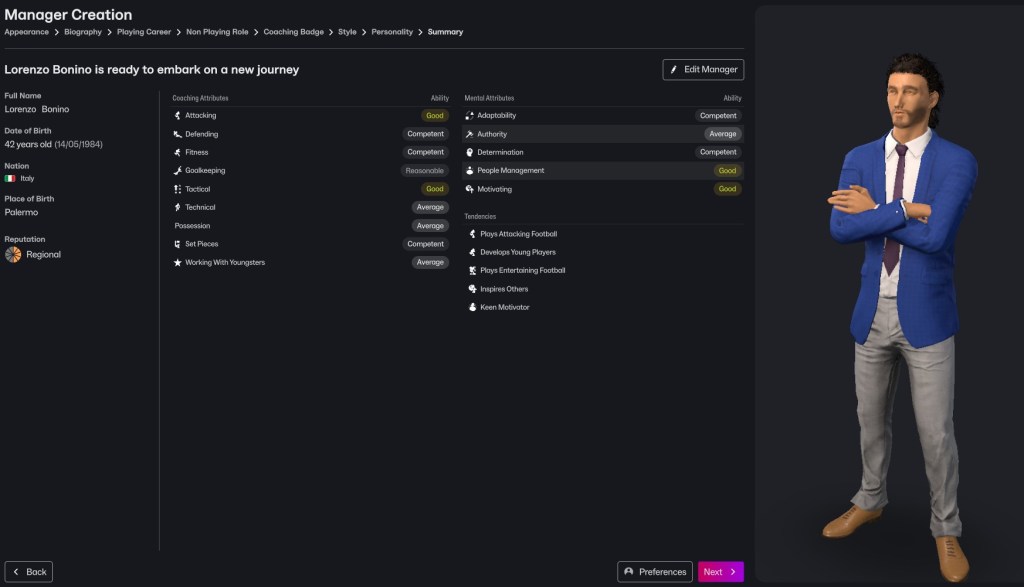
Lorenzo Bonino was well accustomed to his football vision being written off with disdain. Once considered one of the brightest young coaching talents in Italy, Bonino quickly won plaudits amongst his peers for his tactical innovation and highly effective training sessions.
But Bonino had grandeur ambitions of stepping up from coaching to become a Football Manager, keen to emulate his national heroes like Arrigo Sacchi, Marcello Lippi and Giovanni Trapattoni. He had grown tired of seeing ambitious clubs attempting to challenge the elite by wasting millions on washed-up stars and neglecting factors like youth recruitment and development, data analysis and tactical nous. Owners at sides in Italy’s third and fourth tiers initally bought into his concepts, only to show a lack of patience in his vision, before a misguided attempt to go under the radar by accepting an MLS head coach role left his reputation in tatters.
Now, after 12 months out of the game, most commentators were torn on whether Bonino was a misunderstood visionary or simply a terrible manager best suited to sticking to coaching. Either way, his reputation was damaged and his agent had run out of ideas.
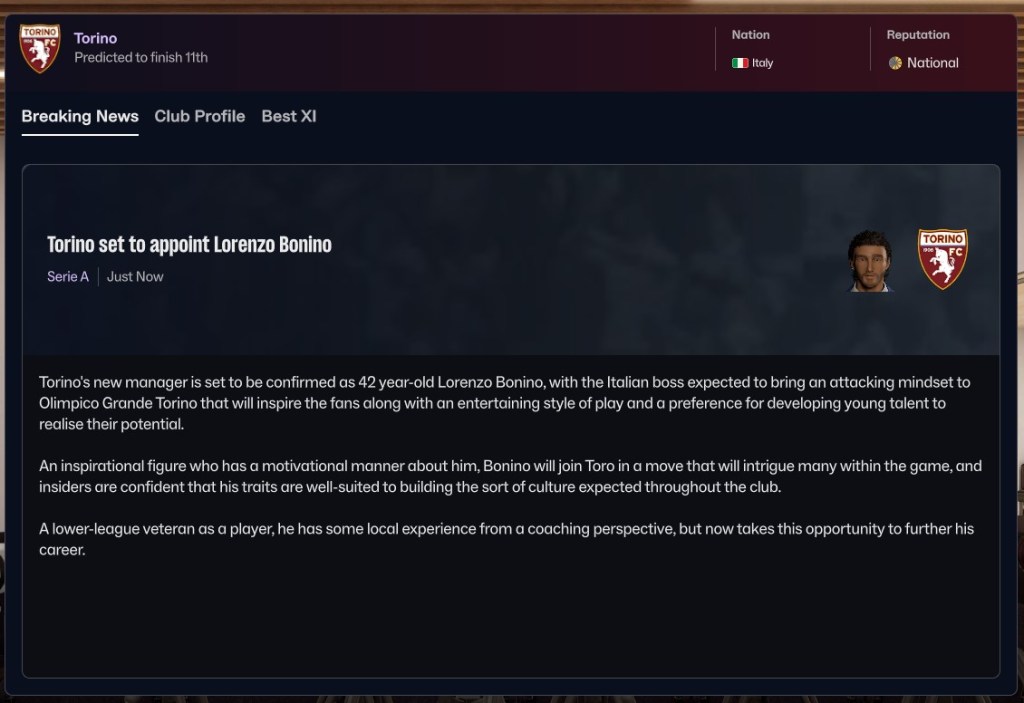
That was until June 2026, when Bonino received a phone call from an unknown Italian number. Fast-forward three days and Bonino, having called his agent to relieve him of his services, soaked up the early morning sunshine outside Caffé Torino in Piazza San Carloin, watching the world go by as he waited for an old friend.
Gasps and hushed whispers among the locals told Bonino that his friend had arrived, which was confirmed as he looked up from the pages of Gazzetta dello Sport to see the immaculate Gianluigi Lentini walking through the square. Lentini came through the Torino ranks in the late 80s and played over 200 league games for his hometown career, which earned a then world-record transfer to AC Milan before a car crash curtailed his potential. Now, he had been drafted in as an advisor to help the Torino board rebuild the club with the aim of getting the Torinesi back on board and usurping city rivals Juventus.
The two friends, who met on coaching courses in the early 2000s and stayed in touch after taking separate career paths, embraced warmly before sitting down to order coffees and engaging in small talk before getting down to business. “I’ll get straight to the point,” Lentini began, as he slurped on a double espresso. “The Torino board and supporters are sick and tired of living in the shadow of Juventus. The President, Urbano Cairo, has tasked me with finding someone capable of transforming our approach and is open to new ideas to help the club progress at any cost.
“Signore Cairo read your manifesto and, having discussed it with him in depth, he fully believes that you’re the kind of visionary we need to take Torino to the next level. We’ve got all the pieces in place to help you, from a solid scouting team to data analysis capabilities that compete with any other club in Italy. However, previous managers haven’t taken advantage of this, and Signore Cairo recognises the need for change.
“Our proposal is simple: While we may not have the finances of Juve, Napoli or the Milan and Rome clubs, we’ll fully commit to your vision of recruiting undervalued players and developing young talent to build a team that can potentially compete with Italy’s elite. But in return, we want to overthrow Juventus to become the best team in Turin within five years. And we want trophies to follow it.”
Bonino couldn’t hide his delight. He’d come to terms with the likelihood that his chance in football management had passed him by, and couldn’t have dreamed of earning an opportunity at one of the most historic clubs in Italian football. As a result, it took very little persuading to get him to sign on the dotted line before stepping into Lentini’s lavish Ferrari for the short drive over to Stadio Olimpico Grande Torino to meet his new employer for the first time.
Torino Football Club – A History
Football was introduced to Turin by English and Swiss industrial workers at the end of the 19th Century. The oldest Italian football club, Football & Cricket Club, was founded in the region in 1887 and merged with Nobili Torino to form Internazionale Torino before Football Club Torinese was founded in 1894. Football swiftly usurped pallapugno, a traditional Italian ball game, which led to two further sports clubs, Ginnastica Torino and Juventus. Football Club Torinese absorbed Internazionale Torino on 3 December 1906, which led to the founding of Foot-Ball Club Torino.
The first Turin derby was played the following month, with Torino defeating Juventus 2-1 before finishing second to AC Milan in the Italian Football Championship. The club led the way in Serie A in 1915 with one match remaining, only to be denied a first title by the outbreak of World War I. It had to wait 12 years to finally secure that first title, only for it to be revoked due to the Allemandi Case, the first major scandal of Italian football. However, 12 months later, Torino finally became champions of Italy for the first time.
Since then, only four clubs – Juventus (36), Inter Milan (21), AC Milan (19) and Genoa (9) – have bettered Torino Football Club’s tally of seven Italian titles. However, I Granata (The Maroons) have gone 50 years without winning a Scudetto. The club’s greatest era is etched into history by Grande Torino, a team that won five titles during the 1940s, became the backbone of the Italian national team and was captained by Valentino Mazzola, the father of Inter legend Sandro Mazzola. However, the era ended in tragedy as an aeroplane carrying the entire team crashed into Turin’s Basilica of Superga on 4 May 1949. The crash killed the entire first team, reserve players, coaches, club officials, four crew members and three journalists.
A period of decline followed the tragedy, leading to I Granata’s first relegation to Serie B in 1959. The club recovered, going on to win its seventh and most recent Scudetto in 1976 and its most recent major trophy, a fifth Coppa Italia in 1993 following previous successes in 1936, 1943, 1968 and 1971. But now, Bonino was looking to rewrite history having been entrusted with the Torino manager’s seat.
Bonino’s Torino Takeover Begins
Fresh from an encouraging meeting with President Cairo, Lentini drove Bonino to the Torino training ground in the Filadelfia neighbourhood to meet his backroom staff and the playing squad. The new manager was fairly impressed with the facilities, as the 28,000 Olimpico is supported by great training and youth facilities, above average youth recruitment and good academy coaching.
Bonino was very familiar with the vast majority of the players led by the surprisingly strong attackers Giovanni Simeone and Nikola Vlasic. He had solid midfield options including Rolando Mandragora, Cesare Casadei, the legendary Daniel Braganca, Kian Fitz-Jim, young Lithuanian Gvidas Gineitis and Emirhan Ílkhan, along with and ageing defender Ricardo Rodriguez, goalkeeper Lucas Perri and young centre back Pietro Comuzzo on loan from Fiorentina. There was also an exciting talent in 19-year-old left sided Alessio Cacciamani, who’d train as an attacking left back, a former FM wonderkid in striker Pietro Pellegri and a now 35-year-old Duván Zapata.
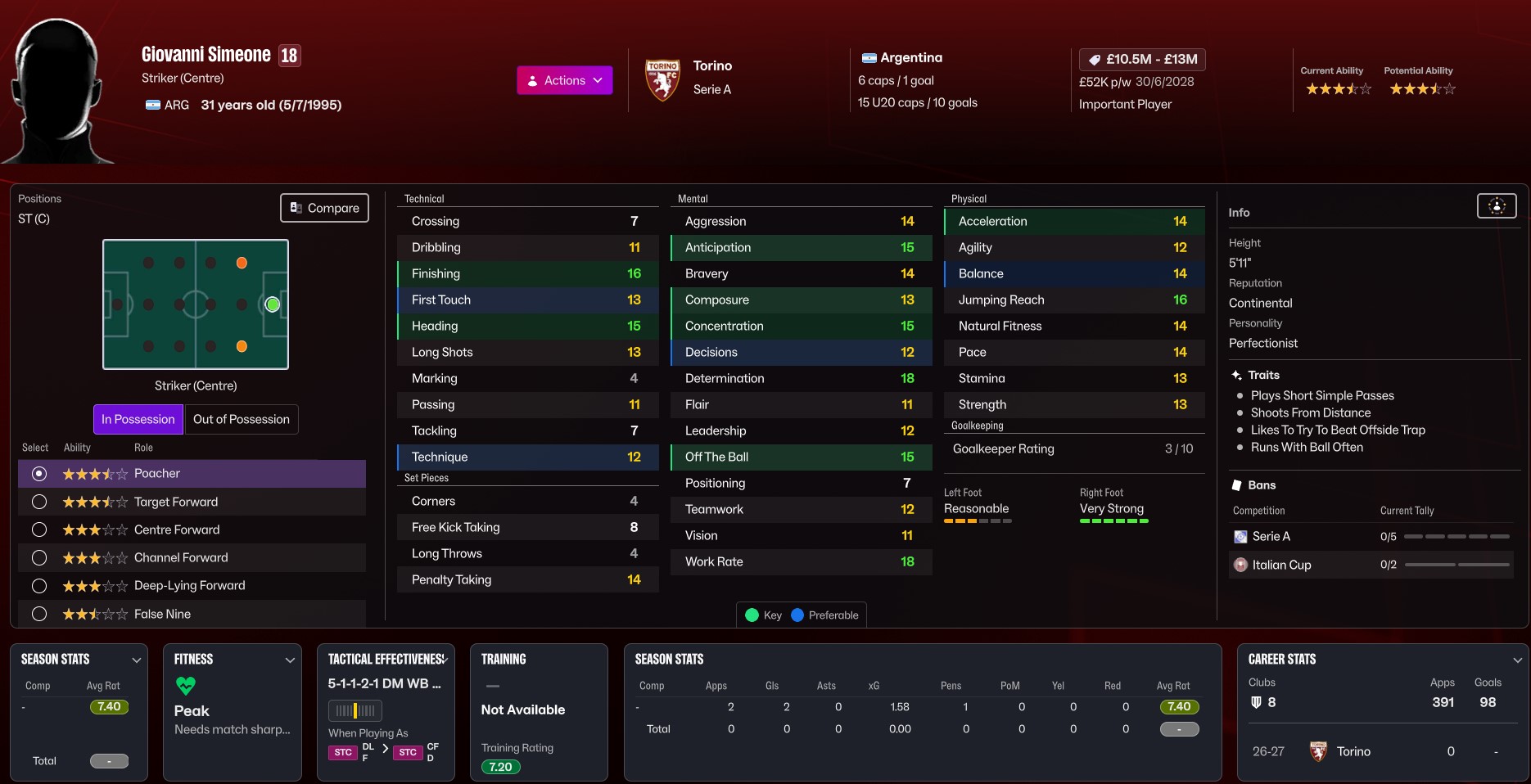
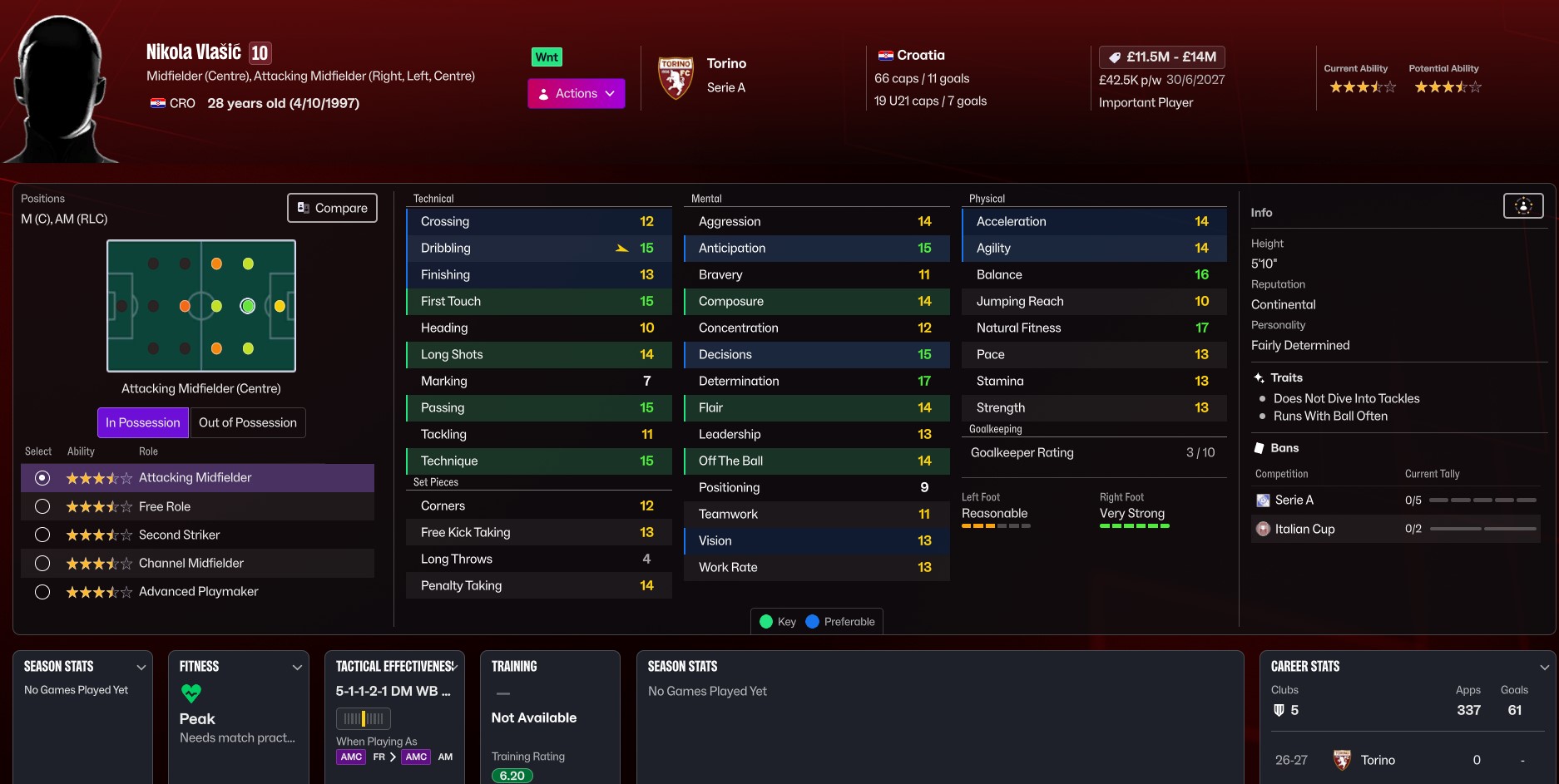
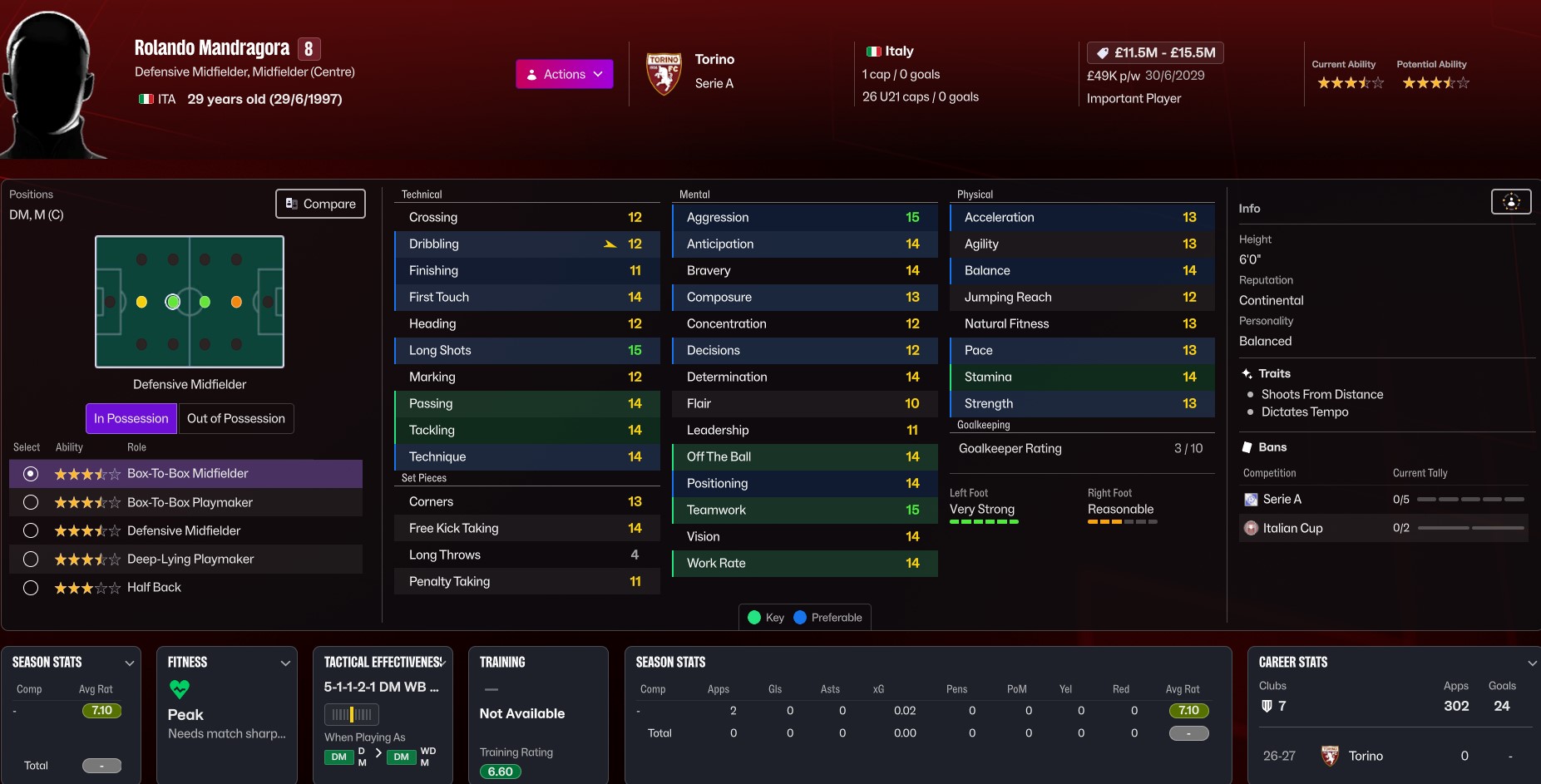
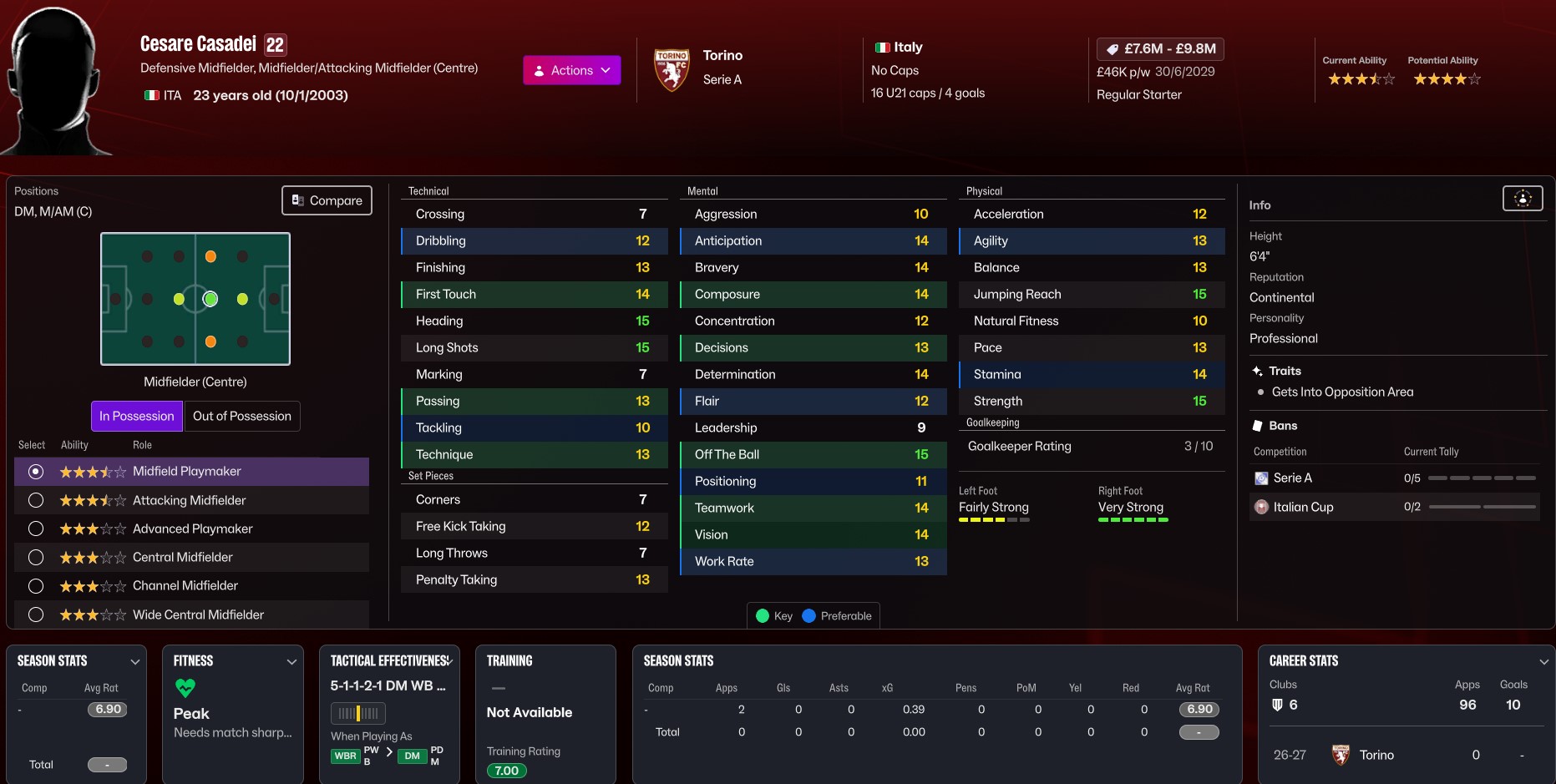
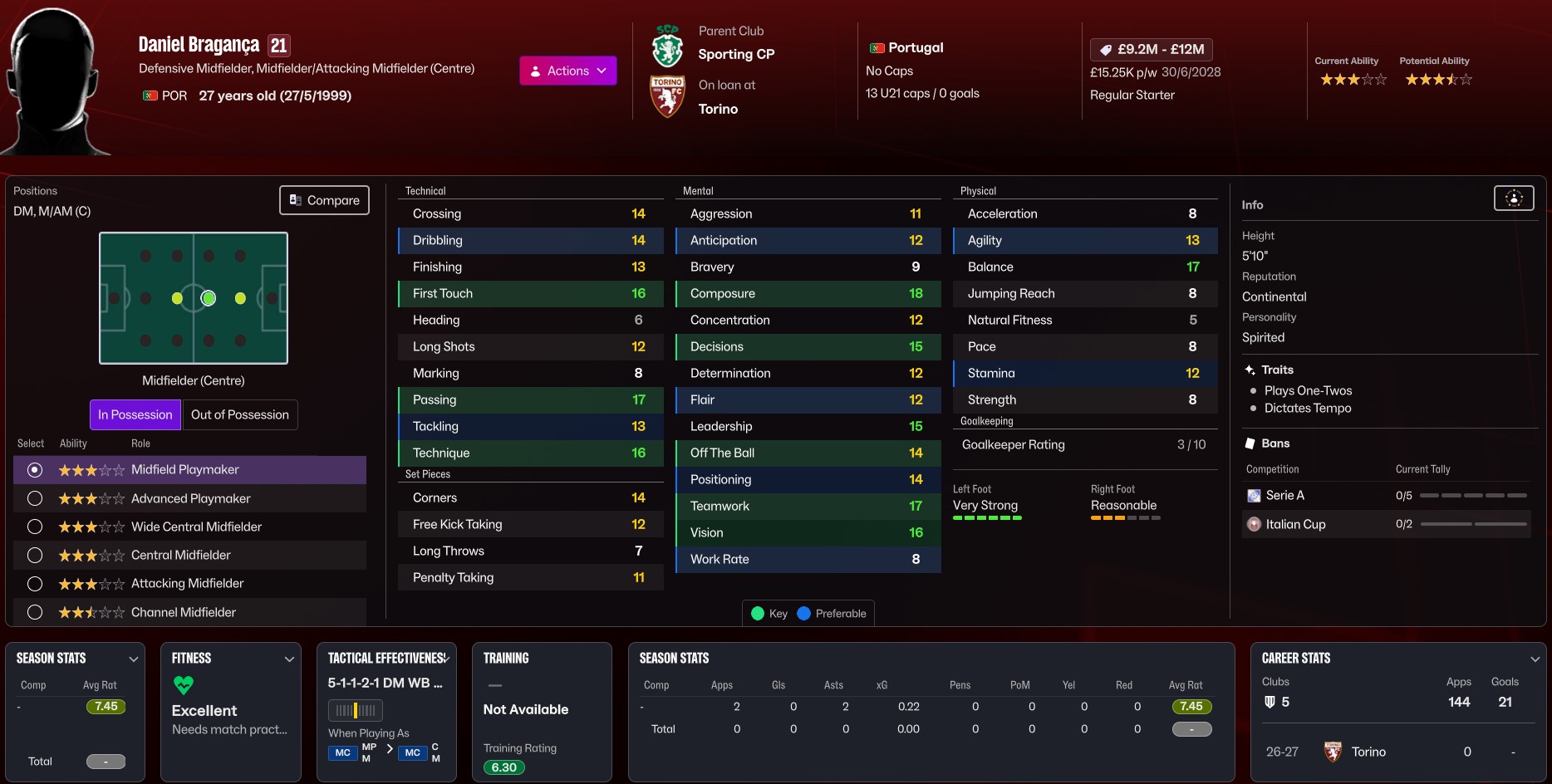
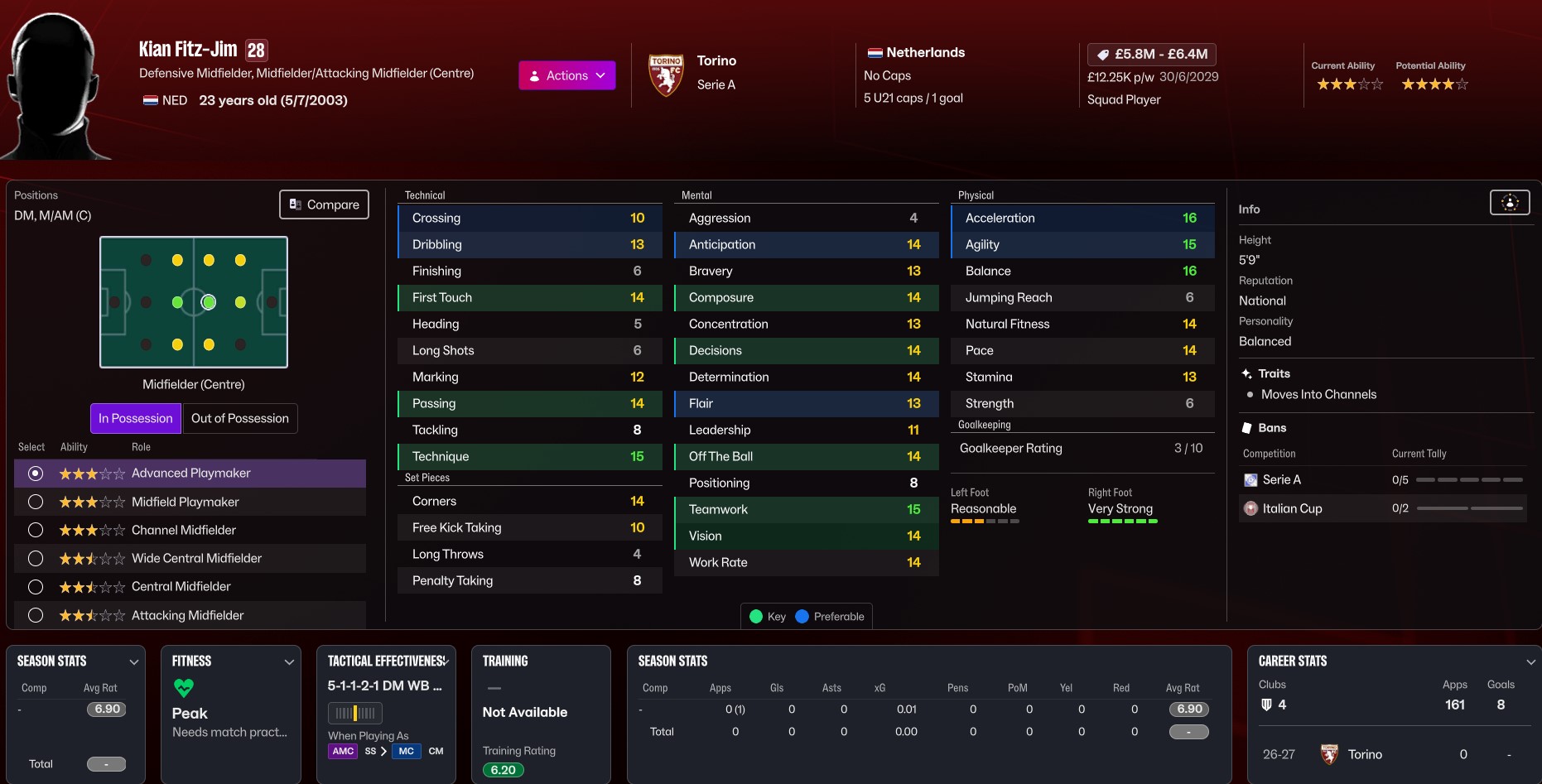
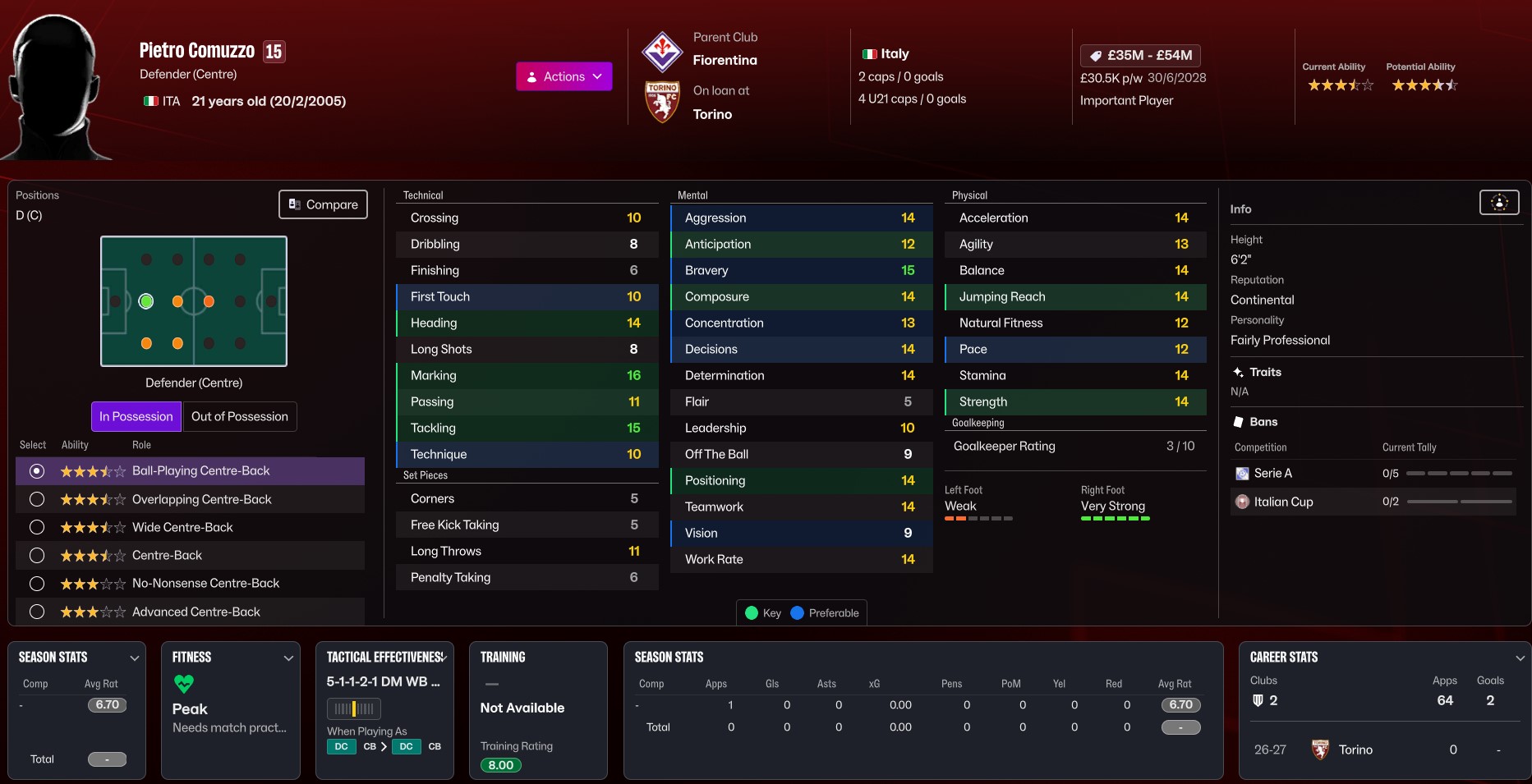
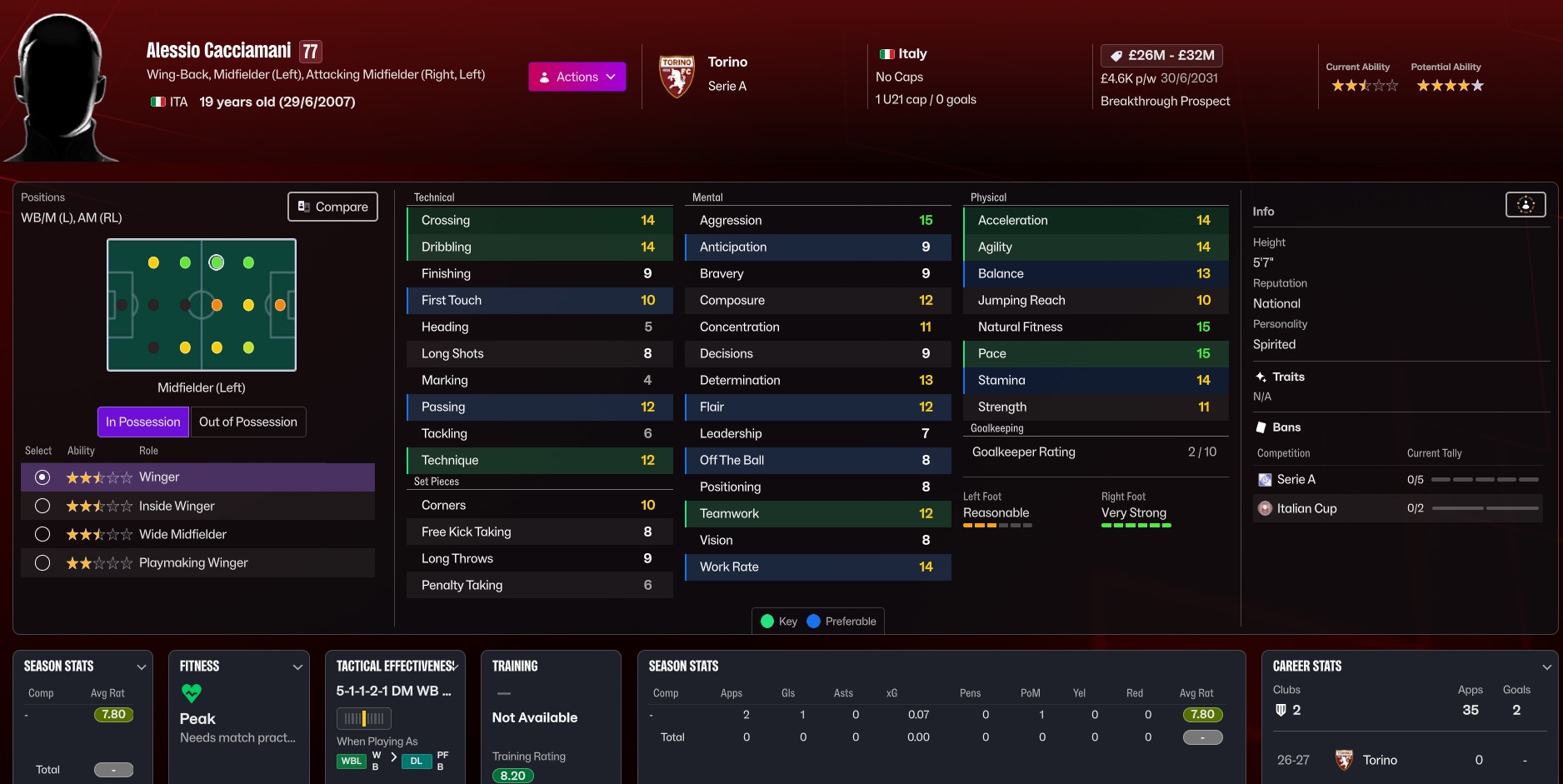
However, he’d inherited a squad that was far too big, so he wasted no time selling the likes of Che Adams to Everton for £4.1m, old man Cristiano Biraghi to Saudi for £250k and centre back Saúl Coco to Crystal Palace for £14m, which freed up £100k per week in wages. That gave Bononi a bank balance of £30m, transfer budget of £23m and £125k spare in a weeky wage budget of £950k. But he chose not to spend it in the first summer, instead putting faith in the squad he’d inherited.
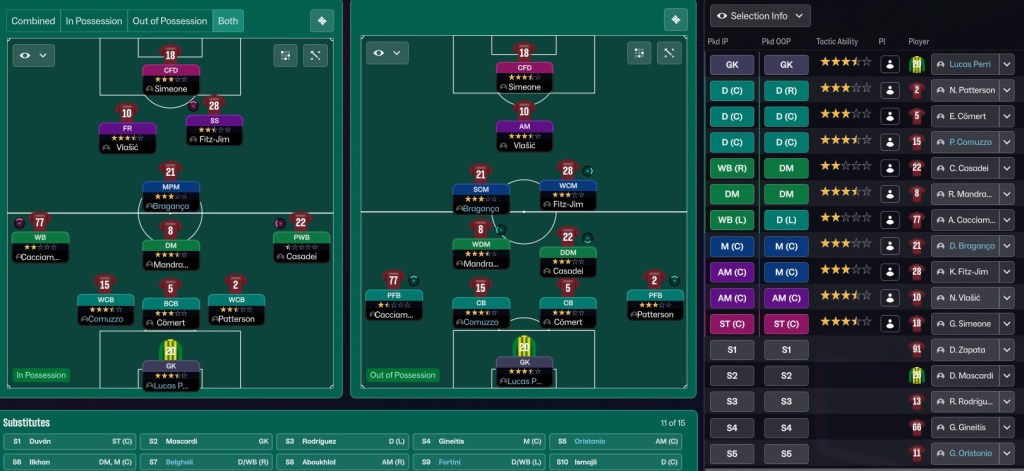
With that squad, he initially worked on a narrow 4-3-3 approach, which morphed into a slightly more unusual narrow 5-4-1 that drops into a narrow 4-4-2 out of possession. Simeone will lead the line with support from Vlasic and one of the various midfielders available, Braganca pulls the strings in midfield, while Casadei will retrain to play as a wider playmaker in the right wing back role with Nathan Patterson playing as a wide centre back who moves out to full back.
Getting Started in Torino
Bonino’s Torino reign began with a pretty tough run of games, facing five of last season’s top eight in his first eight games. His career began at the Olimpico with a Coppa Italia first round tie against Benevento. They started brightly as Mandragora whipped a 30-yard free kick against the post and dominated the first half, only to concede two absolute worldies in the first 10 minutes after the break and somehow lost 3-0 despite having 18 shots to 6.
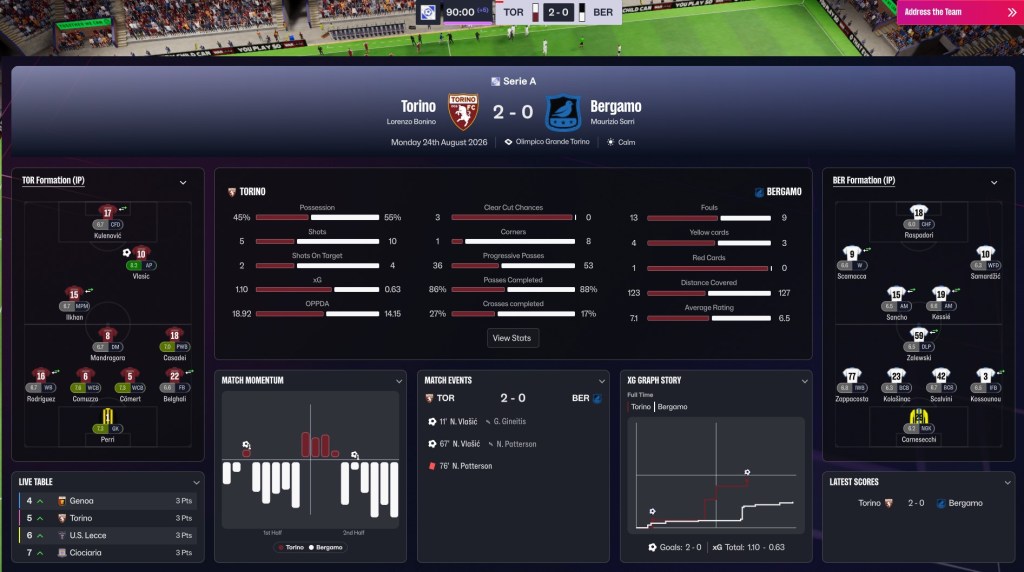
A week later, they were back at the Olimpico with the Torinese expecting a much better showing in Bonino’s Serie A debut against Atalanta. And they got the desired response as Gineitis picked out Vlasic to neatly convert the first goal of the Bonino reign from the edge of the box inside 11 minutes. After the break, Ginetis created a great goal for Simeone, which was ruled offside, but Vlasic soon doubled the lead with a brilliant cut inside and a deflected shot. Patterson foolishly got himself sent off, but they shut up shop to earn Bonino’s first victory.
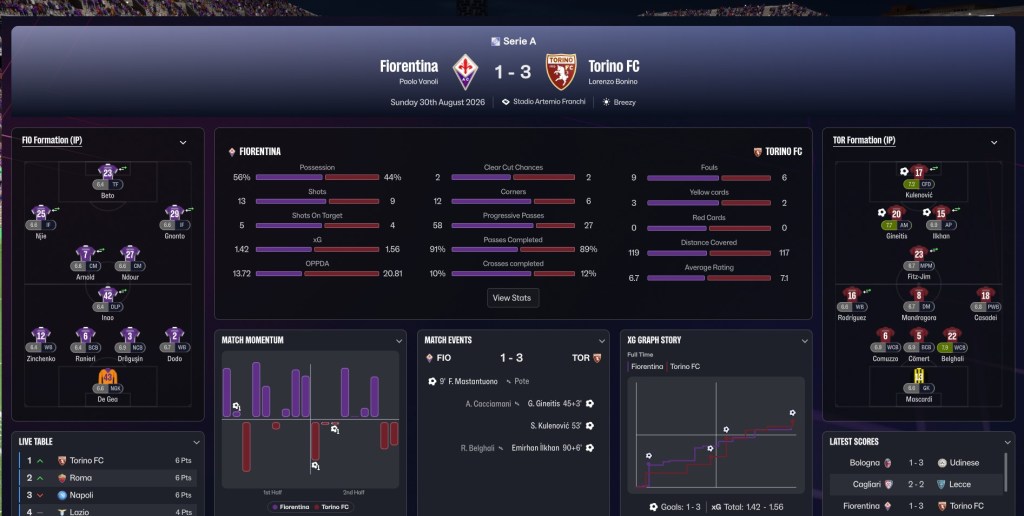
Goalkeeepr Perri got injured ahead of Bonino’s first away day was a trop to Fiorentina, where Simeone missed an early chance before Mastantuono scored and Vlasic and Simeone got injured. Gineitis grabbed an equaliser just before half time against the run of play and replacement striker Kulenovic took advantage of a goalkeeping clanger to grab an unlikely lead. And, with David De Gea venturing forward for a late corner, Ílkhan scored a third in an unguarded net.
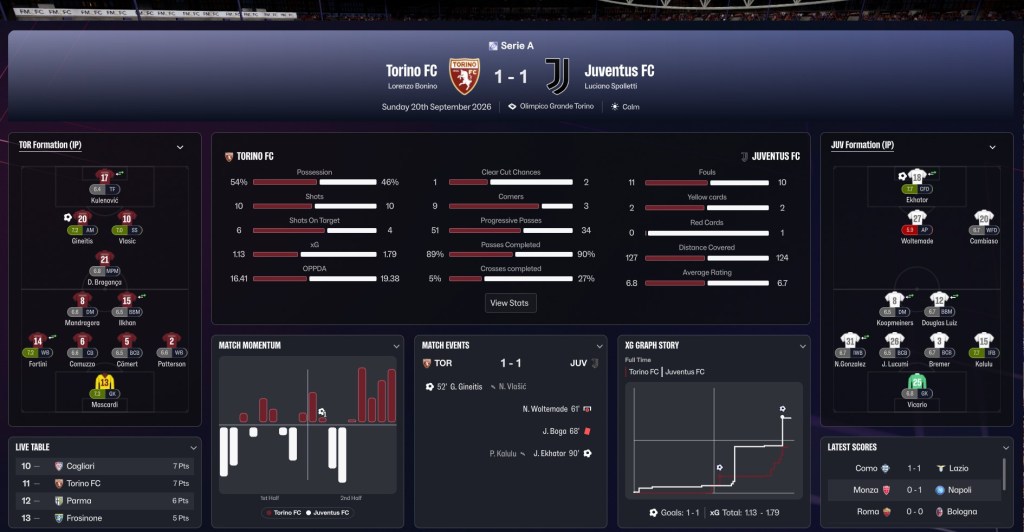
Next up was a huge test at home to holders and huge title favourites Inter, who lined up in an aggressive 3-2-4-1. I Granata did well to hold Inter off for the most part, but a breakaway Bonny goal on 70 minutes earned Inter a 1-0 victory. Another tough game followed with a trip to a strong Lazio side, where they firmly outplayed and suffered a 2-0 defeat. And it didn’t get much easier as Bonino got his first taste of the Mole Derby as Juventus came to town. Bonino decided to switch things up, moving to his narrow 4-3-3 and they dominated the ball in a tame first half. But a halftime team talk worked wonders as Vlasic picked out Gineitis to chip the ball over the advancing Vicario. However, Juve earned a penalty for a “push” at a corner, only for backup keeper Mascardi to save Woltemade’s spot kick and 7 minutes later Boga was sent off for a shocking two-footer on Patterson. Kulenovic had a goal disallowed and, annoyingly, Juve were somehow allowed to score a late equaliser with 10 men, which looked dubiously offside.
Bonino chose to take the positives from a game they’d been given no chance in. Heading into the first international break of the season, his Torino side sat in a solid 12th place in Serie A, which matched the board’s objective of a mid-table finish despite a really tricky fixture list. And that gave Bonino hope for the future as he looked to build a Torino side that could compete with Juventus and the Serie A elite.
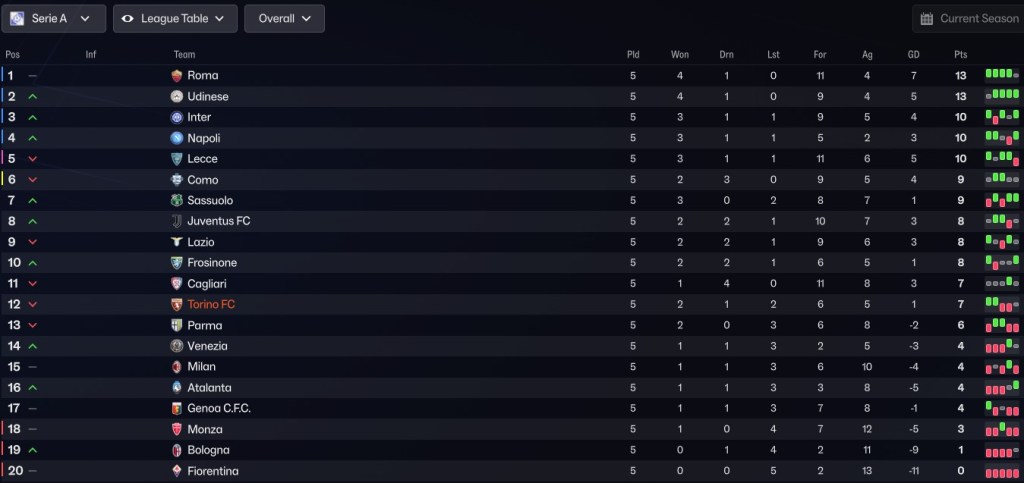
Could he maintain Torino’s fairly promising start to the 2026/27 campaign? Join us next time as we continue to get to grips with the FM27 Launch Preview!


Leave a Reply