Long before playing Football Manager, FIFA, PES and even the likes of Premier Manager 98 and Ultimate Soccer Manager 98, my first football management obsession was a Commodore 64 game called Football Director. I must have been about 8 years old, and thought my friend’s parents were really cool because they’d allowed him and his two brothers to have a Commodore 64 in their bedroom. We played it relentlessly, and I remember it being quick and easy to play, navigate the menus and rattle through matches, but pretty damn difficult to master along with the challenge of playing a game on a tape system.
However, the simple nature of its design and accessibility comes through in abundance with upcoming game Proper Football Boss. The game’s developer, Boot Room Games, released it as a playtest in browser format on Wednesday (4 August), which gave us a chance to get a feel for it ahead of its full release via Steam later this year.
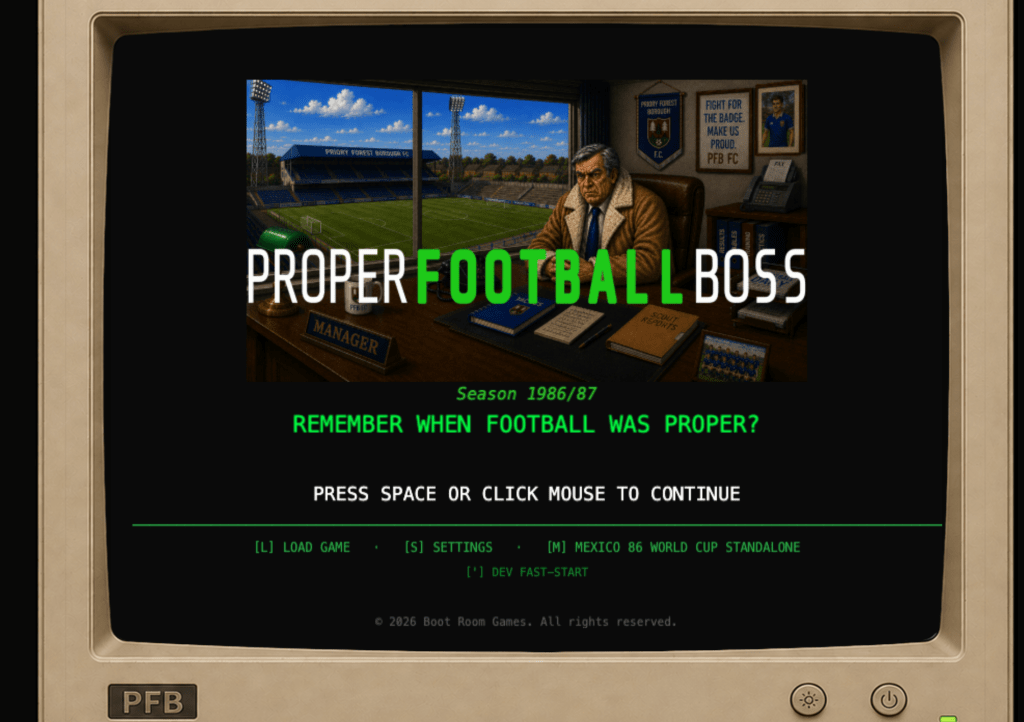
What is Proper Football Boss?
Proper Football Boss takes us back 40 years to the start of the 1986/87 season, when “naming two subs was still a luxury and the only seven-figure salaries were in Italian Lira.” The game allows players to manage teams in the top four leagues across England and Scotland, with seven more top European leagues visible. It contains the actual 1986/87 squads, the old school format of First, Second, Third and Fourth Division, and more than 3,000 real players. It also has the two foreign player limit, plastic pitches, accurate stadiums and finances, with the emphasis very much on managing players and their drinking problems, rather than ticket prices and sponsors. But if domestic football isn’t doing it for you, there’s a standalone mode to manage any of the 24 nations at the 1986 World Cup in Mexico.
As the developer explains: “My first goal was for players to get an immediate hit of nostalgia – to recapture that feeling of loading up an 8-bit tape game or slipping a disk into their Amiga. Putting rose-tinted specs aside, most of those 80s and 90s footy management games promised more than they could deliver. Sure, games like Football Director and Kenny Daglish’s Soccer Manager worked miracles with meagre 48k of memory, but I don’t have those limitations. I wanted to pack in all the depth and features I always imagined I’d find from the screenshots and promises on the back of the cassette box.
“Teletext is an obvious nostalgia trigger point. With the game’s minimalist UI / design style, I figured it would really beef up the player’s experience to provide fully interactive teletext league tables, results etc, almost exactly like you remember them from a Saturday morning browse, minus the smooth jazz piping through your TV (or maybe I should ADD the jazz).
“In terms of gameplay, my core design tenet was to replicate the job of an 80s and 90s football MANAGER. Not a football club director. As much as I enjoyed selecting sponsors, setting ticket prices and improving stadia (in Premier Manager for example) that is NOT the job of a football manager, but instead falls to a commercial manager or similar role.
He also highlights the four Ts: “Training, Tactics, Transfers and the most important of all – TALKING. Talking means man management, probably the most important skill for any 80s football manager. Few games give you dilemmas to deal with in your squad’s personal lives. A sick child, or a drinking problem. Cliques and camaraderie. Sulky players and emergent youth stars. You’ll interact with all these and more via the main hub news items, from the sublime to the ridiculous.”
Getting Started in Proper Football Boss
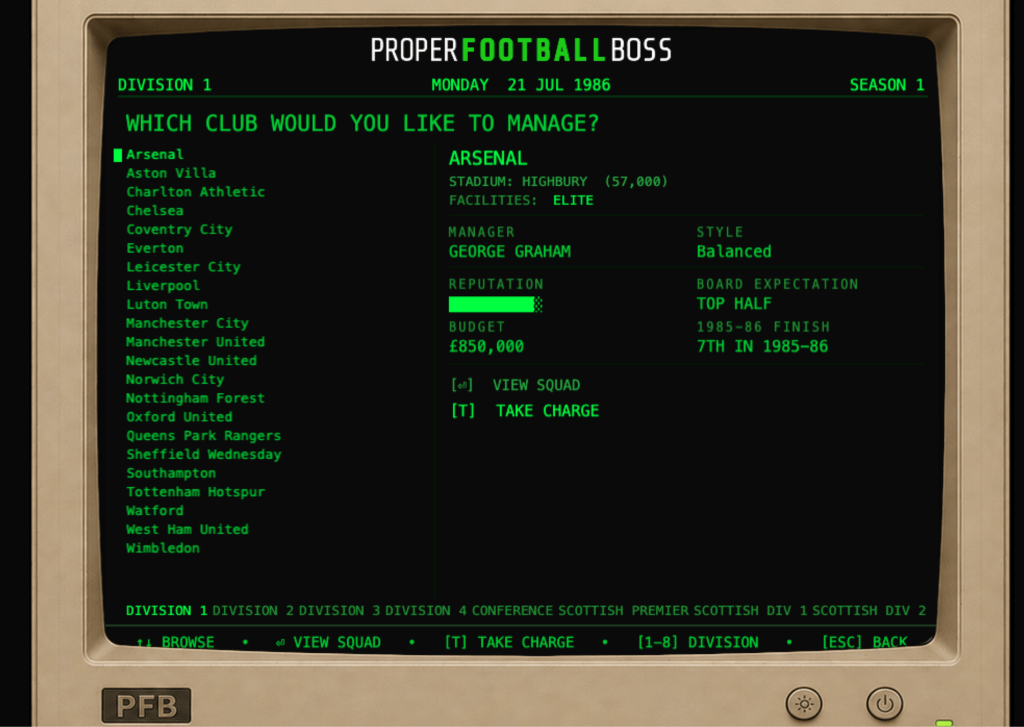
Upon starting the game up, we’re presented with a cool opening screen (see top right), then press space or click the mouse to continue, press L to load an existing game or S to change the settings. Starting a new game takes us to a team selection page and hovering over a club allows you to assess facilities, current manager and style, reputation, finances, board expectation and where they finished in the previous season. You can also assess their squad by clicking on the club.
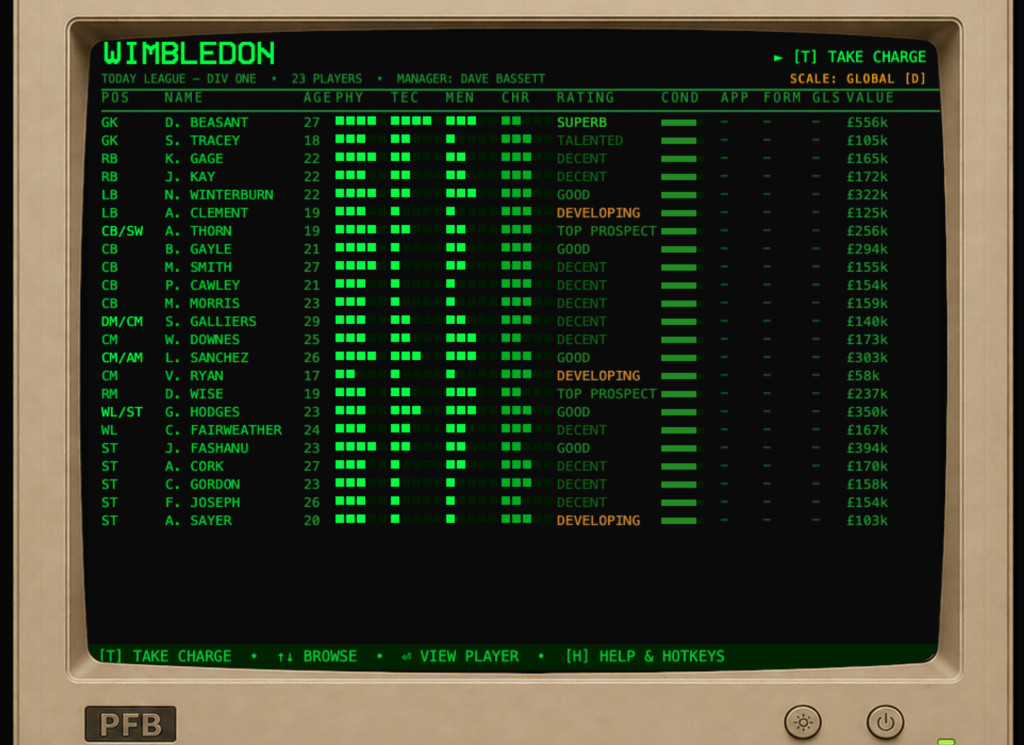
For the purpose of testing the game out, I decided to continue the Crazy Gang philosophy by taking control of Wimbledon in the First Division. That sees us inherit a squad boasting the likes of Dennis Wise, John Fashanu, Lawrie Sanchez, Alan Cork, Wally Downes, Andy Thorn, Dave Beasant and, strangely belatedly, a 21-year-old Vinny Jones.
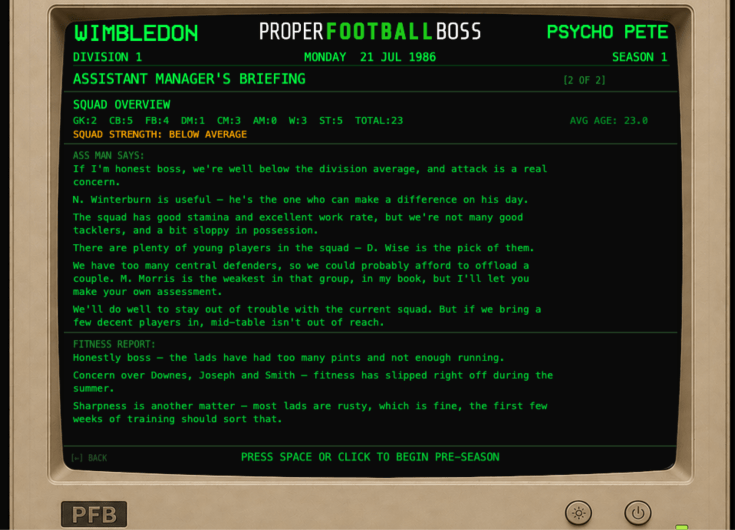
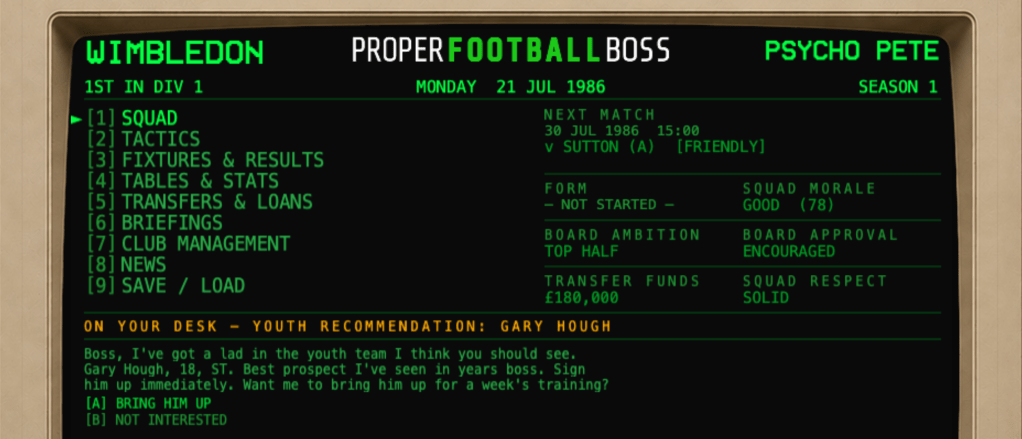
The assistant manager gives us a relatively warm welcome before giving us an overview of the squad, which wasn’t very optimistic to say the least. That said, he believes we have good stamina and excellent work rate, which is a decent start. Furthermore, when it comes to the fitness report, the lads have, apparently, “had too many pints.” To address that, we’re asked to set our pre-training focus across Conditioning, Core Skills, Other Skills, Tactics and Recovery, which I tweaked to focus more on fitness. From there, you’re taken to a home screen consisting of squad, tactics, fixture schedule, league tables and stats, transfers, briefings, club management, news and save options, along with an overview of your next match and further details.
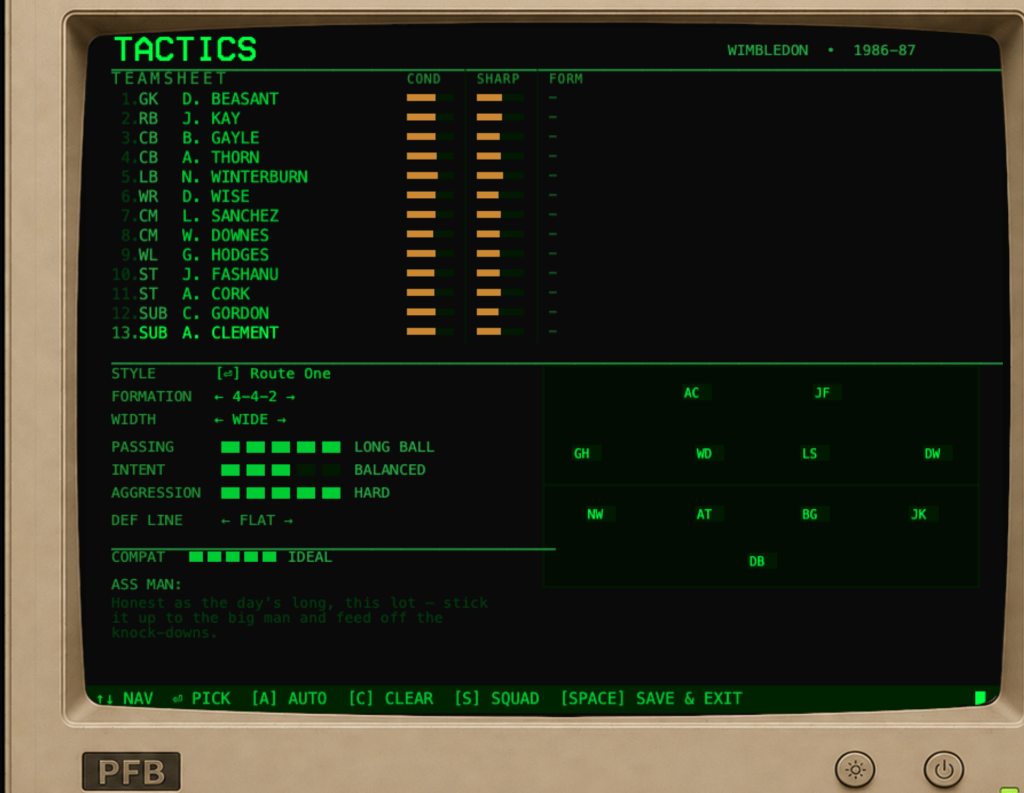
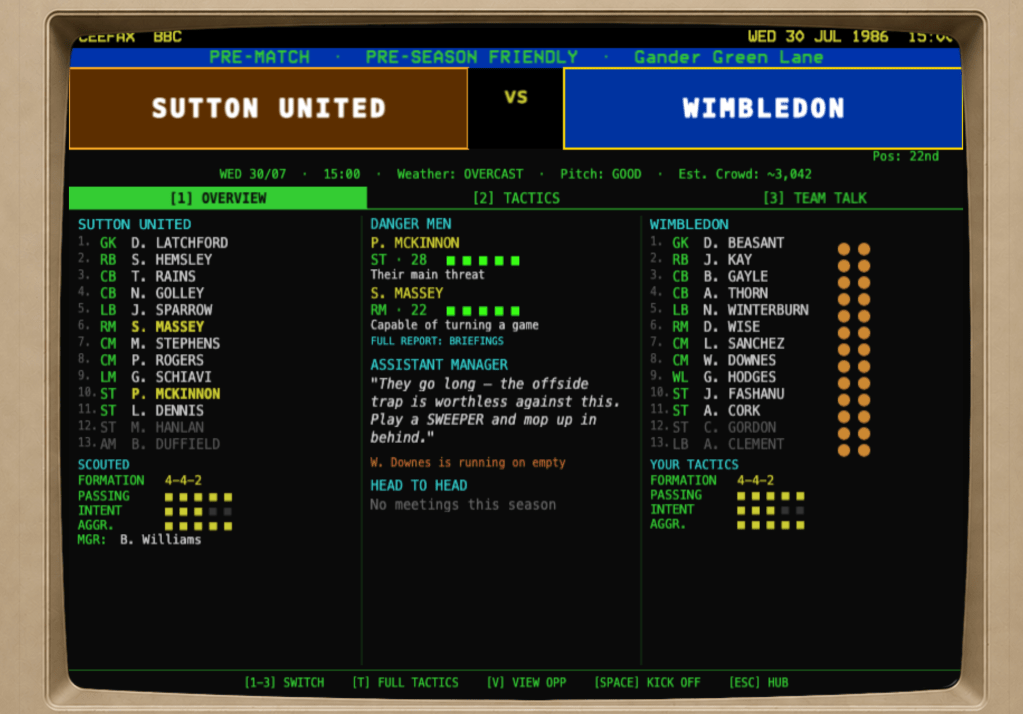
Our first game is against Sutton United, against whom my assistant tells me we’re best off playing long ball, which sounds perfect. So I head into the Tactics page, which is pretty easy to navigate. Clicking on a vacant position allows you to select the most appropriate player, before managing the team tactics in terms of style, formation, width, and style of passing, intent, aggression and defensive line. We, of course, opted for a direct, wide 4-4-2 with a route one style of play. ‘Ave it.
Navigating to the transfer centre, there are several options. You can see players that are available for transfer, from which I scouted the legend Ray Clemence, and free agents, from which I made my first signing by snapping up a talented 16-year-old called Wesley Yates. And the negotiations are quick and simple, with the player immediately joining the club as soon as he was happy with the £320 a week deal.
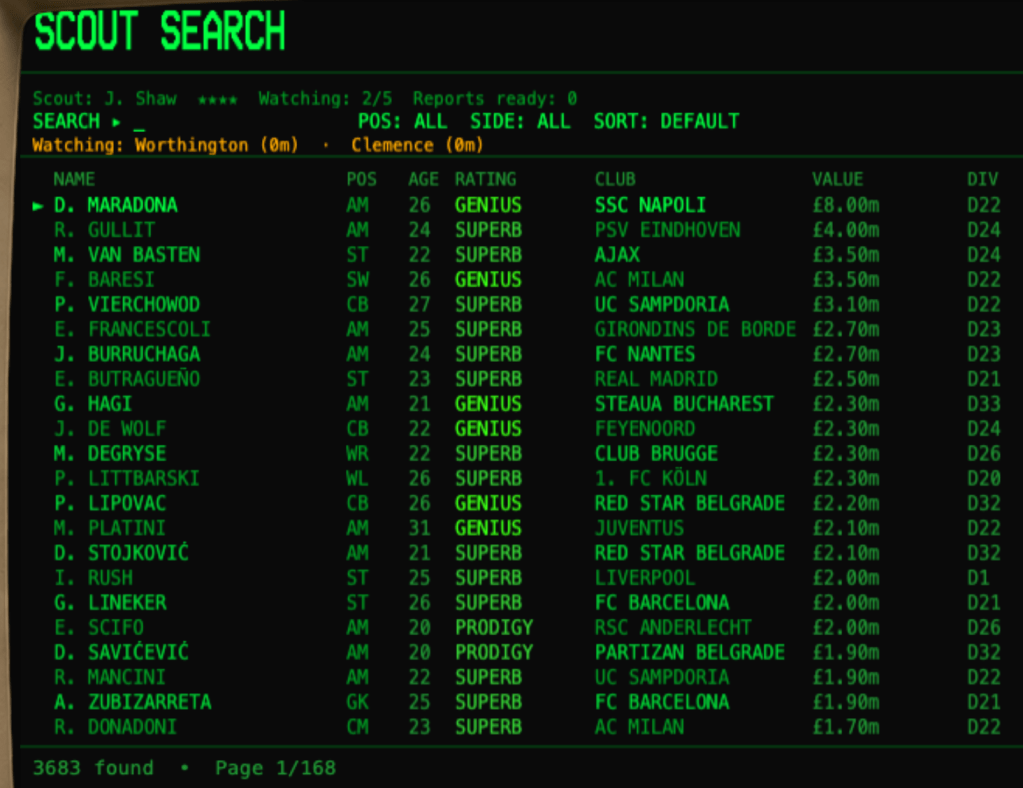
You can also scout specific players, which presents you with a list of the most expensive players in the world, led by Diego Maradona, Ruud Gullit, Marco van Basten and Franco Baresi, along with the likes of Gheorghe Hagi, Michel Platini, Ian Rush, Gary Lineker, Enzo Scifo, Roberto Mancini and Roberto Donadoni.
It’s easy to navigate through the game, hitting the space bar or the numbers allocated to each menu item. A few space bar hits later, it was time for our first friendly at Sutton. Once in the game, the commentary is classic text-based that scrolls through the screen, and you can hit F to speed up the commentary, P to pause it or go into tactics. Our approach didn’t work at all, as we had 0 shots to Sutton’s 5 in a terrible first half. So I made a few tactical tweaks and demanded more in a halftime team talk. And that worked nicely as we had 6 shots in the second half, didn’t give up any, and scored 3 of them!
A few days later, we had a series of bids for players. One of those was goalkeeper Tracey, who had bids from Bolton and Hamilton. And that was the first little oddity as I didn’t receive a notification that the negotiated bid had been accepted by Hamilton before he joined for £275k. Next up,was another friendly at home to Reading, for which my assistant advised using a sweeper style defensive line. We were inept again in the first half and, this time, the team talk didn’t work and we drew 0-0. And another friendly at Welling, which the game oddly thought was a league match, ended in a 1-0 win.
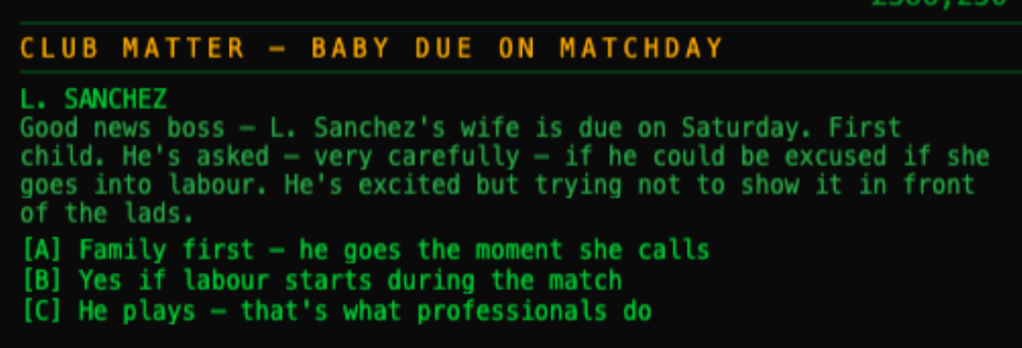
Occasionally, interestng little news items will pop up, such as Sanchez’s wife giving birth on a match day and being given an option of whether to force him to play – I told him to be a professional and play, and he accepted it. That was for a friendly with our groundsharing rivals Crystal Palace, in which we scored our first first half goal then scored from a corner after the break.
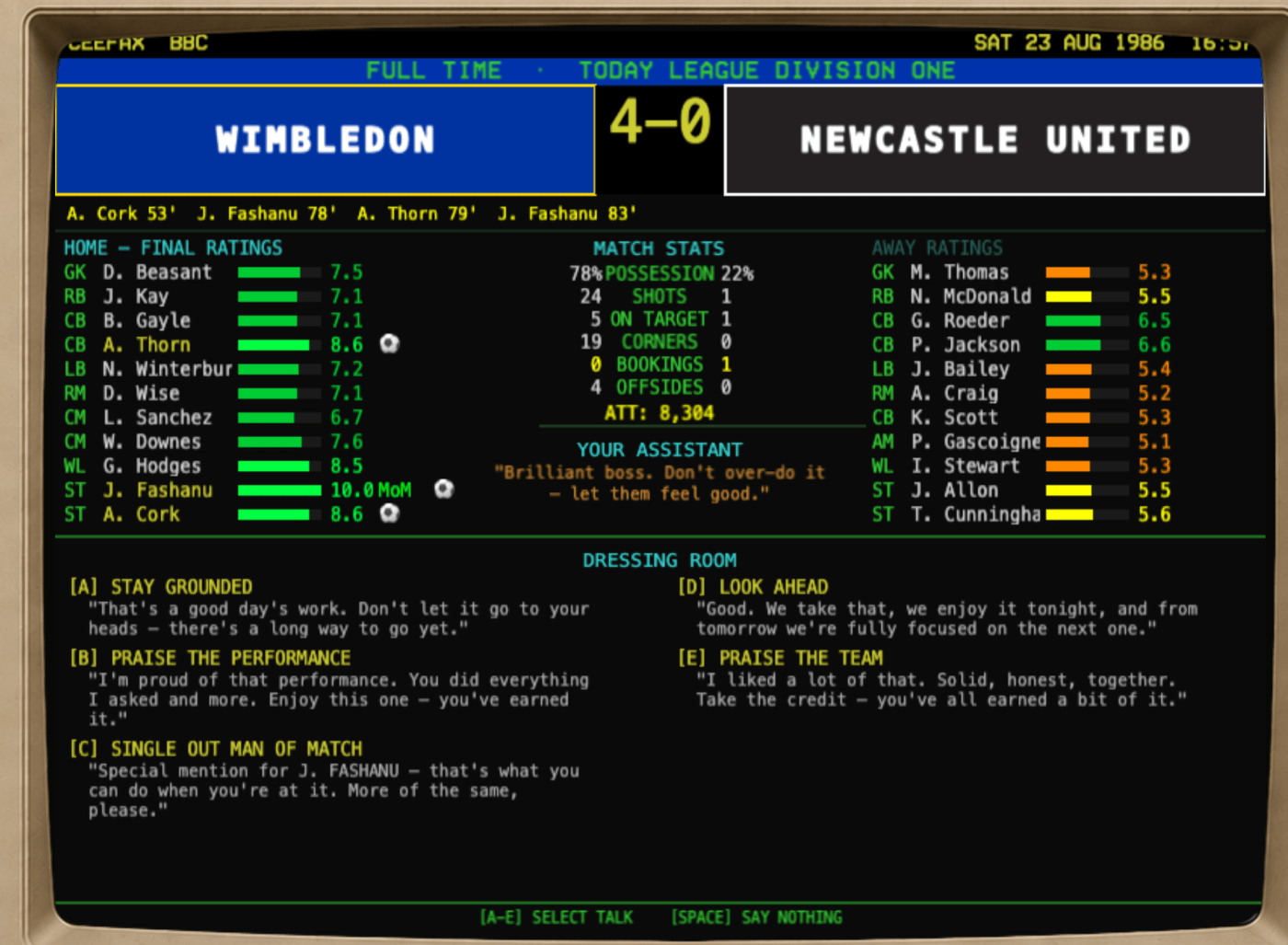
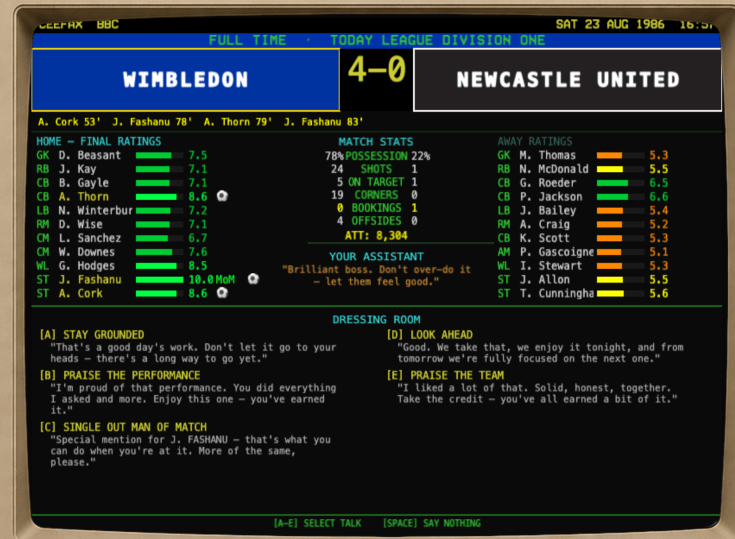
Our first league game was at home to Newcastle, who had Peter Beardsley and Paul Gascoigne playing in a very attacking midfield. We bossed possession and had a ridiculous 15 shots in the first half, but couldn’t score. But a good team talk got the desired result as Cork scored the opener on 53 minutes, Fashanu doubled the lead on 78, Thorn smashed in a volley a few minutes later and there was still time for Fashanu to score again, crowning a wonderful 4-0 win that sent us top of the league after the first weekend.
The following week, Wisey decided to get drunk at a sponsor event – legend – giving us a choice to fine him or warn him. I chose just a warning, and he got booked after just 6 minutes in our first away day at West Ham, who battered us and won 1-0. We got a 1-1 with Sheffield Wednesday, who are predicted to be top 6, then were unlucky to lose 2-0 at Man United and somehow drew 0-0 at home to Watford despite not having a shot. We nicked a 1-1 at Norwich and drew 0-0 at Millwall in the Littlewoods Cup, which forced a long-forgotten replay that we won 1-0 late on, and lost 1-0 at home to Spurs, 2-0 at Everton and 1-0 at home to Leicester. And suddenly, things were looking bad as we dropped into the relegation zone after 10 games.
I realised we’d mistakenly been playing with attacking intent (largely because in-game tactical changes continue through to the next match), which I dropped down to 2 bars and was rewarded. We finally got back to winning ways as Wise and Fashanu scored at Oxford, then thrashed QPR 3-0, with recently promoted 18-year-old striker Gary Hough playing a 10 in place of the injured Fashanu, and earned a 0-0 at Chelsea. The injury situation was borderline worse than anything you’ll see on FM, as we racked up six and had to chuck in a load of youngsters in unnatural positions, but Hough stepped up again with both goals to win 2-0 at Coventry.
Six players got tired and needed a week of rest, so I was forced into the loan market for Gordon Durie, Tony Daley, Ruel Fox and Paul Ince. But the improvement continued, including a 1-0 win at Aston Villa and a 0-0 at leaders Arsenal, to move up to 12th after 18 games, in which we’d amusingly only scored 16 (4 of which were on the opening day!) and conceded 12. A few more defeats followed before beating West Ham 3-0, only for Beasant to get injured and I realised I hadn’t replaced my backup goalkeeper! So Durie went in net against Man U, and his defence performed heroics to prevent a single shot and earn a 0-0.
Continued struggles and injuries – including 4 after matches twice in a month! – saw us drop to 19th, just 1 point above the relegation zone with 12 games remaining. We nicked a 1-0 at Leicester, then lost star left back Winterburn for around £600k – even though I rejected the bid! But another 1-0 win at home to Oxford moved us 7 points clear of relegation with 10 to play, before claiming a huge 1-0 win at home to Chelsea and Hodges and another loanee Gavin Peacock earned a 2-0 at Southampton. Another 1-0 at home to struggling Coventry moved us up to the heady heights of 13th and probably safe, 10 points from danger with 6 games remaining.
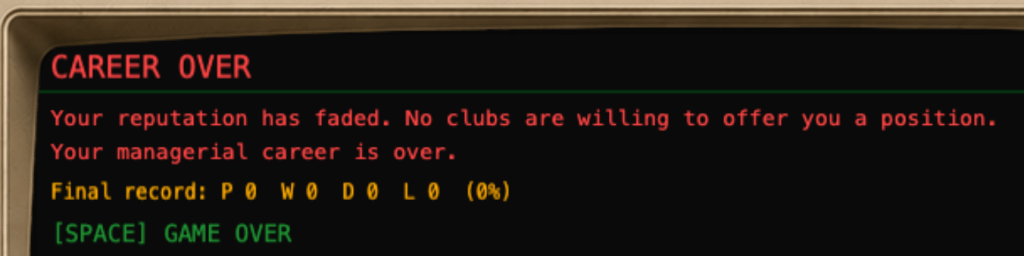
For the second time this season, a striker kept a clean sheet as Fashanu didn’t face a shot on target in a 0-0 at home to Villa and he only conceded once against Arsenal. However, out of nowhere and with zero warning, the board sacked me straight after losing 1-0 at home to Arsenal, which felt extremely harsh!
I was forced to continue the game until a job became available but, when none did, I was forced into early retirement after less than a year! So our very first save on Proper Football Boss came to a premature end after what I thought was actually a half decent season, after plenty of struggles midway through it.

My Thoughts on Proper Football Boss
If, like me, you like your gaming with a touch of nostalgia, then Proper Football Boss may be just the ticket. Obviously, we’re in the very early stages of the game – and it’s great the developer gave us a browser-based mode to test it out and iron out any problems – so there are bound to be a few teething issues. So we’ll gloss over a few bugs, such as players being sold when you reject bids, wage budget disparities (which may well have been to blame for my sacking and, to be fair, the developer has potentially fixed after raising the bug), and a pre-game error with replays.
But the gameplay itself is really enjoyable. It’s straightforward, albeit there are sometimes challenges with picking teams when you have injuries, seriously nostalgic, quick and easy to pick up, and it’s simple to fly through games without having to worry about simulating through the week or getting bogged down in the nitty gritty of running a football club.
If you like the idea of solely focusing on football management, this game may be worth a try. Your job is solely on managing players, such as picking the team, choosing tactics and rattling through matches. Clearly it doesn’t have the depth of games like FM26, but there’s a grittiness about the game that I really warmed to. I particularly like the nostalgic feel of the approach, such as the news and fixtures being presented in the form of classic Teletext pages, while the odd player interactions, such as choosing whether to punish them for going out on the lash, are a fun touch.
The full version of the game is scheduled for release in November 2026 on Steam and there may be more early access available before then. So hopefully we’ll be back with more Proper Football Boss gameplay in the near future.


Leave a comment