
Robaato Rasamu passed 15 years in charge of Thespakusatsu Gunma, fresh from leading the club to a fourth 2nd-place finish and a sixth top-four finish in J1 League. In those 15 years, Rasamu had led Gunma into battle 680 times, winning 332, drawing 163 and losing 185 en route to leading the club out of the third tier and competing with Japan’s elite. And, ultimately, they achieved the pinnacle as Gunma secured their maiden J1 League title in 2038.
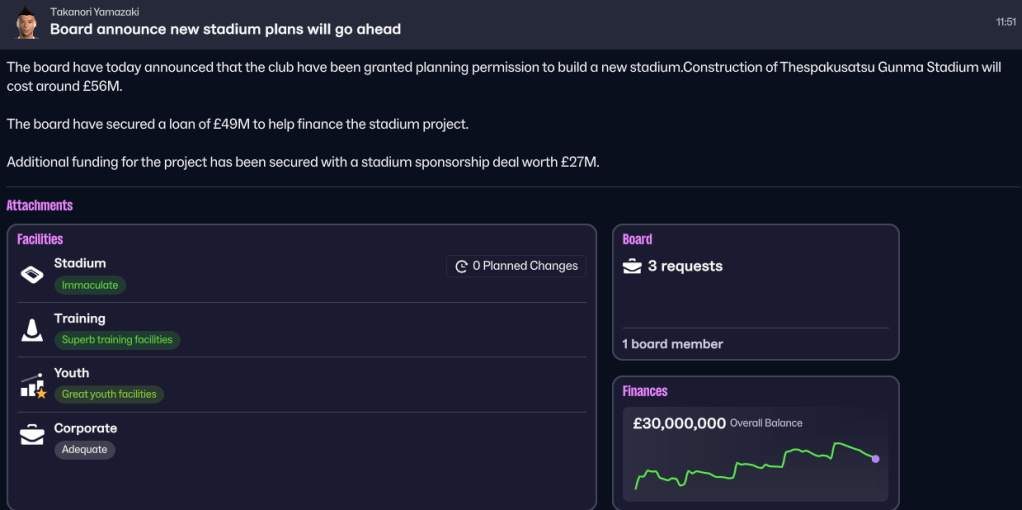
Heading into his 15th season, and 10th in J1 League, the club’s board announced plans for a new stadium. The imaginatively named Thespakusatsu Gunma Stadium will cost £56m, plunging the club into debt with a £49m loan offset by a £27m sponsorship deal. And they immediately began paying that debt off with monthly fees of £450k.
Finances were boosted by midfielder Víctor Gómez, who contributed 0 goals or assists in 26 games, attracting surprise bids from Porto and Man United, who he joined for £6.5m. Centre back Yuji Nagashima also departed after 263 games for the club to Saudi for £3.5m, along with backup attacker Oli Magnusson to ReinMeer for £1.1m and left back Michiteru Masushima to Sendai for £300k. That boosted the bank balance to £48m, while Rasamu had a transfer kitty of £47m that he couldn’t really dream of spending. Instead, he dished out a few new contracts, including wingback Yoshimitsu Mito pocketing a club record £19,500 per week that was swiftly surpassed by Japan international midfielder Atsushi Shimizu bagging £45k a week once he’d ended his unhappiness at the club.
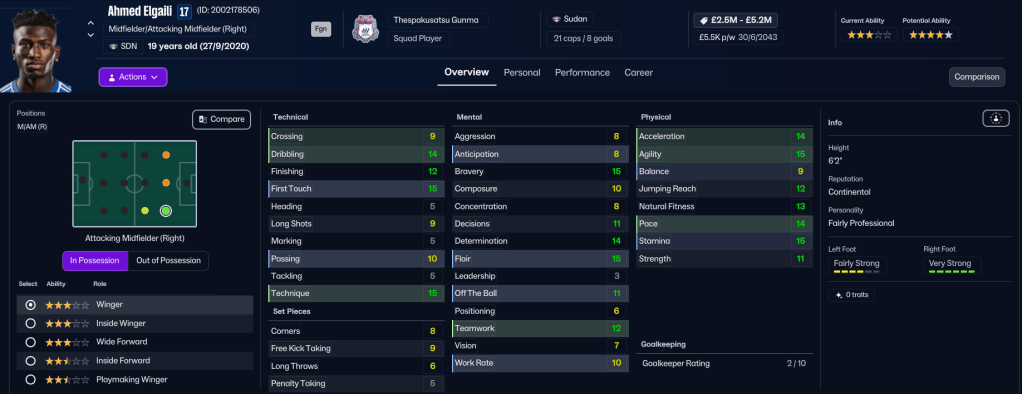
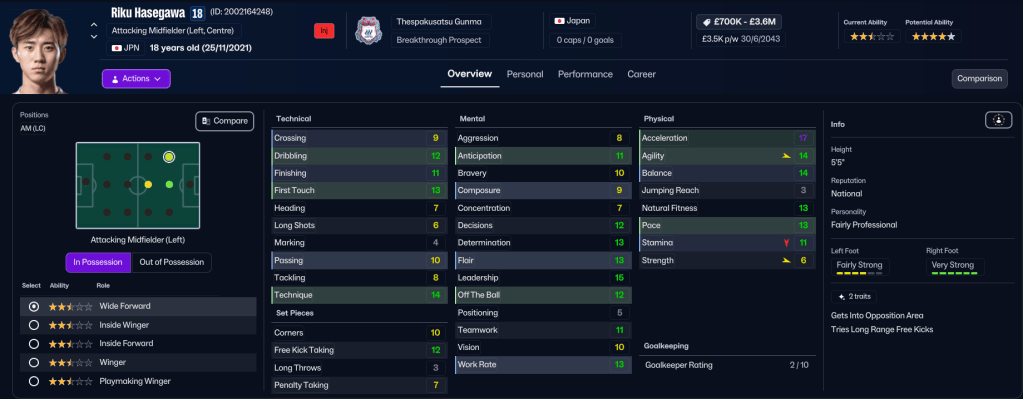
Rasamu brought in one addition as Sudanese attacker Ahmed Elgaili, who’d attracted interest from Chelsea and Liverpool, signed for £750k. He also promoted more youth in attackers Riku Hasegawa and Tashiki Hayami, midfielder Naoya Miura, wingback Hayato Tashiro, centre back Toshiya Saito and goalkeeper Kohei Iwaki.
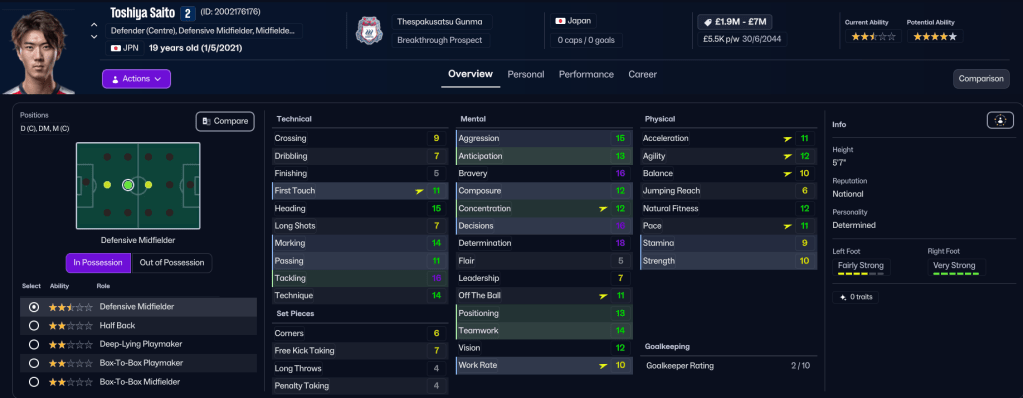
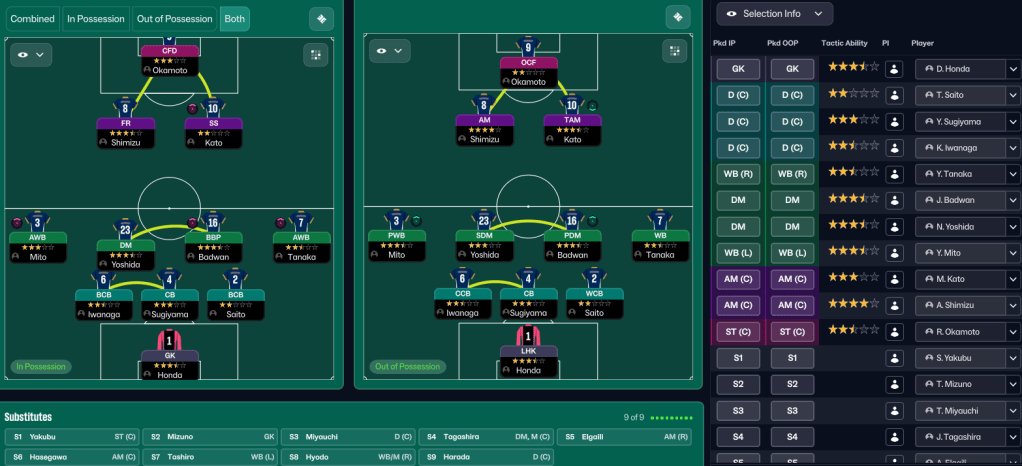
Rasamu stuck with the 3-4-3 approach he’d used for several years, with Saito stepping into the backline and star players Shizumi and Mitsuhiro Kato playing behind striker Rintaro Okamoto, in an all-Japan international attacking trio.
Rasamu’s 15th Thespa Gunma League Campaign
Gunma remained 5th favourites to win J1 League, level with Urawa Reds and Kashima Antlers at 14/1. Kashiwa Reysol were now 5/4 favourites to retain their title, but lost manager Shunshuke Nishimura to retirement in the summer and, after Rasamu turned them down, replaced him with Hiroshima boss Masaumi Mikami, ahead of Gamba Osaka (5/4), who finished 15th last season. And Mito and Colombian midfielder Jhohann Badwan are named in the media Dream 11.
The 2040/41 campaign began with a few players exhausted after an Olympics call-up, and a weakened side struggled to a 1-0 defeat at JEF United. Rasamu rested the squad, which paid off as Shimizu and Badwan earned a 2-1 win at home to Cerezo Osaka, before a wild 3-3 at Shimizu and Okamoto’s brace led a 3-0 win over Yokohama. A fairly up-and-down start continued, including a 2-1 defeat at Kashiwa, which left Gunma 8 points off the top in mid-November. However, Kato, who’d started the season slowly, hit top form with two goals in a 4-1 win over JEF United before going one better with a hat trick in a 4-1 victory at Vissel Kobe.
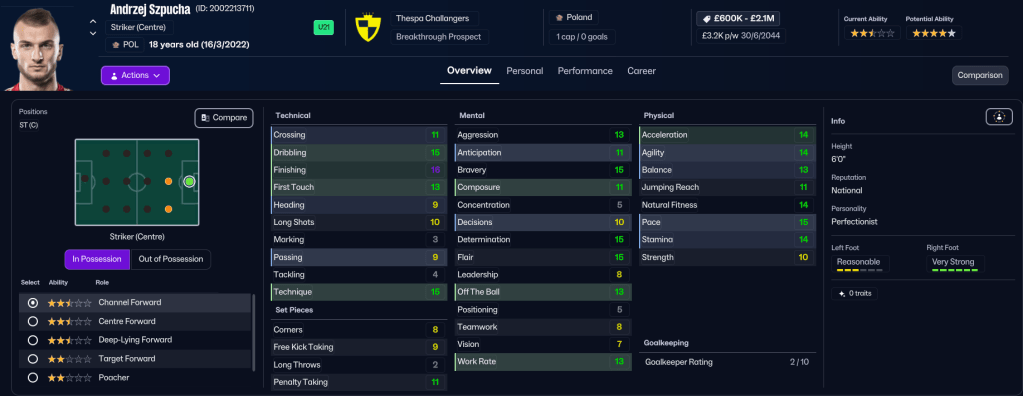
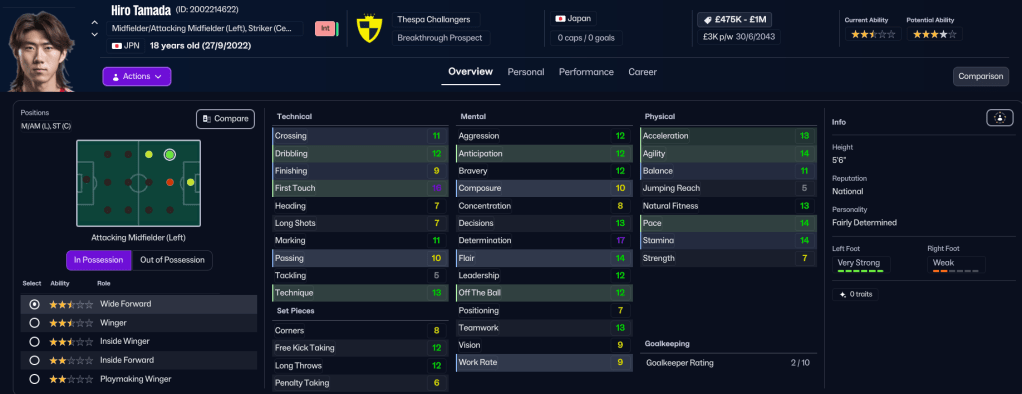
Rasamu decided to go for it and blow some of the money he’d saved up in January. He broke the club’s transfer record to recruit exciting Argentinian striker Lucio Lucero for £6.5m rising to £11m from San Lorenzo. He was joined by Poland international attacker Andrzej Szpucha for £2.1m from Lech and 18-year-old attacking midfielder Hiro Tamada for £875k from Yamagata.
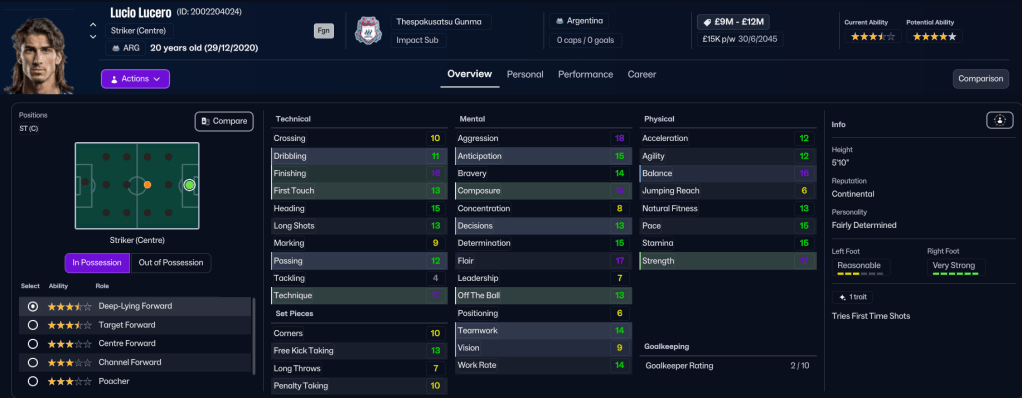
Lucero had an immediate impact, scoring on debut in a 2-0 win at Yokohama before Shimizu’s brace inspired a 3-1 win at Yokohama FM. And Lucero’s brace earned a 2-1 win at home to Nagoya, which took his new side top of J1 League for the first time this season, albeit Kashiwa had 2 games in hand.
Familiar Feeling in AFC Champions League Return
Gunma returned to the Champions League after a year away and started it with Shimizu nicking a 1-0 win over Port before thumping China’s YN Yukun 5-0 away, led by Miura’s first 2 goals for the club. Miura scored again as they dominated Shandong 3-0 and won 2-0 at Thailand’s Pathum United. Qualification was confirmed as a rotated team eased past Melbourne Victory 2-0 before losing 2-0 at Sydney, winning 3-2 at Western Sydney and beating Jeonbuk 2-0 to wrap up 2nd behind Urawa, who won all 8 games and only conceded 5 goals.
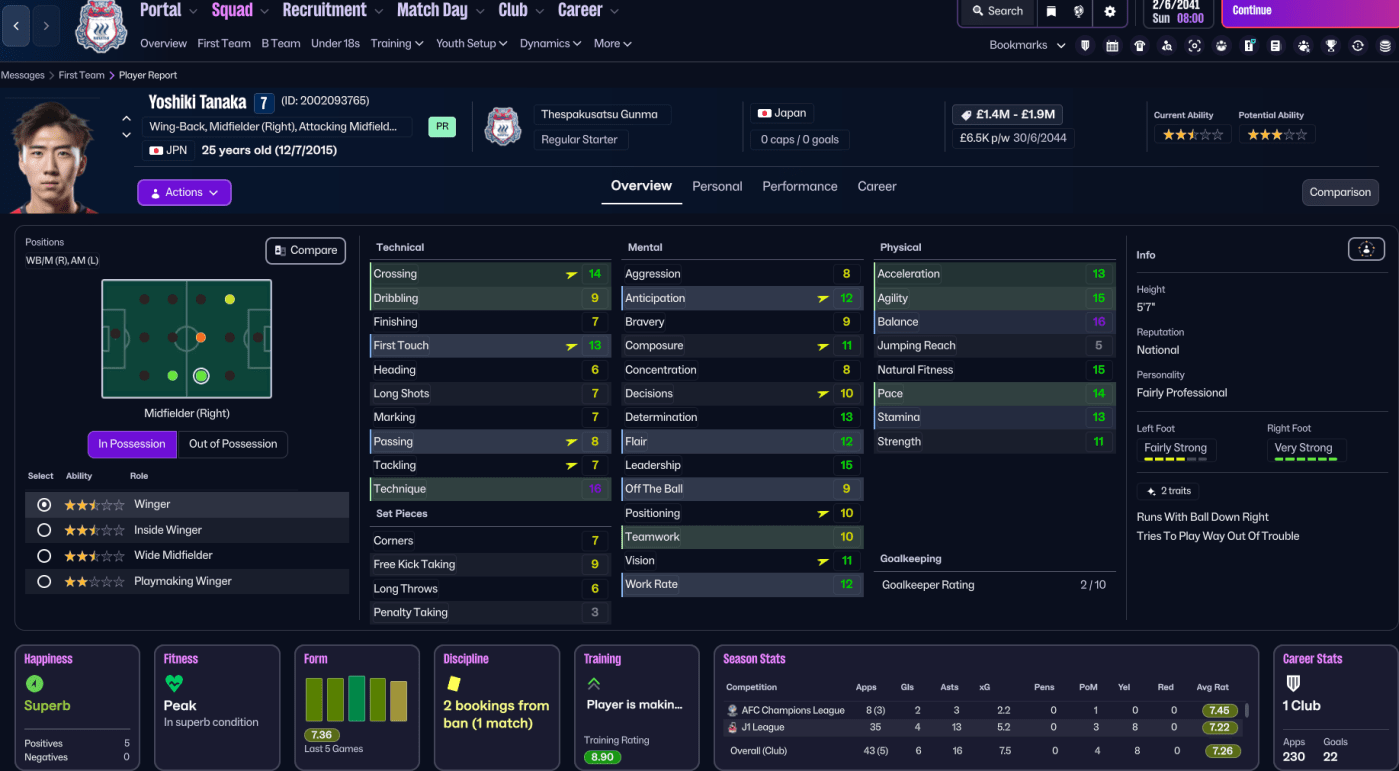
Moving into the knockouts, Gunma again faced Yukun in the last 16 and cruised to a 3-1 win in China before a rotated side won 4-2 at home. Predictably, that teed up yet another clash with Al-Nassr, with the sides meeting in the quarter finals for the fourth time. And it was a familiar outcome as Gunma suffered a fourth defeat to the Saudis. But this was probably the most painful as former striker Matar Moussa Fayé scored both their goals after right wingback Yoshiki Tanaka had opened the scoring inside 5 minutes.
Outside Shot at the Japanese Title
The good form continued to send Gunma into what was realistically a two-horse title race. However, Kashiwa were very much in control with 2 games in hand.

Lucero helped Gunma keep the pressure on with two first-half goals to defeat Tokyo 3-1, then got the winner at Machida Zelvia. And that pressure paid off as Kashiwa lost 3-0 at home to Kashima, then 1-0 at Urawa, which saw Gunma open up a 6-point lead having played two more.
A huge game followed as Gunma hosted Kashiwa. The title battlers played out a cagey first half, but a great run by captain Nobuhiro Yoshida teed up Mito to score inside 90 seconds of the second. The three centre backs somehow allowed Kashiwa’s striker Onishi (who has 26 goals in 42 caps for Japan) to walk through the middle of the pitch and convert a long hoof over the top. So Rasamu took one of them off and switched to more of a narrow 4-3-3, but nothing else happened, and the sides settled for a share of the points.
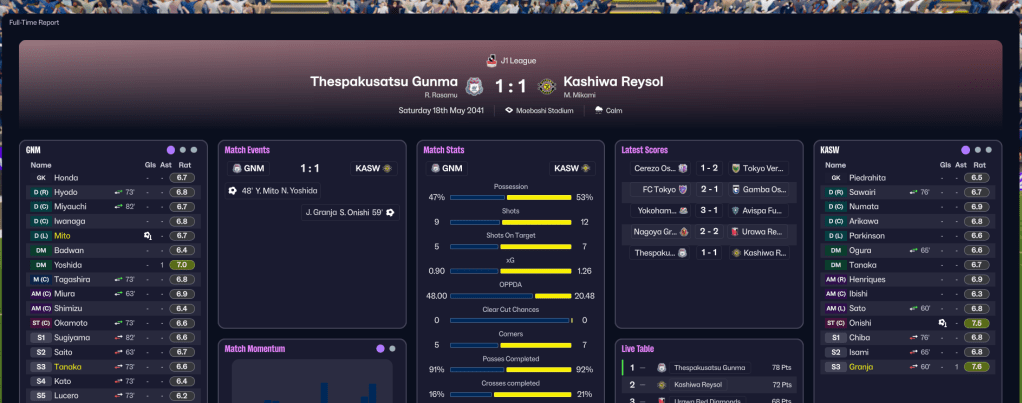
That draw kept Gunma 6 points clear, having played two more and with a 5 better goal difference, with Kashiwa playing their games in hand in the next two Wednesdays. Kashiwa played their part with a 2-1 win as a 92nd-minute goal nicked a 2-1 win at Hiroshima and played the day before Gunma, beating JEF United 2-0 to draw level on points. But Gunma lost both wingbacks to suspension and struggled to get going in a 1-0 defeat at 4th-place Kashima. And Kashiwa took advantage with a 2-0 win at Machida Zelvia to take a 3-point lead into the final day.
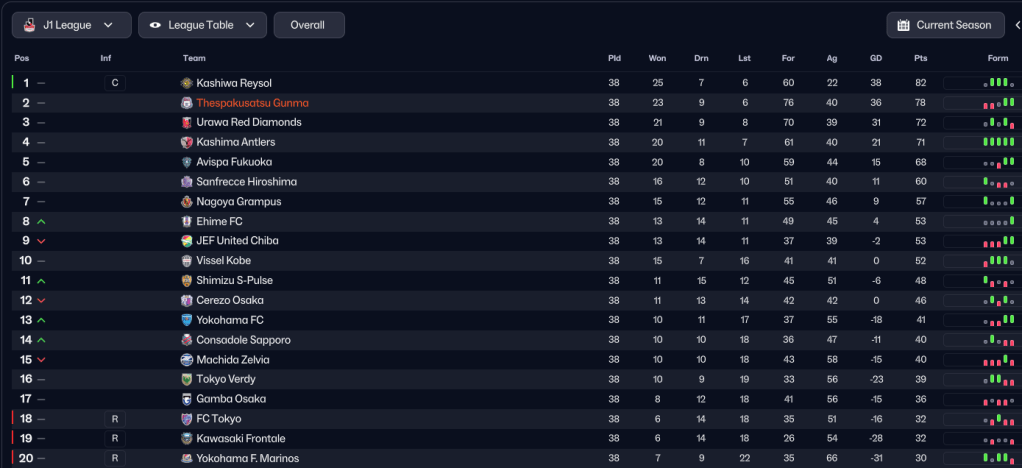
So Gunma had to win at home to Hiroshima while hoping Kashiwa lost at Cerezo. But they started terribly as Sugiyama scored an own goal after 12 minutes. Lucero won a penalty and got up to cheekily panenka it in to equalise 15 minutes later. Hiroshima obviously scored their first shot on target, Gunma struggled to make their chances count and somehow lost 2-1. But Kashiwa drew at Cerezo anyway to win a 4th successive title. Gunma finished 2nd on 78 points (5 more than last season) after 23 wins, 9 draws and 6 defeats, scoring 76 and conceding 40 (18 and 11 more than last season).
Another Close Title Miss
You could forgive Rasamu for getting a complex about narrowly missing out on the Japanese title. His Gunma side finished 2nd for the fifth time in their decade of life in J1 League, yet again missing out to the new dominance force Kashiwa. And the manager was pretty unhappy about the poor form and performances that led to them throwing the title away in the final few games of the season.
Shimizu was again the main man this season, leading the way with 22 goals and 16 assists in 50 games. Tanaka also got 16 assists with 6 goals, Kato popped up with 12 goals and 7 assists, Mito scored 10 with 8 assists, Okamoto scored 9 with 10 assists and Lucero and centre back Kenta Iwanaga also scored 9 goals.
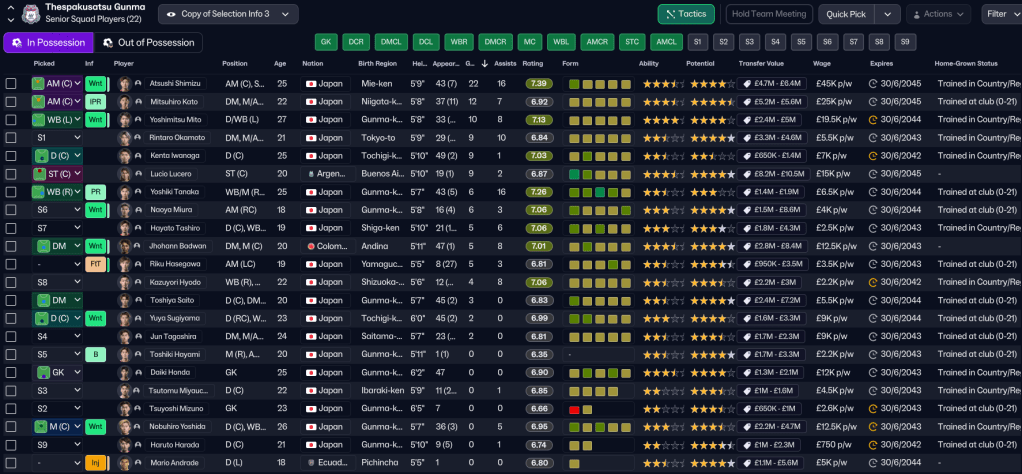
The Gunma squad is now more or less fully homegrown, with a huge number of players having come through the youth academy. Lucero is by far the best player in the save so far with a score of 454 in Rasamu’s attribute ID, followed by Badwan (419), Kato (417), Mito (410) and the rapidly improving Saito (407).
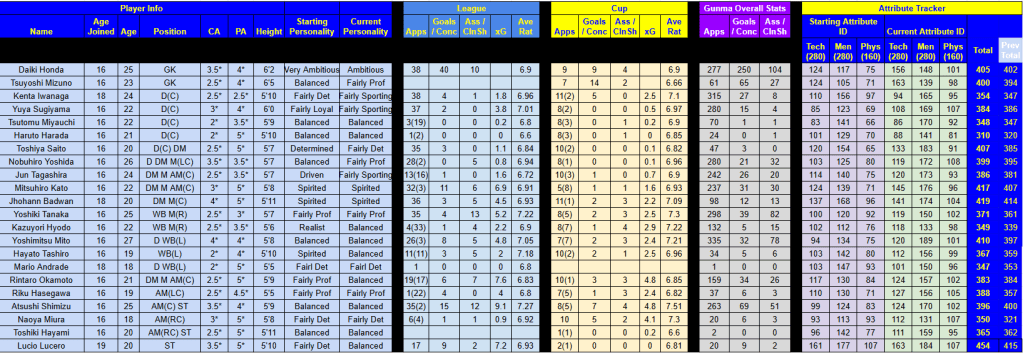
There are a few youth talents pushing for promotion to the first team, led by striker Szpucha, attacking midfielder Hiro Tamada. Lots of players headed out on loan this season to try and boost their ability, and Rasamu would assess their development over the summer.
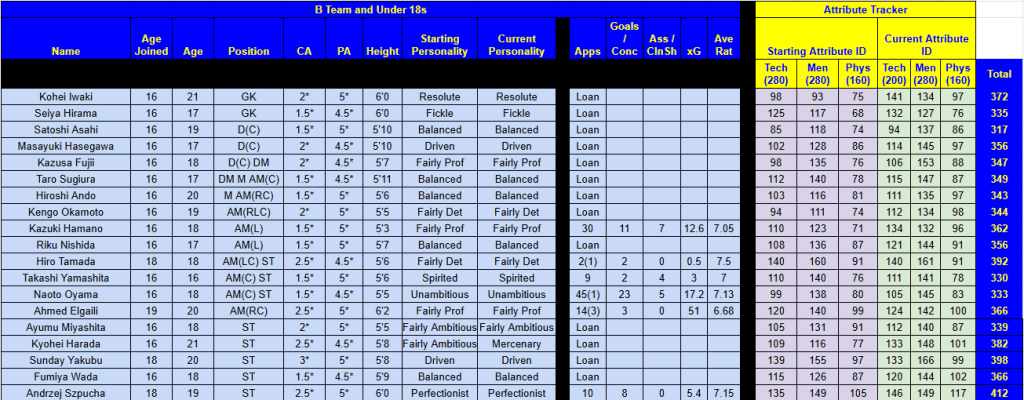
Gunma had an average youth intake led by 4.5-star potential attacking midfielder Takashi Yamashati, which Rasamu would address in the summer by replacing his head of youth development.
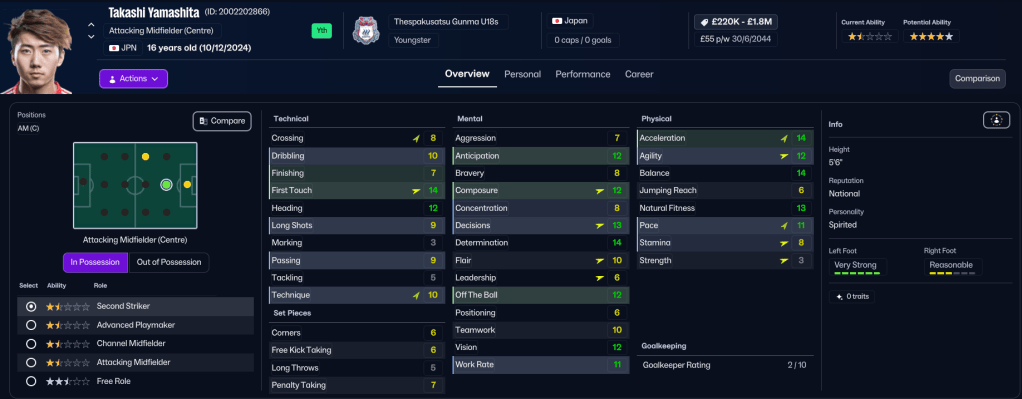
Could Gunma go one better and fight for their second Japanese title? And could they end their semifinal hoodoo i the Champions League? Join us next Friday to find out!


 Football Manager Addict
Leave a comment