
After establishing wonderkid factories at Envigado, AZ Alkmaar, Valencia and Mainz, one of my target saves for FM26 was to use the power of youth to take over Japan. And we’re going to do things a little differently, not taking over a top-tier challenger but a team lingering in the lowest playable tier of the nation. So welcome to Wonderkid Factory Japan!
Robaato Rasamu had grown up obsessed with all things sports-related, largely fuelled by the growth of football during the early years of Japan’s J.League. Growing up in Nagoya, he took delight in watching superstar striker Gary Lineker spearhead the new league and increasingly tuned in to football from around the world. The more he watched football, the more Rasamu became obsessed with the idea of developing young players to maximise their talent – largely fuelled by the Class of 92 being at the heart of Manchester United conquering England and Europe under Sir Alex Ferguson.
Despite playing football, baseball, tennis, golf and basketball as a youngster, Rasamu knew his talents were more academic than physical. His early career focused on several areas of research in the field of sport, including sports science and performance analysis, while working with youth sides at local clubs in the Nagoya and Osaka regions.
That experience shaped his Football Manager philosophy to pay close attention to youth development and inspire youngsters to achieve their maximum potential. With that in mind, the Wonderkid Factory approach is to sign players that would count towards homegrown quotas in nations that operate such a model – so players aged 19 or younger.
The overall aim is to win the Japanese title with a side that’s fully homegrown at the club, relying on the club’s own academy and young signings. As with our previous Wonderkid Factory stories, this save will be less about how we perform game-to-game and more about how well our young players are developing.
Selecting a Japanese Wonderkid Factory
Rasamu decided to skip the first season in Japan, which begins in January 2025, and then go on the hunt for a club in December. Rasamu wanted a club that didn’t have specific playing cultures but did have a tendency towards developing homegrown talents.
Hiroshima Sanfrecce won J1 with Shonan Bellmare, 2022 champions Yokohama F-Marinos and Albirex Niigata going down. Ehime FC won J2, with Fujieda and Sandai promoted and Kumamoto, Yamaguchi and Yamagata relegated. And Numazu won J2 with Matsumoto and Fukushima going up and Kochi and Nagano being relegated out of the playable leagues.
Annoyingly, Matsumoto had been top of his list in J3, so he required a rethink. That left him with a shortlist of Gifu, Gunma, Sagamihara, Tochigi-C and relegated Yamagata, who all wanted to sign players aged under 23, and Kitakyushu, who wanted to sign players under 23 and develop players using the youth system. In the end, having done a little online research, one club jumped to the top of the list.


Who are Thespa Gunma?
Thespapakusatsu Gunma, also known as ザスパクサツ群馬 and Zasupakusatsu Gunma, is a professional football club based in the city of Maebashi in the Gunma Prefecture to the north of Tokyo. Gunma is one of the country’s eight landlocked prefectures and 14% of its land is designated as a national park, which includes several mountains and stratovolcanoes.
The football club was founded in 1995 in Kusatsu, one of Japan’s most popular spa resorts, as Liaison Kusatsu Football Club. Its first players were students at the Higashi Nihon Soccer Academy, which closed in 1999 and the players decided to keep the club going. In 2002, it was renamed K.K. Kusatsu Onsen Football Club, before adopting the name Thespa Kusatsu, which literally meant The Spa, Kusatsu. But it adoped the current name Thespakusatsu Gunma – The Spa, Kusatsu, Gunma – to effectively represent the entire Gunma Prefecture.
Gunma spent 12 years in J2 League before being relegated to J3 League for the first time in 2017, they returned in 2020 but were relegated again in 2024. And, in 2023, they adopted the current name of Thespa Gunma. Unsurprisingly, Thespa Gunma have never won a major honour.
The club plays at the 18,900-capacity council-owned Maebashi Stadium which, intriguingly, has a 100-strong standing area. That’s supported by average training facilities, academy coaching and youth recruitment and adequate youth facilities. Finances also aren’t great, with around £500k in the bank but a transfer budget of £1.7m and £4,400 spare in a wage budget of £46,500 per week. But Rasamu’s biggest appeal was the dark blue home kit with flashes of yellow.
Cobbling Together a Squad at Gunma
Last season, after being expected to finish 7th, Gunma did finish 7th, losing their final four matches to miss out on the playoffs by 1 point and promotion by 7 points. Next season, the Gunma board expected a mid-table finish.
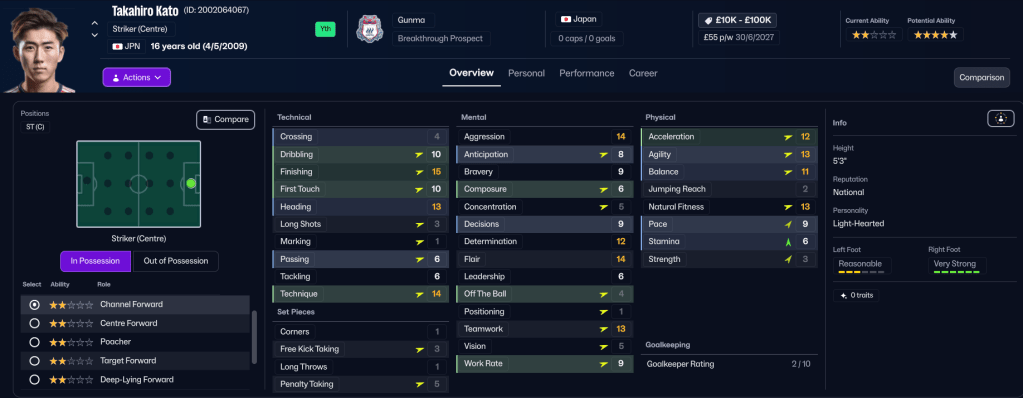
Rasamu walked into a looming disaster, with 15 of his 26-man squad’s contracts expiring in January – including the club’s five best players, none of whom had any interest in renewing – and five more being loanees. Better news was a handful of promising youngsters, including eight players in the under 18s with at least 4.5-star potential. That was led by recent intake attackers Takahiro Kato, Masaya Nishi, Tatsuhiro Takahashi and Masato Baba, who were all fast-tracked to the first team.


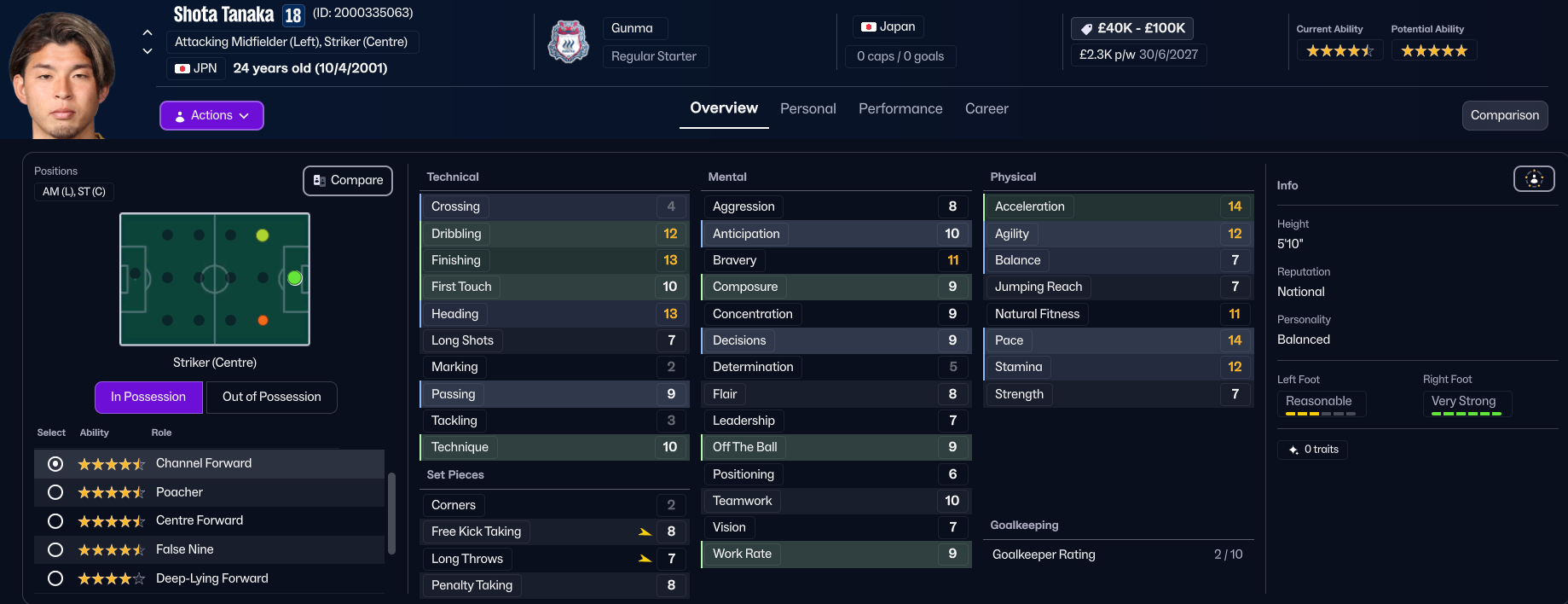
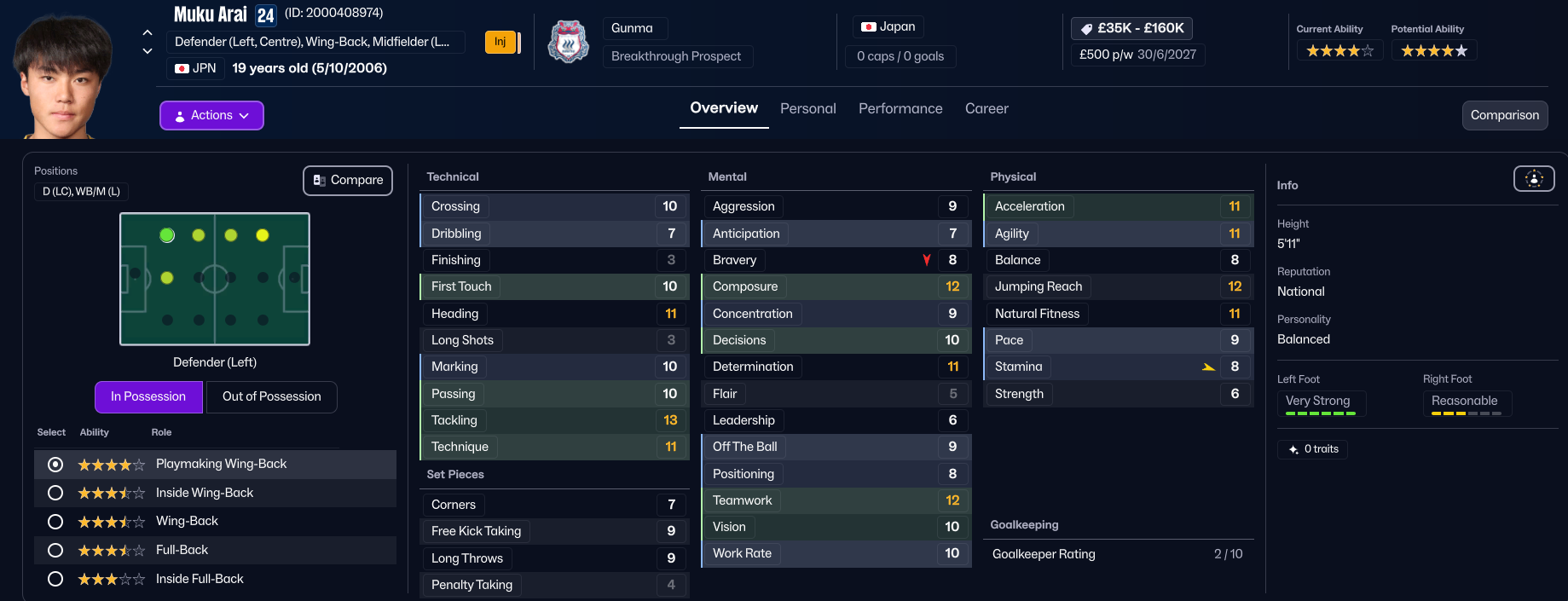
However, come 1 February 2026, Gunma had nine first-team players, four of whom were teenagers. The standout players remaining were defender Rikiru Nakano and attacker Shota Tanaka, along with left-back Muku Arai, goalkeeper Kim Je Hee, and winger Taiyo Shimokawa. With zero scouting knowledge, as he had to create adverts for two scouts, Rasamu was forced into the market, searching for players aged 19 or under and bringing in a handful on one-year deals to at least remove the reliance on greyed-out players. But he did manage to unearth a couple of potential gems in midfielder Hiro Hirota and goalkeeper Tomoyuki Koyama.

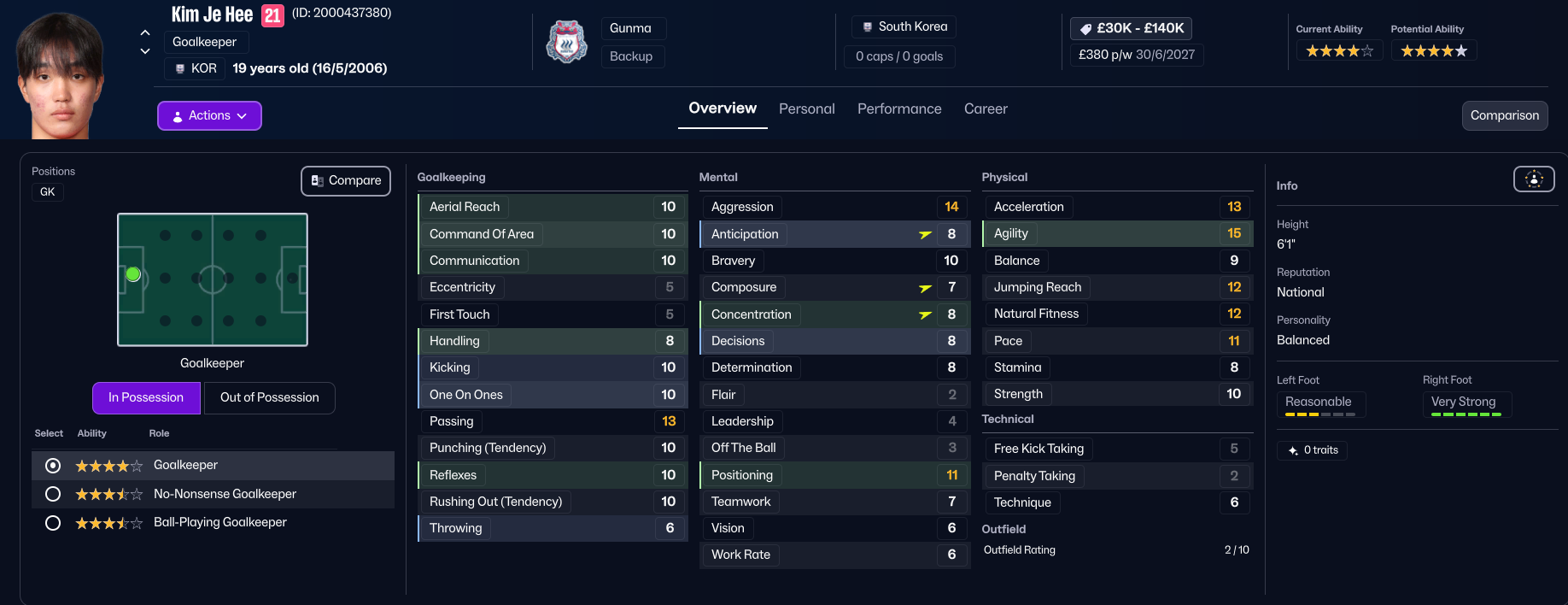
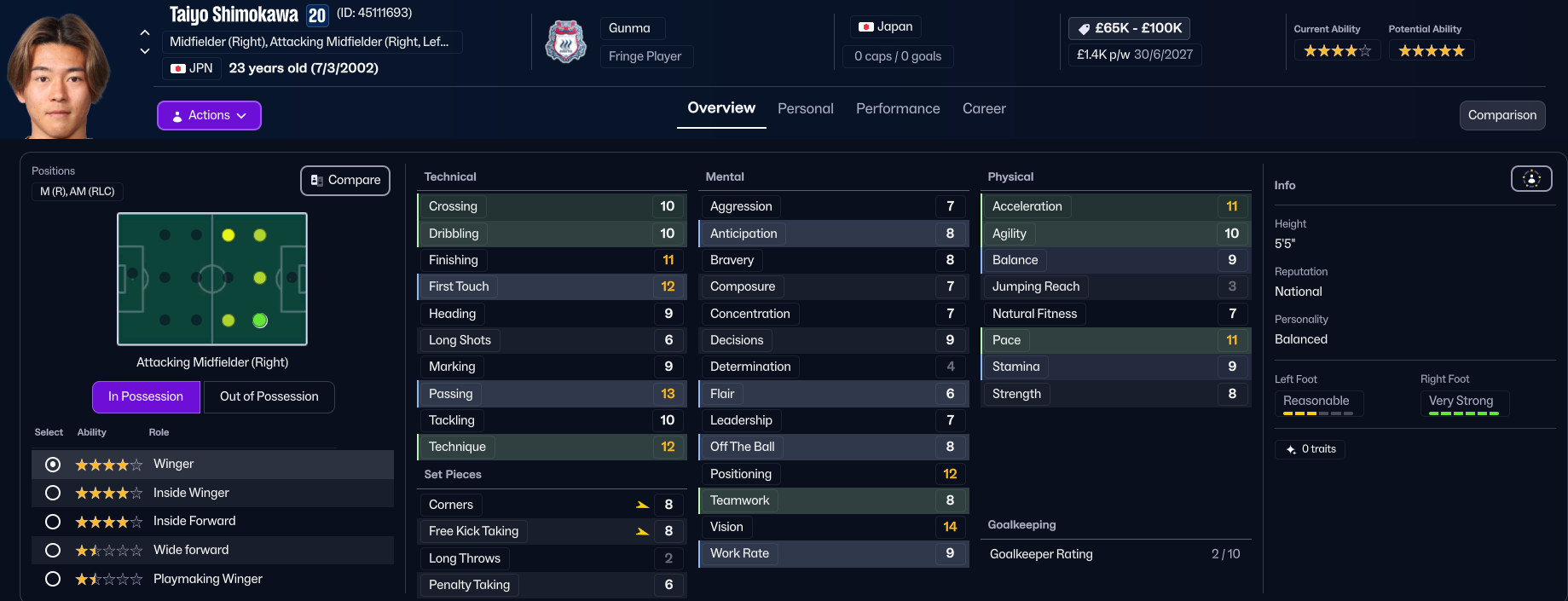
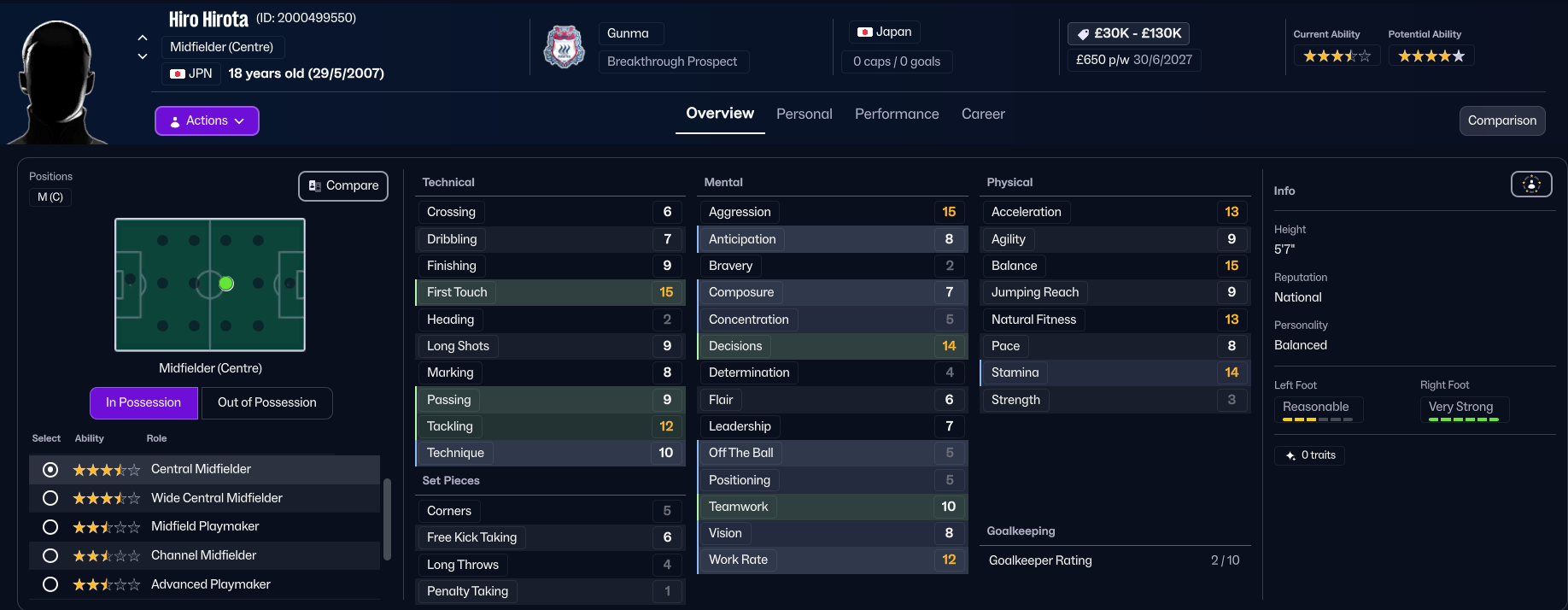

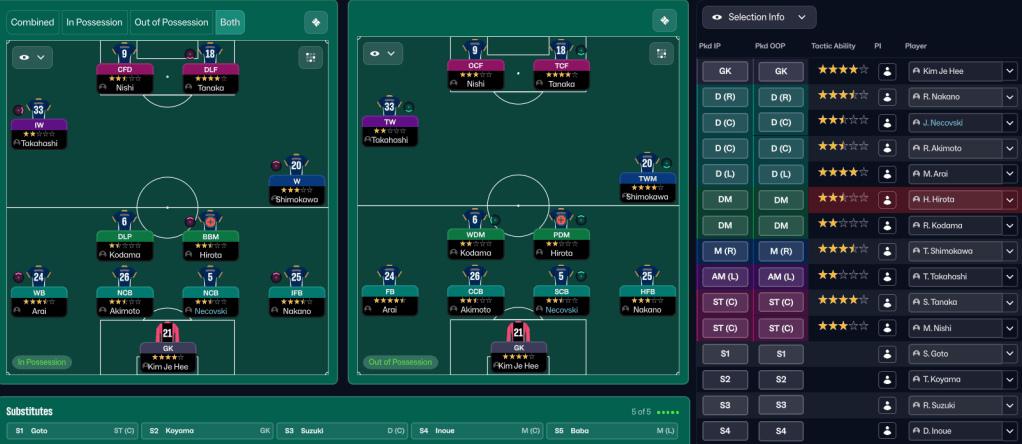
With the squad depth boosted, Rasamu opted for a 4-2-4 approach, with Tanaka playing as a deep lying forward to drop into the space between the attack and midfield. However, it’s worth keeping in mind only four of the first-team squad were considered to be of J3 standard before the start of the season.
Getting Started in J3 League
Rasamu’s Gunma reign began with the J2/J3 Special Tournament, which Rasamu assumed was to fill the gap as the Japanese leagues transition to an August-to-May schedule. But that competition effectively means the second Japanese season in FM26 lasts for 16 months! He treated it as a glorified series of friendlies to blood young players against tough J2 teams. But still, 7 successive defeats didn’t fill the new manager with optimism, and they went on to lose 17 out of 18, only scoring 15 and conceding 54.
Rasamu’s efforts to build out the Gunma squad with youth was boosted by his first academy intake in April, before the J3 League began. Another good batch of players included four players with 5-star potential and 3 more with 4.5-star potential, led by midfielders Ryotaro Kodama, who was promoted straight into the first team and, just to highlight the lack of leadership at the club, made vice-captain in July, Takuya Hosokawa and Shota Asada, goalkeeper Taiki Nakata and defenders Kazumasa Yoshida and Jin Udo.
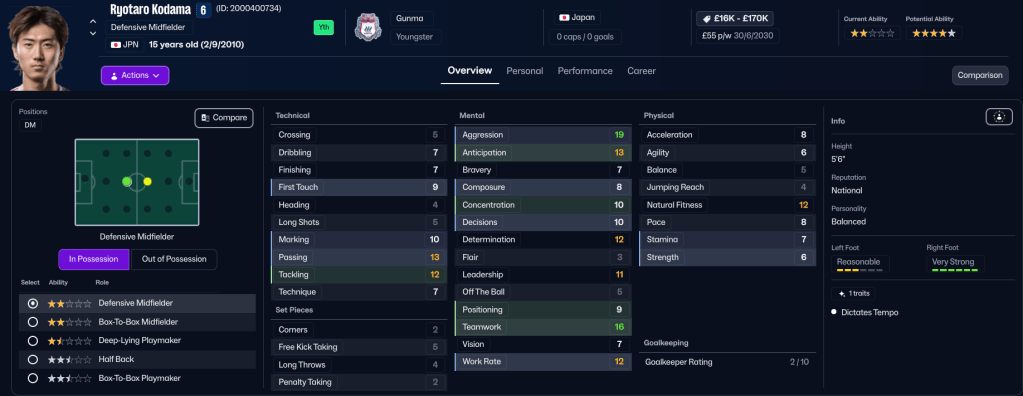

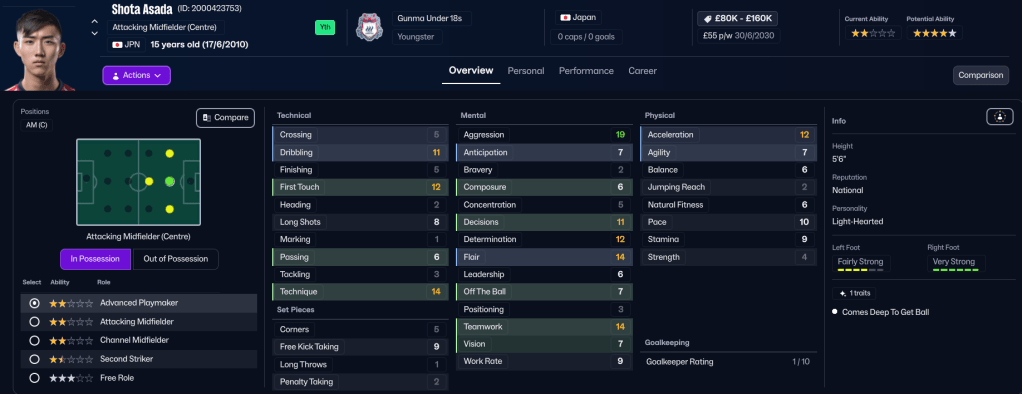
J3 League eventually kicked off in August, with Gunma’s unconventional transfer business leadinga media prediction of 20th and last with title odds of 200/1. Their relegation rivals were likely to be Kitakyushu, Hachinohe, Tottori and promoted Morioka United. Relegated Yamagate are 1/10 favourites, followed by Kumamoto (11/10), Ryukyu (7/2), Sanuki (10/1) and FC Gifu (11/1).
Gunma got underway with a big game at Kitakyushu, and goals by the strikeforce of Tanaka and Nishi earned a point. A tough first home game saw them taken apart 3-0 by title favourites Kumamoto. A 0-0 at Hachinohe delivered Rasamu’s first clean sheet in his 24th match in charge and was quickly followed by his second at home to Kagoshima. And they finally got a first win as a Nishi brace inspired a 4-2 win at Morioka.
That middle-of-the-road form continued, including a 1-0 defeat at Gifu being followed by a 0-0 at home to Yamagata and a first away victory courtesy of Nishi’s early goal, his 9th of the season, at Miyazaki. And Gunma found themselves firmly in mid-table, just as the board wanted, after 10 games of J3 League, having drawn half of their matches.
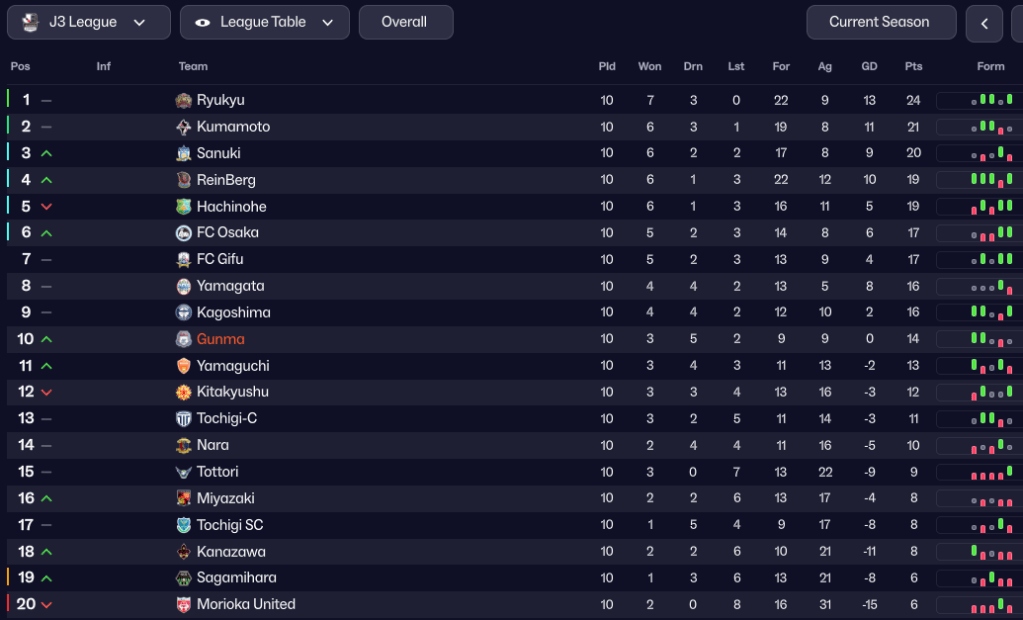
Obviously, the initial objective of this Wonderkid Factory is to survive in the first season of J3 League while blooding the youngsters. But in the long term, the aim is to work towards promotion to J2 and J1 in the next few seasons, then look to establish Gunma as the premier youth system in Japan and, eventually, become national champions.
Could Gunma survive in Rasamu’s first season? Join us on Saturday to find out and for a first look at how the Gunma youngsters fared!


 Football Manager Addict
Leave a comment