
The streets of the Gunma Prefecture witnessed one of the wildest parties this part of Japan had ever seen as the homegrown heroes of Thespakusatsu Gunma paraded the J1 League, AFC Champions League and Emperor’s Cup trophies. A fully homegrown side, led by star academy products Atsushi Shimizu, Mitsuhiro Kato, Yoshiki Tanaka, Yoshimitsu Mito, Rintaro Okamoto, Daiki Honda, Naoya Miura and Riku Hasegawa, claimed a famous treble that quadrupled the club’s trophy tally.
Manager Robaato Rasamu had been expected to celebrate that achievement with a brand spanking new stadium. However, that project got delayed for at least a few months. Furthermore, the success went to the heads of his board, who bizarrely went from expecting a top-half finish… to expecting Rasamu to win the league. That was probably reflective of Gunma’s improved reputation, which saw them become the 2nd most reputable club in Japan, only behind Kashiwa Reysol, and 4th most reputable in Asia, only behind Al-Hilal, Al-Nassr and Kashiwa.
Eight Gunma players made the Japan squad for the 2042 World Cup in England. Japan had a tough group but started well as Honda’s man of the match performance earned a 0-0 against the Netherlands, with Okamoto also starting, and he kept another clean sheet as they beat Slovakia 1-0, with Kato, Shimizu and young centre back Masayuki Hasegawa also starting. And they qualified for the knockouts as Honda, Kato and Hasegawa earned a 1-1 with Tunisia. Honda kept two more clean sheets as they beat Thailand 2-0 and Iran 1-0, only to lose 1-0 to Serbia in the quarter finals, with Kato earning man of the match. Serbia lost 1-0 to Italy and finished 4th with a 4-0 defeat to Germany, before
Gunma’s summer began with a couple of sales that Rasamu didn’t want to do but was forced into. First, Saudi side Abha offered a pathetic £5m for striker Lucio Lucero, who predictably got upset. Rasamu managed to negotiate a second bid up to a huge new club record fee of £10m rising to £13.5m with a 50% sell on. Then, midfielder Jhohann Badwan decided he wanted to move to a bigger club and, with 12 months on his contract, joined Al-Ahli for £3m.
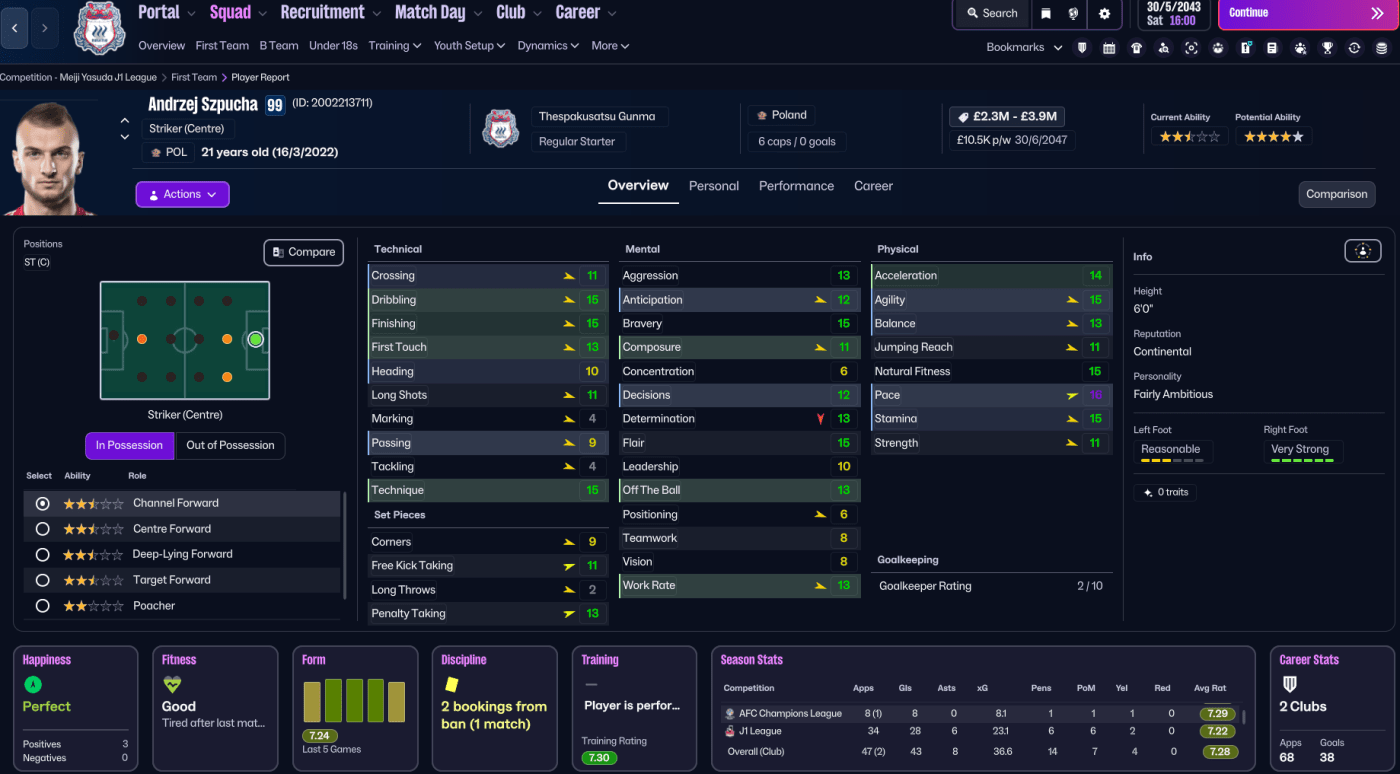
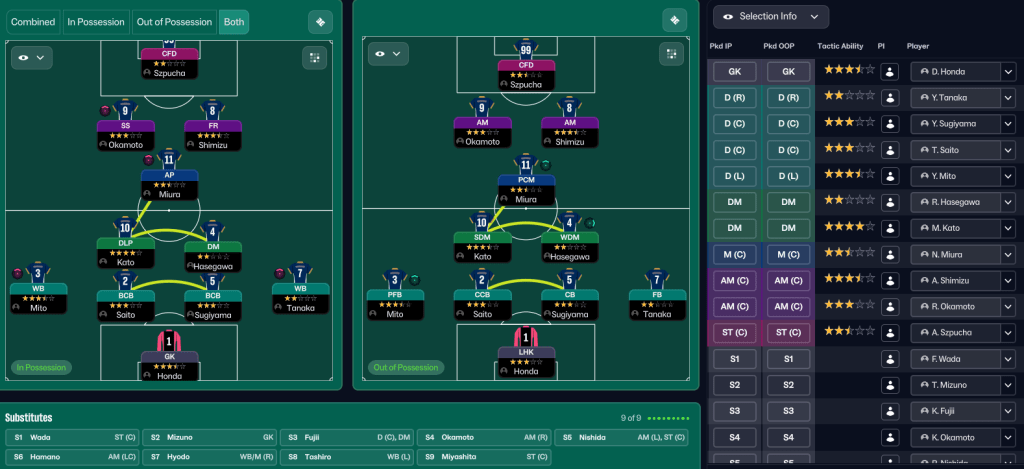
Given the quality of players coming through, Rasamu saw no need to rush out and panic buy. Instead, he promoted striker Ayumu Miyashita, midfielder Kengo Okamoto (not to be confused with namesake Rintaro) and centre backs Kazusa Fujii and improving Burkina Faso talent Abou Zabré. That sees Polish striker Andrzej Szpucha given a huge opportunity to replace Lucero’s goals, while Hasegawa comes in for Badwan. And Rasamu stuck with the narrow 4-3-3 approach that had worked wonders last season.
J1 League Title Defence
Kashiwa Reysol remained the bookies’ favourites at 7/5 to reclaim the Japanese title. But Gunma’s chances were boosted to 9/2, ahead of Gamba Osaka (7/1), Kashima Antlers (10/1), Urawa Red Diamonds (12/1) and Sanfrecce Hiroshima (13/1).
Gunma’s title defence began well as Szpucha scored 2 minutes into the season, before Kato and R Okamoto sealed a 3-1 win over Sapporo. Szpucha also opened the scoring in a 2-1 win at Kawasaki, but the Asian Games saw 10 players go on international duty for a month and a strong start ended with defeats at Kashiwa and Kashima.
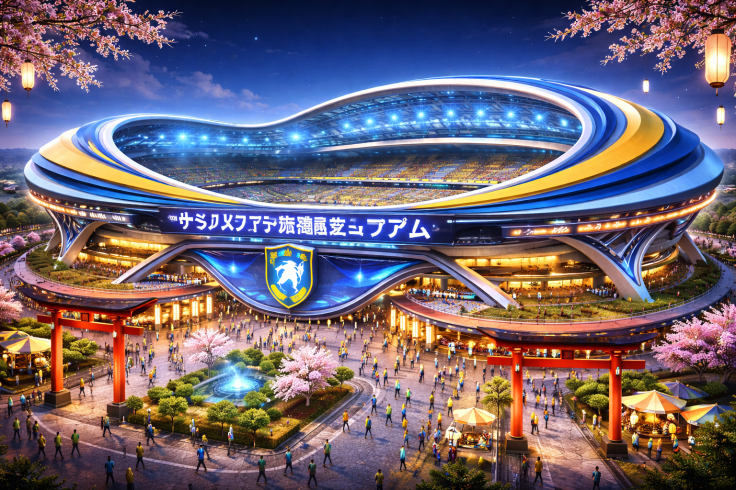
At the start of October, work on the 25,875-capacity all-seater, imaginatively named Thespakusatsu Gunma Stadium was finally completed. Fittingly, the first game in the new stadium welcomed old boy Yusuke Ishii back home with his Urawa side. But it very much was not one to remember as Gunma just about snuck a poor game 1-0 thanks to Szpucha’s late header. But just look at that beautiful, iconic new arena!
Some continental shenanigans (see below) left Gunma with up to 5 games in hand, but still in 6th place, by the end of November. But they hit top form with consecutive 6-1 away wins over Kumamoto, with Shimizu’s brace and a hat trick by Kato on his 250th league appearance for the club, and Kofu, led by Okamoto and Szpucha hat tricks. The red-hot Szpucha scored two more in a 2-1 win at Sapporo to send Gunma top for the first time this season in early December, despite having 3 games in hand on Kobe in 2nd.
Gunma began 2043 with a mass of injuries. Still, they started the new year with Miura and striker Fumiya Wada securing a comfortable 2-0 win over Shimizu, who’d gone from a title battle to a relegation fight. A 3-0 win over leaders Kashiwa, despite goalkeeper Daiki Honda suffering a fractured arm, moved Gunma level on points with them… with four games in hand… The good form continued, and Gunma edged 6 points clear by mid-April, still with four games in hand. A big 5-0 win at Tokyo and a 2-0 win over Kumamoto extended that lead to 7 points with 10 games remaining, but the mass of games in hand meant the title race was very much in Gunma’s hands.

Gunma began the run-in with a comfortable 2-0 win at home to Kawasaki on 6 May. However, they again had a massive fixture overload, with their final 9 games played over 24 days, including five games between the 10th and 20th May. Four days later, a tired team slipped to a 2-1 defeat at Hiroshima so Rasamu rotated fully three days later and Harada and R Okamoto’s goal off the bench edged a 2-1 win at Ehime. That left Gunma 3 points clear with six games remaining and two in hand on Gamba.
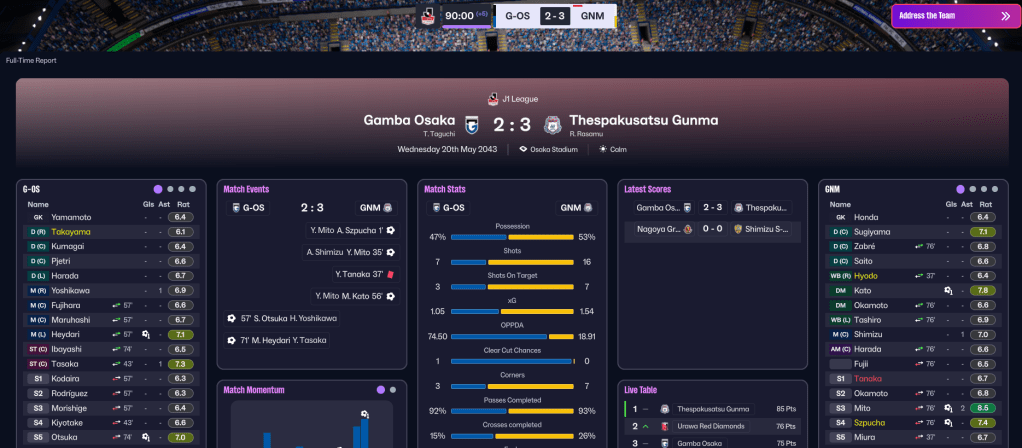
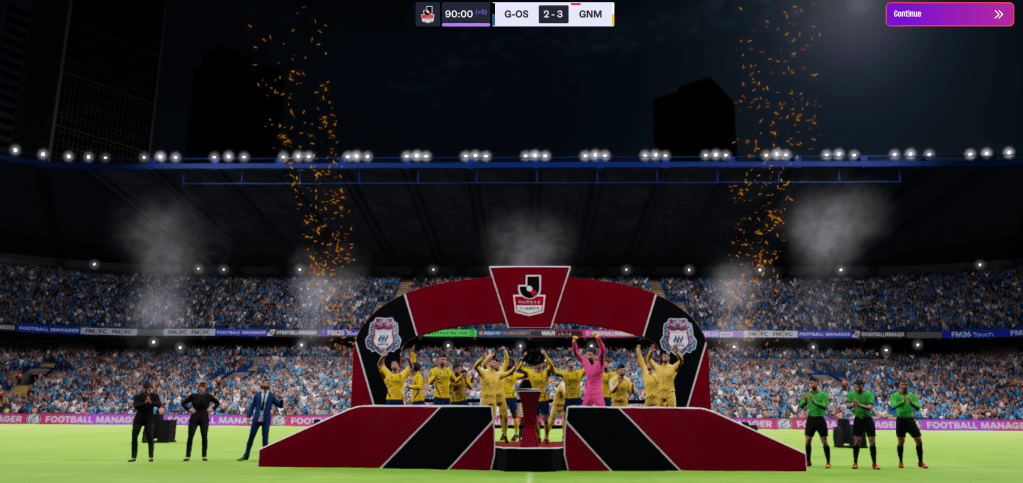
Szpucha broke the club record for most league goals in a season to secure a point at home to Yokohama on the Saturday. Then on Monday, a fully rotated team managed to shut down Zelvia and Harada’s neat finish nicked a 1-0 victory. That moved Gunma to the edge of the title, led Urawa by 6 points and Gamba by 7. Two days later, a huge game took them to Gamba, knowing a point would secure consecutive Japanese titles. They got a flyer as Mito got down the left and crossed for Szpucha to power in a header after 42 seconds. The left back was in the thick of it again as he latched onto Shimizu’s throughball and calmly slotted past the keeper after 35 minutes. However, his opposite number landed them in hot water, as Tanaka was shown a straight red for a shocking challenge. Against all the odds, Kato smashed home a 25-yard piledriver to put Gunma on the verge of the title, only to immediately concede Gamba’s first shot on target… and their second. But Rasamu went on full defensive mode and they held on to win 3-2.
Thespakusatsu Gunma won consecutive J1 League titles!
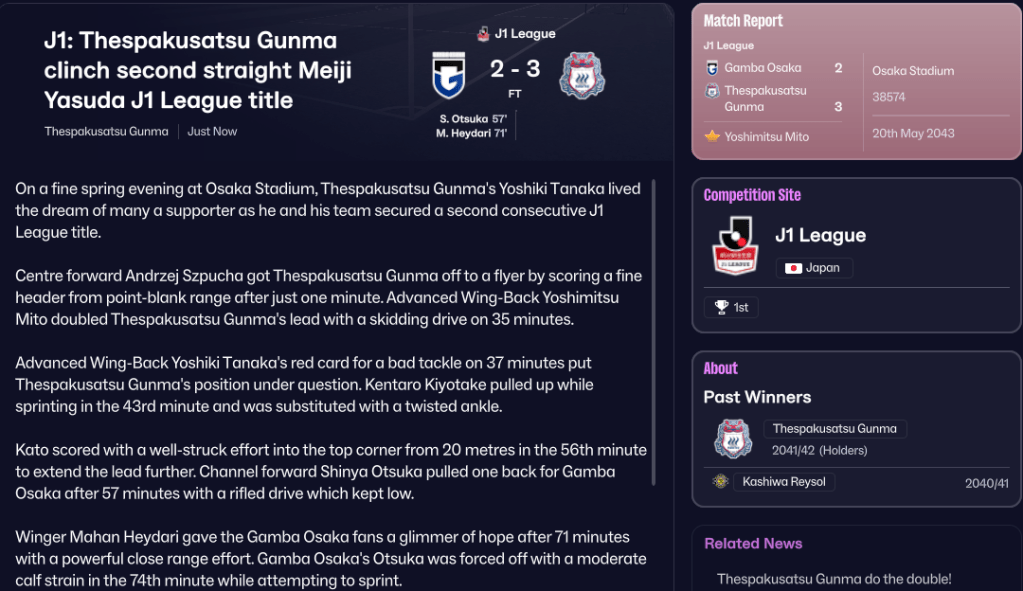
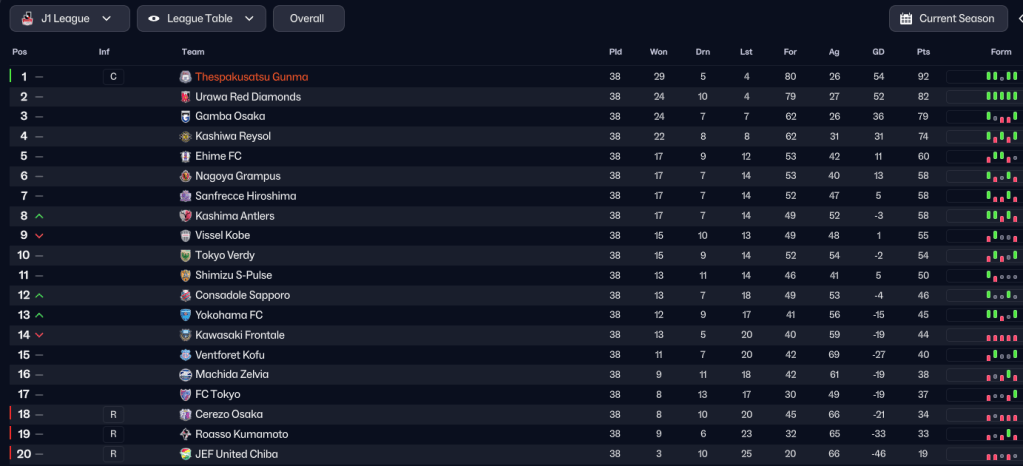
Gunma continued to navigate the fixture congestion well, largely led by the outstanding Mito. They went on to win the league by 10 points, finishing on 92 points after 29 wins, 5 draws and 4 defeats, scoring a league-high 80 goals and conceding a joint-low of 26. Azpucha led the way with 28 goals in 34 games, as well as the most shots (145, 26 more than anyone else), with Miura joint-14th with 11 in 35. Mito was the top assister in the league with 15 followed by Shimizu’s 14, with Tanaka joint 8th on 9 and leading the way with 122 key passes. But Shimizu created the most chances (30) ahead of Tanaka (28).
Intercontinental Excitement Amid First AFC Champions League Defence
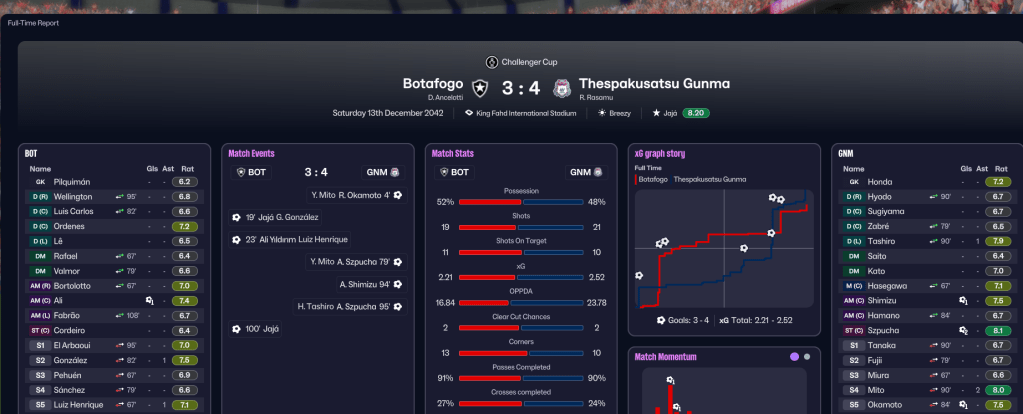
Last season’s Champions League success sent Gunma into the Afro-Asian Pacific Cup, which is the first step in the wider Club Intercontinental Championship (which Rasamu had never heard of). First up, in mid-September, was a playoff against African champions MC Alger, from Algeria, which they dominated and won 4-2 thanks to R Okamoto’s brace. A month later, they faced Oceania champions Auckland FC in the Final, and cruised to a 4-1 victory led by a Szpucha goal and assist for Shimizu. That sent them into the Challenger Cup against South American champions Botafogo in Saudi in mid-December. The two sides served up an absolute thriller with Okamoto scoring an early header only for Botafogo to score two quickfire goals. But Szpucha headed in an equaliser just after halftime and it went to exter time. Shimizu scored a complete fluke and, straight from the kickoff, Szpucha tapped home his second. And, despite Botafogo getting one back, they held on for a wild 4-3 victory.
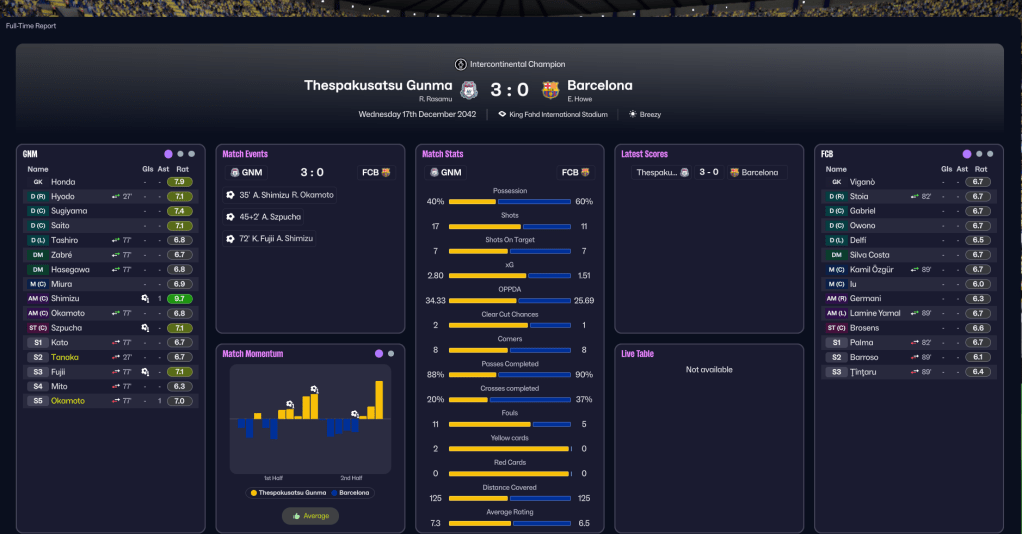
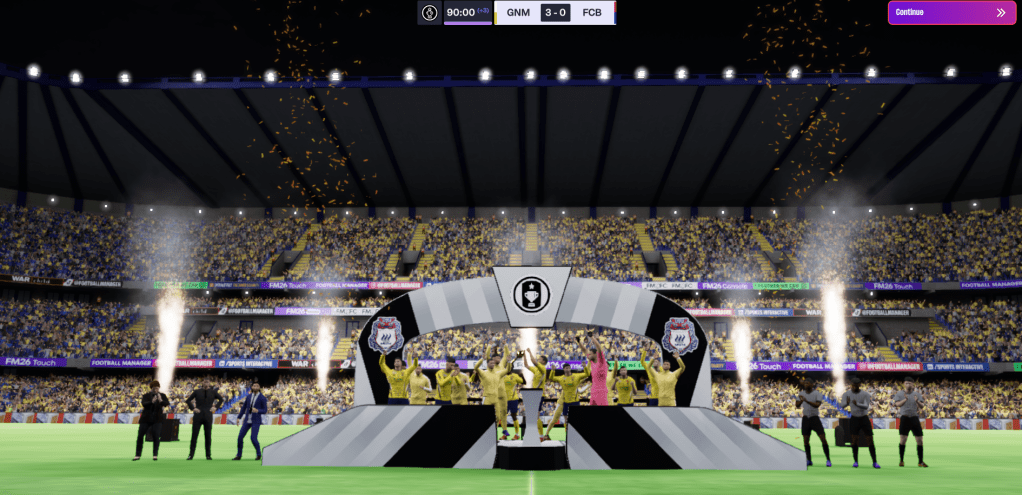
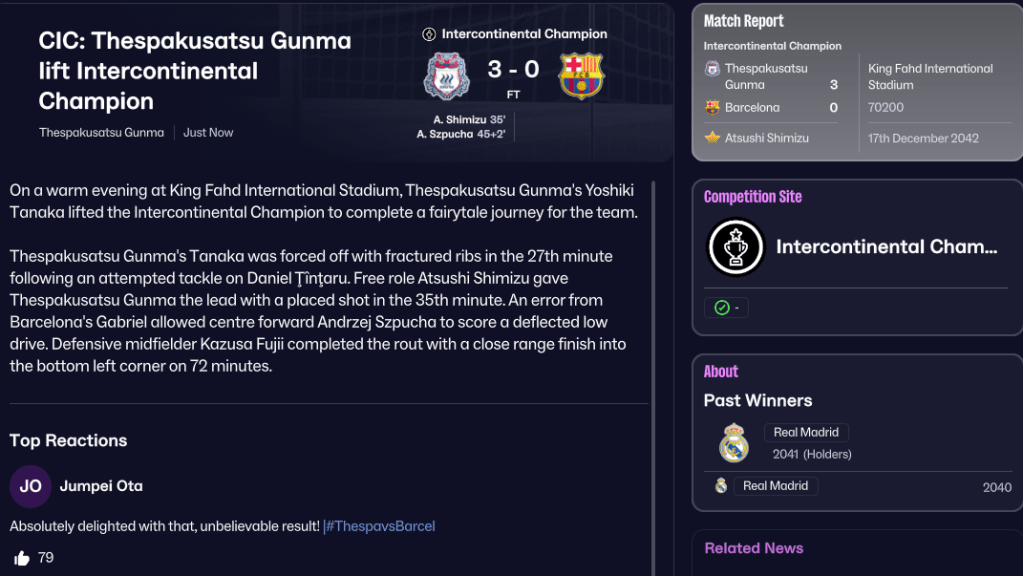
However, that victory saw the difficulty levels rise a few notches as, five days later, little Thespa Gunma took on the might of FC Barcelona in the Club Intercontinental Championship Final. Gunma actually started fairly nicely, having 5 shots inside 25 minutes, only for Tanaka to be kicked out of the game. But they took advantage of that start, shocking the world of football as R Okamoto threaded Shimizu through to calmly tuck the ball into the far corner. Nut not content with that, on the verge of halftime, Szpucha intercepted a pass on halfway and raced through to double the lead. Barca wasted a couple of decent chances early in the second half, but Gunma held on, steadied themselves and struck again, as brilliant play by Shimizu teed up Fujii for his first senior goal. It could easily have been four as K Okamoto saw a shot well saved, but Barca offered nothing and Gunma cruised to a victory that shook the football world.
Thespakusatsu Gunma succeeded Real Madrid, Liverpool and FC Bayern as Intercontinental Champions of the World!
The Champions League defence began with an 8-0 obliteration of CA Ha Noi led by a Szpucha hat trick. Miyashita’s first goal for the club and attacker Kyohei Harada earned a 2-0 win at Western Sydney before an easy 3-0 at Buriram and a 4-0 thumping of Melbourne Victory in the second match at Thespakusatsu Gunma Stadium. A rotated side beat Suwon 3-0, before a 0-0 at Hiroshima and a fully rotated side beat Guangju 3-0 in the new year to finish 2nd in the group, only behind Shimizu.
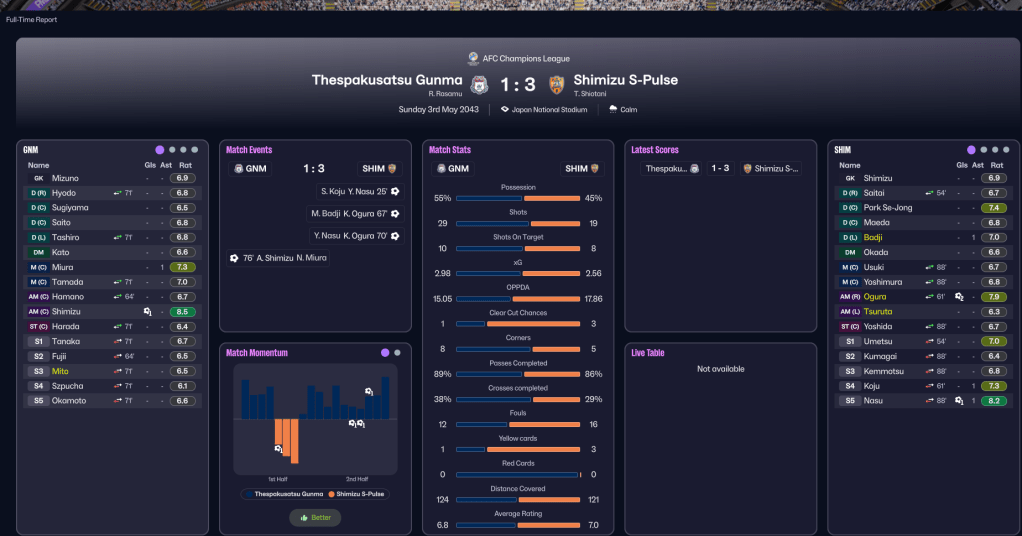
That teed up a last-16 clash with Suwon, and Shimizu’s brace led a 5-2 away win before a rotated side eased through with a 2-1 home win. Unsurprisingly, Gunma got Al-Nassr in the quarter finals, and a brilliant Shimizu display saw him lay on two tap-ins for Szpucha to edge a narrow 2-1 victory. That teed up an all-Japanese semi with Gamba, which Shimizu again bossed with the opener before midfielder Hiro Tamada’s late winner. Five days later, another all-Japanese clash followed as Gunma played in back-to-back Champions League Finals, this time against Shimizu S-Pulse, who were 12th in J1, at the Japan National Stadium. Honda was still sidelined, so Rasamu lined up:
Mizuno; Tanaka, Sugiyama, Saito, Mito; Fujii, Kato; Miura; Shimizu, R Okamoto; Szpucha
Subs: Harada, Hirama, Zabré, Tamada, K Okamoto, Hamano, Hyodo, Tashiro, Wada, Hasegawa, Miyashita
Gunma started the game on top, but S-Pulse grew into the game and scored a goal that clearly hit the striker’s arm. Gunma continued to push without creating any major chances, and S-Pulse added a second against the run of play and immediately scored a third. Shimizu finally got a consolation, Tamada hit the bar from the next attack and Harada missed an absolute sitter, but their worst performance for a long time – in which they had 29 shots – saw Gunma blow the chance at consecutive Champions League wins.
Another Historic Season for Gunma
Gunma had firmly established themselves as the best team in Japan, navigating a tricky fixture schedule to cruise to consecutive titles. Not only that, they had an argument for being the best team in the world, courtesy of the shock win over Barcelona.
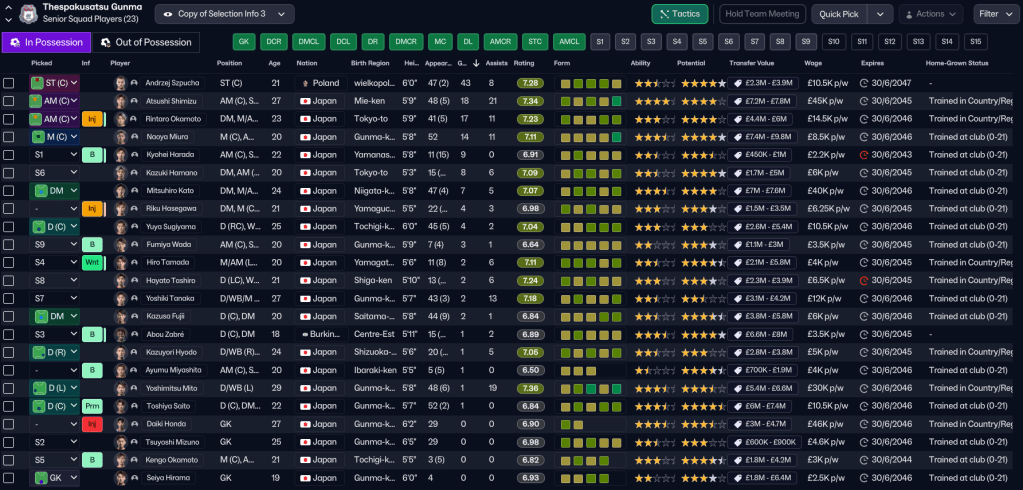
The loss of Lucero wasn’t felt at all, as Szpucha stepped up big time to smash the club’s goalscoring records. The 21-year-old surpassed Ishii’s 22 league goals and 29 in a season by scoring 28 in the league and an incredible 43 in 49 in all competitions. Shimizu was again excellent, with 18 goals and 21 assists, along with R Okamoto (17 goals and 11 assists) and Miura (14 goals and 11 assists). But the full backs were also magnificent, with Mito racking up 19 assists and Tanaka delivering 13.
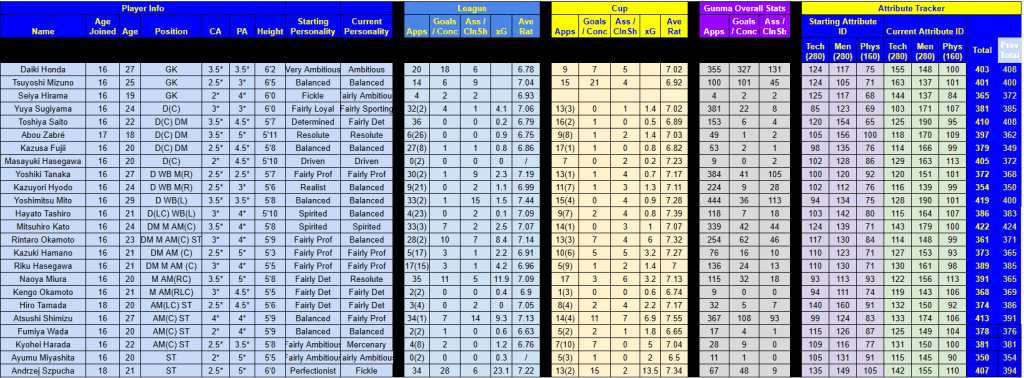
Kato has stepped up as the best player at the club with a score of 422 in Rasamu’s attribute ID system, followed by Mito (419), Shimizu (413) and Szpucha (407). Mito has moved past 400 games for the club, moving on to 444, with Tanaka on 384, Yaya Sugiyama on 381 and Shimizu on 367. While Shimizu is the only player to have scored more than 100 goals for the club (now 108), and Mito and Tanaka both passed 100 assists this season (113 and 105). Click the chart below to see all the homegrown Gunma players’ stats.
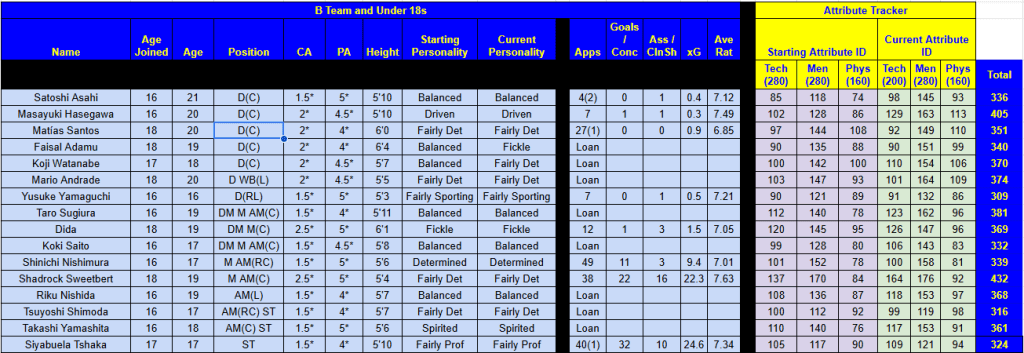
There are also several looking to step up to the first time, led by brilliantly named Congolese midfielder Shadrock Sweetbert (who Rasamu definitely only signed because of his name), Brazilian midfielder Dida and centere back Masayuki Hasegawa.
Yet another homegrown star made their debut for Japan as K Okamoto, who barely gets a game for Gunma, played in a 2-1 Asian Cup win over South Korea. The Japan squad currently contains no fewer than nine Gunma players and 10 of its academy graduates.
Gunma were very much the strong force in Japanese football and Rasamu was thrilled with the levels his homegrown stars were hitting. However, approaching 20 years in charge, he had one eye on the end of his Wonderkid Factory journey in the next couple of seasons.


 Football Manager Addict
Leave a comment