
Thespakusatsu Gunma’s first J1 League title defence didn’t exactly go to plan as they suffered a slow start but recovered to the board’s expected top-half finish in 2039. And manager Robaato Rasamu recognised it was time to shake things up a little.
Off the pitch, that was certainly the case, as Gunma became the fourth most reputable club in Japan, behind Kashiwa Reysol, Gamba Osaka and Kashima Antlers. Chairperson Takanori Yamazaki announced plans to build a new stadium, and began the process of searching for suitable sites and possible investors. While another annual profit of £12.5m saw them go into the 2039/40 campaign with £49m in the bank. And Rasamu continued his mission to improve Gunma’s youth by securing the club’s first international affiliate agreements with Defensor Sporting in Uruguay and Al-Wahda in UAE.
That was boosted as Rasamu finally cashed in on the interest in midfielder Peter Tweh, who massively underperformed last season and moved to Saudi for £5m. He also sold backup strikers Emil Ivanov and Shunichi Sakamoto to Levski Sofia and Shanghai for £475k and £250k and right back Nguyen Van Dung to Hiroshima for £500k to take the club’s bank balance beyond £50m for the first time.
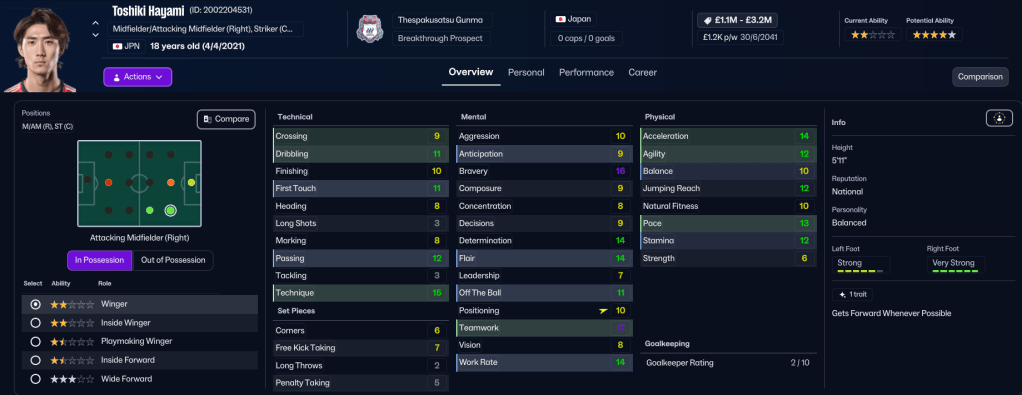
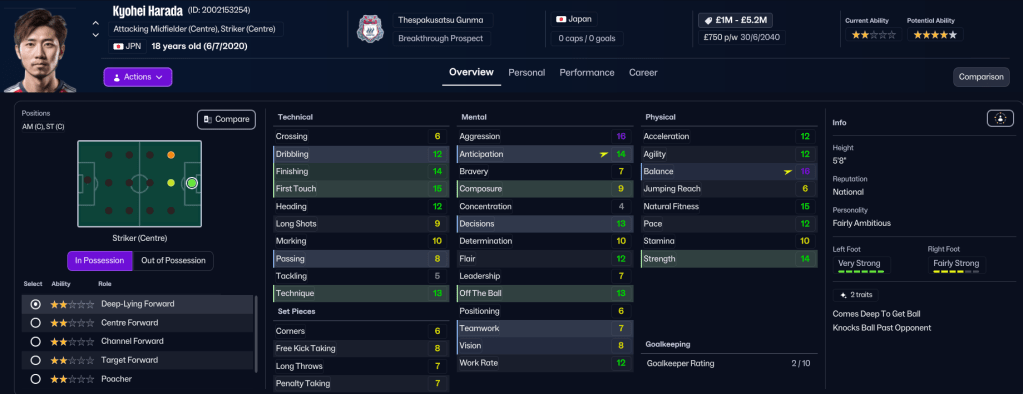
Rasamu’s scouting team still hadn’t unearthed any players capable of replacing them, so Rasamu stuck to what he knew. He promoted attacking midfielder Toshiki Hayami, who later left on loan, striker Kyohei Harada and centre back Kyoga Maie to the first team, which now contains 14 players with at least 4.5-star potential.
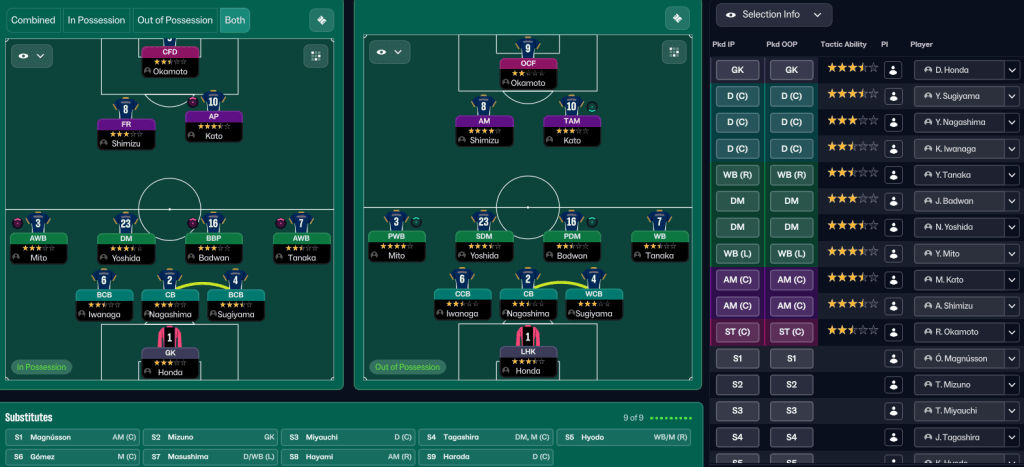
Rasamu toyed with the idea of moving away from the 3-4-3 that had worked nicely for the last few seasons. But they lacked in key areas to move to another formation. Instead, he moved Matsuhiro Kato into attacking midfield with a view to giving more gametime to exciting Colombian midfielder Jhohann Badwan. He also tweaked the team instructions to play into feet, play shorter passes, work the ball into the box and be more expressive, which should be beneficial given the front three are 5’8, 5’9 and 5’9 and they don’t have an outfield player over 6’0.
Seeking J1 League Improvement
Gunma remained the fifth favourites to win J1 League with 33/1 title odds. Gamba remain 11/10 favourites, followed by holders Kashiwa Reysol (9/5), Urawa Red Diamonds (20/1) and Kashima Antlers (25/1). While Kato and left wingback Yotsuhiro Mito are in the media dream 11.
Gunma began the campaign with a tricky trip to Kashima, but a strong defensive effort earned a 0-0 before drawing 1-1 at Tokyo Verdy. Badwan’s first goal nicked a 2-1 win at home to Fukuoka, but the big positive of the opening period was converted striker Rintaro Okamoto equalling last season’s tally of 3 league goals in the first 6 games. Gunma returned to being draw-happy, tying 9 of the first 15 games but only losing once. That good form continued, and Gunma headed into a long winter break sitting 4th with 33 points after 19 games, trailing leaders Kashiwa by 7 points.
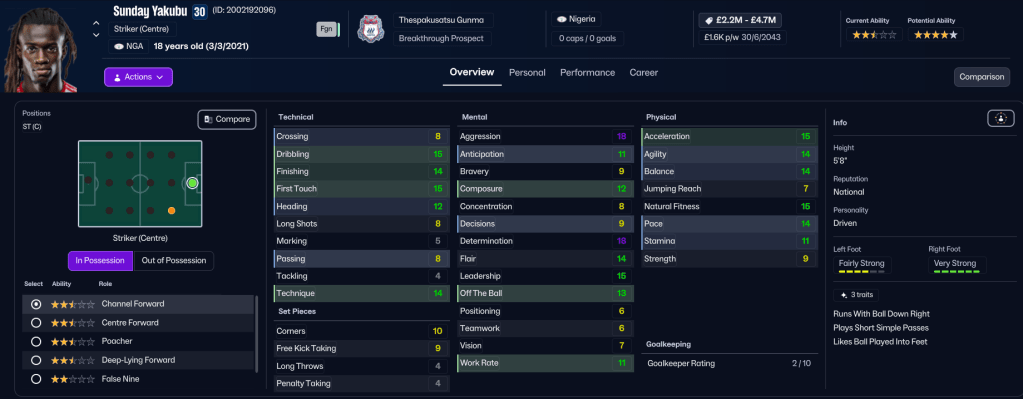
Rasamu bolstered his attacking options in January, bringing in promising 18-year-old Nigerian striker Sunday Yakubu for £400k from Rivers United.
Gunma began the 2040s with solid home wins over Kashima, who were struggling down in 17th, and Tokyo, which shot them up to 2nd. And an Atsushi Shimizu brace downed JEF United 3-0 to take his side top of the league for the first time in mid-February, albeit Kashiwa had two games in hand.
Fixture Chaos Shapes Exciting Title Race
Gunma’s solid form continued, while Kashiwa’s continental exploits left them with four games in hand by the start of April. Kashiwa lost the first of those, which was their first league defeat since early October, then drew back-to-back games before Gunma drew 1-1 at Hiroshima. That meant that with six games remaining, Gunma led the way on 62 points, 1 clear of Kashiwa with 3 games in hand. It was likely a two-horse race for the title, but Urawa Reds were 9 points behind Gunma with a game in hand, and Hiroshima were 12 back with 3 games in hand.

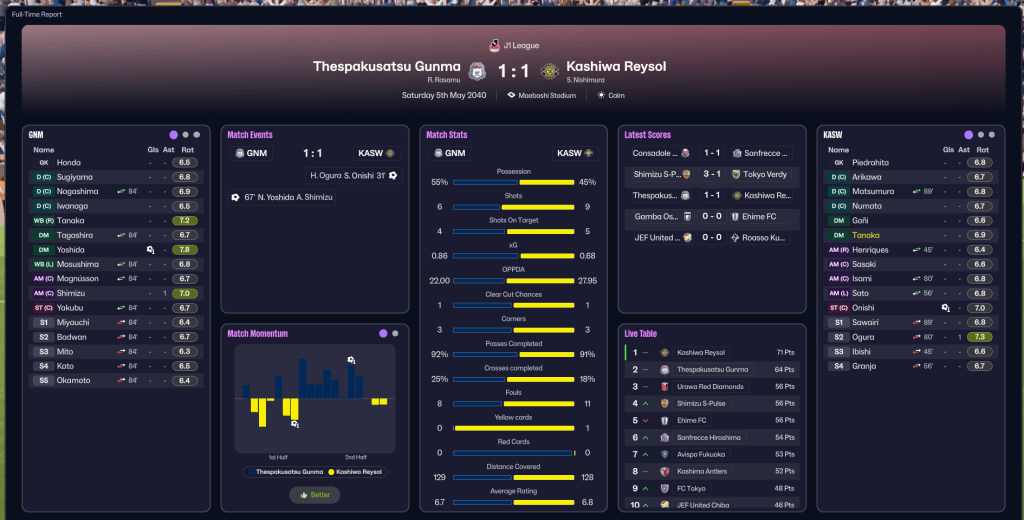
Gunma drew 1-1 again at Kyoto, while Kashiwa went top by crushing Kofu 5-1 to move a point clear with 3 games in hand. And a 2-0 defeat at Yokohama probably handed Kashiwa the first successful title defence of this entire save. But a huge game followed as Gunma hosted Kashiwa in early May. Okamoto had a goal disallowed and Kashima went down the other end to take the lead in the only highlight of the first half. The second half was equally poor until midfielder Nobuhiro Yoshida slammed home after a sneaky short freekick move. It finished 1-1 and Kashiwa won in mid-week to wrap up the title.
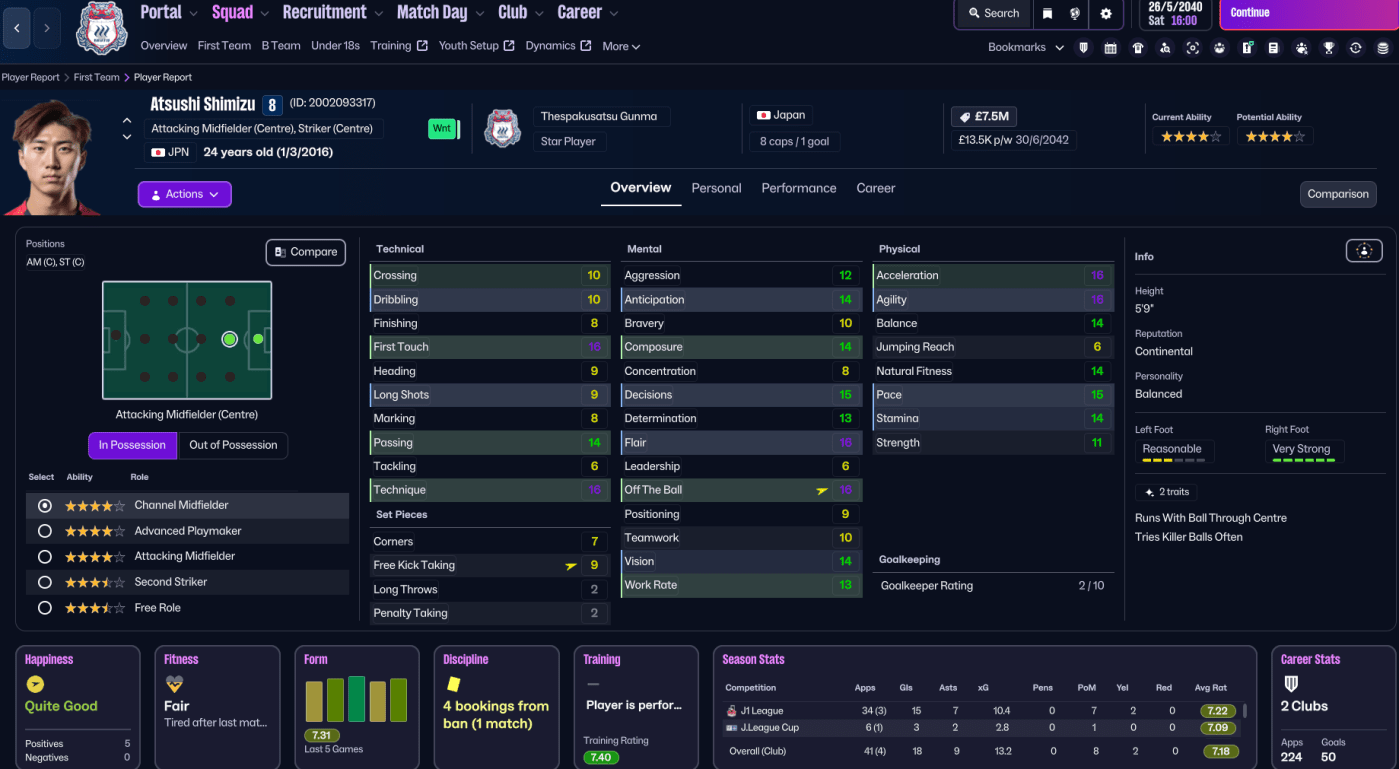
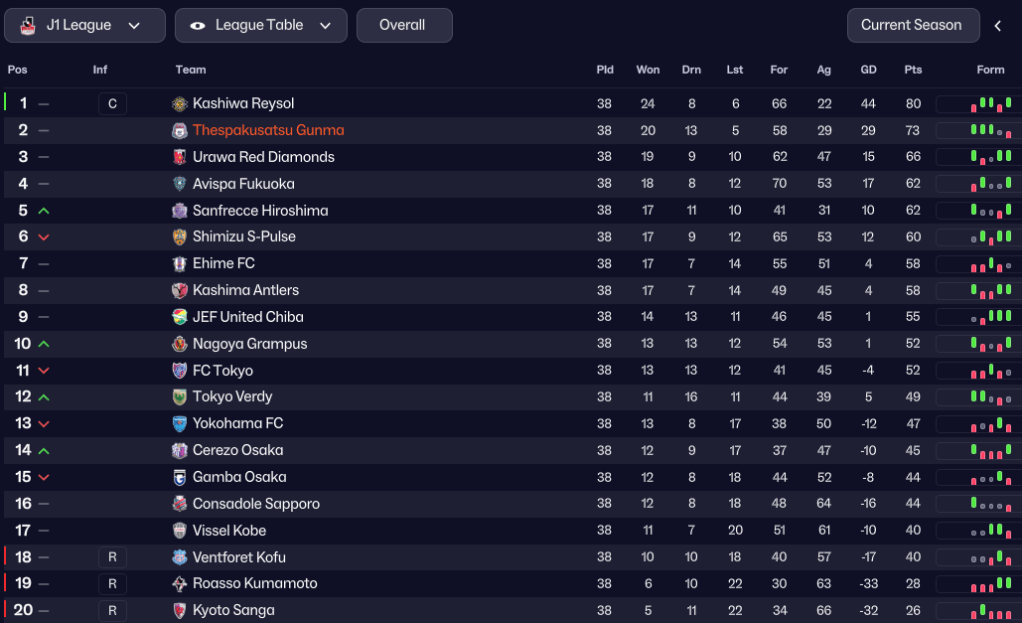
Gunma finished the season well, including 18-year-old midfielder Riku Hasegawa scoring 20 minutes into his senior debut to inspire a 2-0 win at Nagoya. That wrapped up a third 2nd-place finish in the last eight seasons, finishing on 73 points, which would have won the league in five of the previous seasons in the save, after 20 wins, 13 draws and a league-low 5 defeats. They only scored 58 goals but conceded 29, only bettered by Kashiwa’s ludicrous 22. Shimizu was the 9th-best player in the league with a 7.22 rating and the 8th-top scorer with 15, followed by Okamoto with 13, and had the most shots on target (53). While wingbacks Mito and Yoshiki Tanaka provided the 5th-most assists with 9 apiece.
A Much Stronger League Campaign
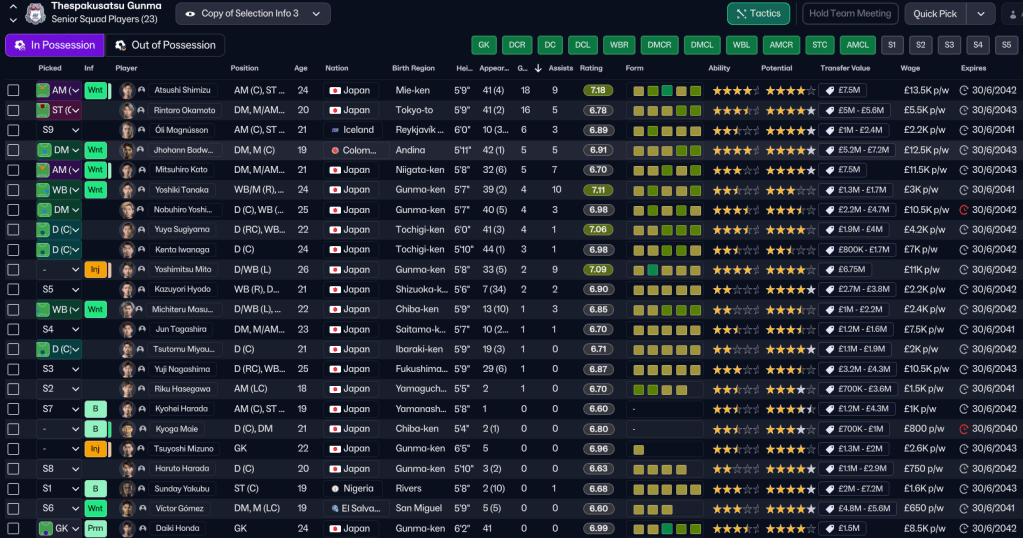
Rasamu was pleased that his young Gunma side again managed to recover and push for the J1 League title. There was no doubt where their issues were, and that was scoring goals. Shimizu was undoubtedly the star man this season, scoring 18 with 9 assists, along with the improving Okamoto (16 goals and 5 assists). Icelandic attacker Óli Magnússon chipped in with 6 goals and Tanaka led the way with 10 assists, but it was clear they needed a little more firepower.
Rasamu’s attribute ID system revealed the best player Gunma had ever had was Colombian midfielder Badwan, who’d developed to 414. He’s closely followed by Kato (407), goalkeeper Daiki Honda (402), Shimizu (400), Mito (397), Yoshida (395) and backup keeper Tsuyoshi Mizuno (394). Click the chart below to see how the players fared this season.
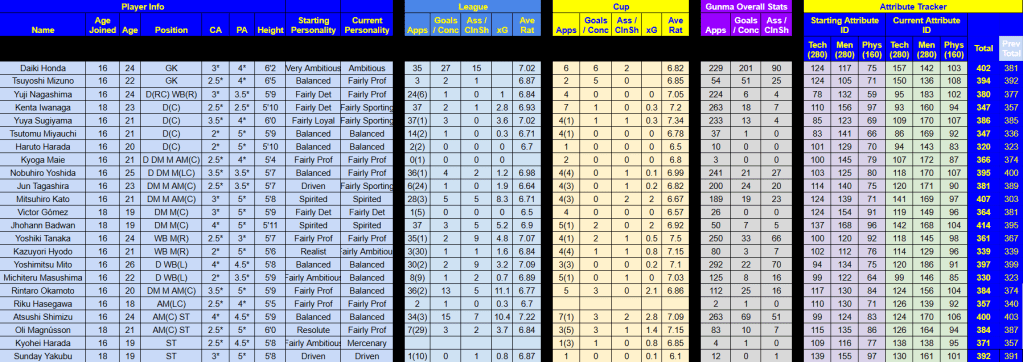
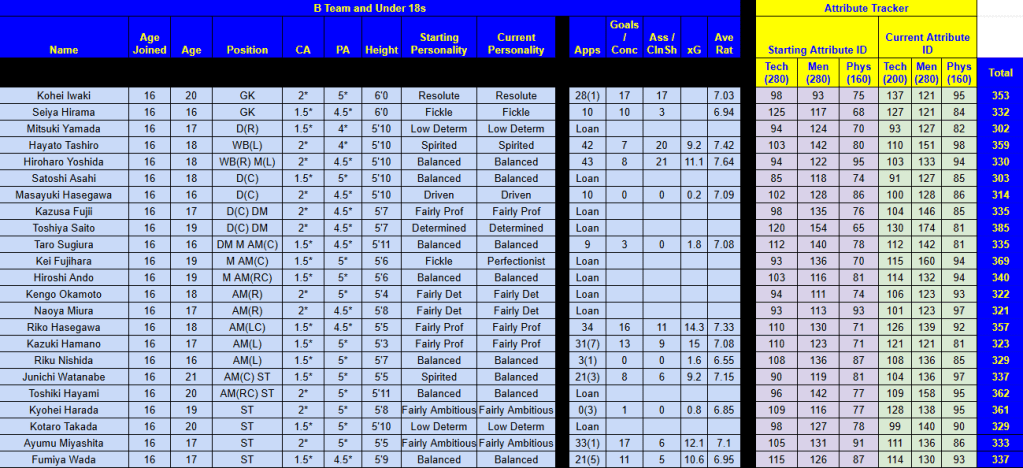
There were also some solid performances in the youth sides, including wingbacks Hiroharo Yoshida and Hayato Toshira combining for 15 goals and 41 assists, the aforementioned Hasegawa scoring 16 with 11 assists and striker Ayumu Miyashita scoring 17 goals. Click the chart below to see the youngsters’ development:
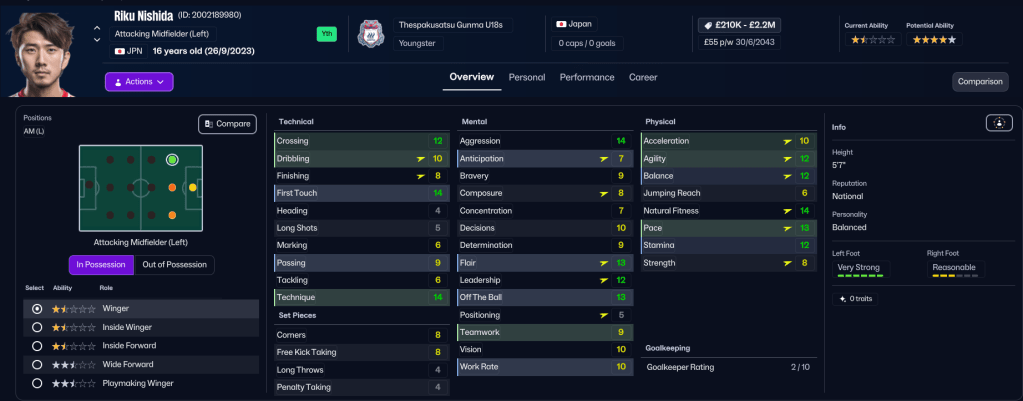
Gunma had another good youth intake that didn’t quite hit the heights of recent seasons. It delivered four supposed elite prospects, led by attacker Riku Nishida plus midfielder Taro Sugiura, centre back Masayuki Hasegawa and goalkeeper Seiya Hirama. It also included a first foreign recruit in Uruguayan left back Pablo Ledesma but, unfortunately, he was terrible.
Rasamu was fairly pleased with his 14th season at Gunma, but they failed in both cups while falling away to a dominant Kashiwa side in the league. The pressure would be back on next season as they returned to the AFC Champions League in addition to having another go in the league.
Could Gunma push for their second league title? Join us next Friday to find out!


 Football Manager Addict
Leave a comment