
The English football system has been stuck to its traditional pyramid system since the Second Division was created way back in 1892. However, in the summer of 2025, a cash-strapped English Football League went bankrupt and was bought out by an American investor.
The Americans ripped up the existing approach, instead opting to put all 92 EFL sides into one giant system. The new-look English Premier League database, created by CTxCB, is formed of four regional divisions of 23 teams: North West (which oddly includes Newcastle), North East, South West and South East. Clubs play the other teams from their divisions once (so a total of 22 games), and the top six from each division proceed to the Championship Group, 7th to 18th go into a Classification Group, from which the top 3 progress to the Champions Playoffs, and the bottom 5 go into a Relegation Group. They then play each team from the group once, before the leading clubs go into a Champions Playoff. Relegated sides drop into an equally giant looking National League, which I didn’t make playable for this save but is probably worth doing.
However, I decided to tweak the database to try and make it more equal (before I realised the league already has boosted finances). I used the Editor to give all clubs £200m in the bank, 18 reputation and a £200m individual TV deal that should renew every season, as well as removing existing other incomes, debts and instalment agreements. That should, in theory, put clubs on a more level playing field, bar the bigger clubs obviously having better squads.
EPL Goes American Season 1
Group Stages
The first season saw Liverpool dominate the North West group, losing 1, drawing 1 and only conceding 10 times, ahead of Man City, Newcastle, Man United, Burnley and Leeds. Barrow finished bottom.
The North East group is by far the weakest and was won by Nottingham Forest, who also only lost 1 game, ahead of Leicester, Sunderland, Stoke and Sheffield United. Northampton finished bottom, behind Crewe (definitely not NE), Notts County and Grimsby.
The South West group was won by Aston Villa by 2 points from Bournemouth (who won once in the last 5 to blow the lead), Coventry, Bristol City and Swansea. Swindon finished bottom, behind Shrewsbury, Cheltenham, Walsall and Newport.
The South East group is arguably the most competitive, in terms of having the fewest bad teams. Arsenal just about won it by 4 points from Spurs, ahead of Brighton, Chelsea, Fulham and Crystal Palace. Cambridge were last, behind Portsmouth, Leyton Orient, Stevenage, Bromley and Gillingham.
Relegation
In the Relegation Group, Barrow again finished bottom of the North to go down with Harrogate, Oldham and Shrewsbury, while Crawley finished bottom in the South and went down with Barnet, Northampton and Colchester.
Championship Playoffs
Liverpool also topped the Championship Group in the north, ahead of Man City, Man United, Newcastle, Leicester and Forest, who joined them in the Playoffs. In the South, Arseanl were top and headed into the Playoffs with Villa, Spurs, Brighton, Chelsea and Fulham. They were joined in the Playoffs by Classification Group qualifiers Wolves, Oxford, Blackburn, Everton, West Brom and Preston in the North and Watford, QPR, Birmingham, Brentford, Ipswich and West Ham in the South.
Now the six-round knockouts began. The first round saw a huge surprise as Man City lost 2-1 at home to Middlesbrough. Preston pushed Man U close in a 2-1 defeat, Coventry only lost 1-0 to Spurs, Newcastle won a local derby 2-1 against Sunderland and Fulham only beat Watford on penalties. A couple of big clashes in the second round saw Arsenal beat Man U 2-1 and Liverpool win 2-1 at Chelsea, while West Brom sprung the big surprise by beating Forest 1-0. In the quarters, Leicester upset Brentford on penalties, Arsenal won a North London derby 2-1 at Spurs, Liverpool snuck a 1-0 win over West Brom, and Newcastle won 3-0 at West Ham.
In the semis, a huge game between Arsenal and Liverpool finished 1-1 and the Londoners won on penalties, while Newcastle eased past Leicester 2-0. And the maiden winner of the new-look Premier League was Newcastle, who won on penalties after drawing 2-2 with Chelsea. It’s worth noting that teams also still play in the Champions League, and Arsenal made it to the Final and beat Bayern.
5 Seasons of American EPL
Fast forward to the end of season five, in May 2030, and, at first look, not too much has changed. That said, Villa won the main league in 2027 before City won the Playoffs, then Arsenal won both the league and the Playoffs and City won the league before Brighton were the surprise 2029 Playoff champions. And the likes of Exeter, Crewe, Fleetwood and Gillingham are currently in the National League. However, according to the reputation ranking, Lincoln is the most reputable club in the league, ahead of Mansfield and Luton. And the wild money on offer (see below) hasn’t helped teams in Europe as Real Madrid won the last four Champions Leagues.
Unsurprisingly, there have been plenty of managerial changes, the most intriguing of which include Gareth Southgate at Blackpool, Andoni Iraola at Port Vale, Ruud van Nistelrooij at Stevenage, Michael Carrick at Preston, Roberto De Zerbi at Bristol City, Oliver Glasner at Arsenal, Patrick Vieira at Plymouth, Sean Dyche at Derby and Ralph Hassenhutl at Coventry.
Transfers and finances have gone pretty crazy, with a massive number of deals over £30m this season alone. The biggest two this season are both at West Ham, who paid £105m for Reda Belahyane and £99m for Dusan Vlahovic. Brentford signed Harry Gray for £87m from Luton, Sheffield Wednesday signed Jamie Gittens from Barcelona for £85m and Liverpool signed Aurelien Tchouameni for £74m from West Ham.
The biggest incoming signings of the save so far are Aleksandar Pavlovic from Bayern to Brighton for £172m in July 2027, Jamal Musiala to Villa from Bayern for £151m in June 2028, Francesco Camara from Sunderland to Oxford (yep, Oxford!) for £132m, Sandro Tonali to Wolves for £131m, Alex Scott to Everton for £113m and Dejan Kulusevski to Brentford for £122m in June 2026. While Erling Haaland got out of the EPL by signing for Real Madrid for £193m in July 2027.
Group Stages
In the current season, Man City won the NW Group, ahead of Newcastle, Everton, Liverpool, Man U and, interestingly, Stockport, with Oldham and Harrogate at the bottom. NE was more interesting as Norwich won it ahead of Chesterfield, Sunderland, Stoke, Forest and Leicester, with York and Northampton at the bottom. Villa are still winning the SW, ahead of MK Dons, Bournemouth, Reading, Coventry and Port Vale, who’ve done really well, with Cheltenham bottom behind Forest Green and Shrewsbury. And Arsenal are top of SE, ahead of West Ham, Chelsea, Brentford, Spurs and Millwall, with Fulham, Palace and Brighton firmly in mid-table and Colchester bottom behind Crawley and Cambridge.
Relegation
Shrewsbury, York, Oldham and Harrogate were relegated from the North, with Colchester, Northampton, Crawley and Cambridge going down from the South. While Barnsley are one of the biggest dropoffs, only just avoiding relegation.
Championship Playoffs
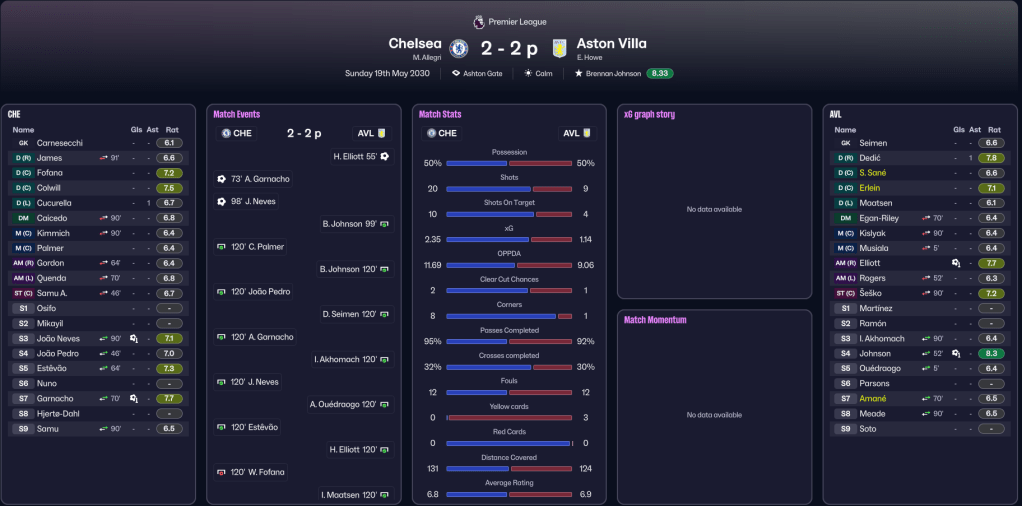
There weren’t too many surprises in the Playoffs first round, although Liverpool only beat Coventry on penalties, then Leicester knocked out Spurs 2-0 and Man U beat Liverpool 1-0 in the second round. In the quarters, Chelsea, Villa and Arsenal beat Newcastle, Palace and Leicester 2-0 and Man City beat rivals Man U on penalties. In the semis, Chelsea beat Man City 2-1 and Villa saw off Arsenal 1-0, before Villa lifted the crown by beating Chelsea on penalties after a 2-2 draw.
At the end of the 5th season, I decided to throw my name into the hat for vacant roles to see what they were offering. Stoke came in with £75k a week, £59m transfer budget and a £3.4m wage budget, Sunderland offered £73k a week with £99m transfer budget and £3.7m wage budget, Oxford, who’d just sacked Enzo Maresca, made an offer of £75k a week, £73m transfer budget and £2.8m wage budget, and Accrington Stanley (who have a player worth £122m) offered £26k a week, £24m transfer budget and £4.3m wage budget.
I decided to take the Accrington job to see how wild their squad has become and gain a little more insight into the league. And I’d say Ibrahim Maza and Conrad Harder on over £300k a week and 7 more players on over £200k a week is pretty crazy. Furthermore, the club has a cool £617m in the bank and sponsorships of £166m per season in addition to the £200m TV deal. Accrington also has the 11th highest salary spend in the EPL, with Arsenal leading the way at £306m per year. While the biggest spending clubs this season were Charlton on £194m, Burton on £188m, Reading on £178m, Walsall on £174m and Rotherham on £173m.
30 Years in the Future
I holidayed ahead to 2055, 30 years into the future, to see how drastically the English league had changed. And, looking at the groups, the likes of Fylde, Barrow, York City, Chesterfield, Newport County and Bromley have been the big overachievers, more than mixing it with and finishing above the so-called big clubs.
Group Stages
Man City just missed out on the playoffs in the North West, finishing 8th with Man United in 16th and Liverpool in 18th, only avoiding the relegation playoffs by 4 points. In their place, Bradford topped the group, ahead of Leeds, Everton, Wrexham, Tranmere and Preston, with Harrogate and Oldham propping it up.
Derby won the North East group ahead of Stoke, Chesterfield, Doncaster, Forest and Sheff U, with Grimsby and Buxton at the bottom.
Oxford won the South West group, ahead of Cardiff, West Brom, Newport, Luton and Villa, with Exeter and Plymouth the two strugglers.
And in the South East, Chelsea won the group, ahead of Watford, QPR, West Ham, Charlton, Millwall, Bromley and Ipswich, who went into the playoffs. Arsenal finished 11th, Spurs were 18th and Brighton were 19th, missing out on the relegation playoffs by 1 point, and Colchester, Aldershot and Boreham Wood propped the group up.
Relegation
In terms of the strugglers, it seems not too much has changed. Grimsby, Oldham, Buxton and Harrogate were all relegated from the North, and were joined by Colchester, Aldershot, Exeter and Boreham Wood in the South.
Championship Playoffs
The Championship playoff round looks very different, with none of Man United, Liverpool, Arsenal, Spurs or Newcastle to be seen. Man City lost 3-2 to West Ham, Stevenage beat Southampton on penalties and Chesterfield defeated Doncaster 3-1. Chesterfield continued their run, beating QPR 4-1, Chelsea snuck past Stevenage on penalties and Everton beat Bournemouth 3-0. In the quarters, Ipswich beat Stoke 3-1, Watford beat Chelsea on penalties, Chesterfield beat Leeds 1-0 and Everton beat West Ham 2-1.
That left the semis looking extremely different. Ipswich and Everton drew 1-1, with Ipswich winning on penalties, while Watford beat Chesterfield 2-1. Everton then sealed third place by beating Chesterfield 2-1 after extra time. And in the big one, Ipswich, despite having players sent off on 69 and 89 minutes, became champions of England by beating Watford 2-0 with two first-half goals.
League History
Annoyingly, I was unable to scroll through previous seasons, even when I got the vacant York City job to try and explore the league further (I presume that’s a bug to do with holidaying).
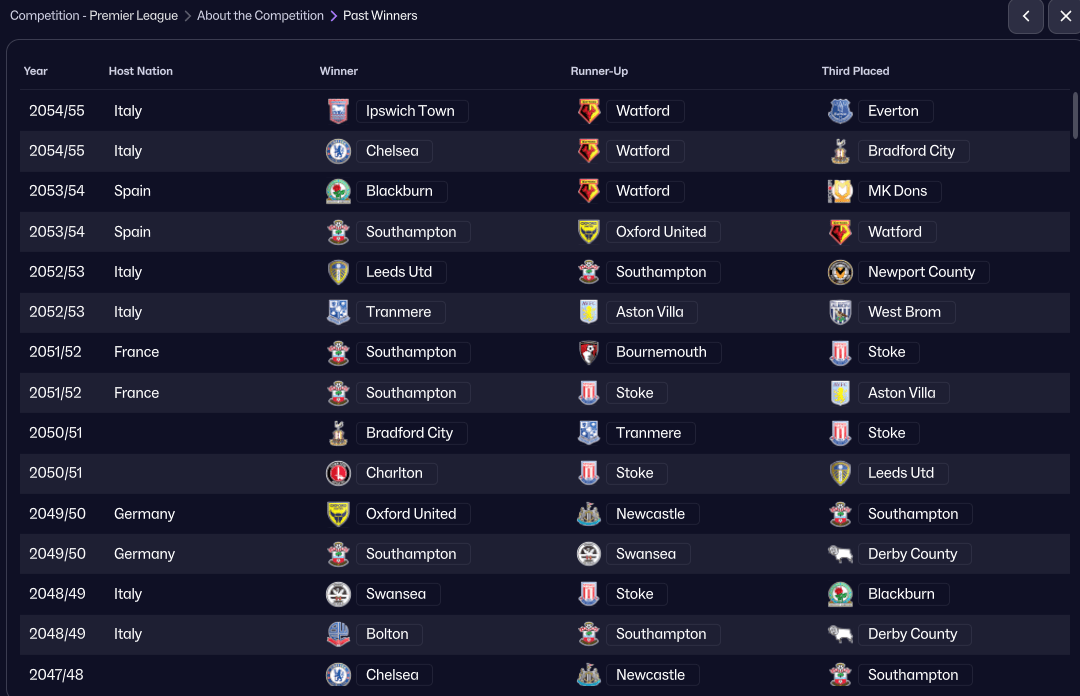
However, it looks like the English league changed very quickly, as the season after the long sim began, Villa again won the league phase before Derby won the playoffs. Bristol City claimed their first title in 2034, Derby won another in 2035, Ipswich won their first in 2036 and the first huge shock saw AFC Fylde become champions of England in 2038.
Arsenal hung around with a few titles up until 2044, but from there, unfancied challengers took control. Bradford won a title in 2045, followed by Bolton and Swansea in 2049, Charlton and Bradford in 2051, and Tranmere winning their first title in 2053. While a shoutout for Watford, who’ve been runners up three times in the last two seasons.
Southampton are the biggest spenders in the Premier League with a £274m annual wage bill, followed by Doncaster (£228m), Salford (£219m), Oxford (£206m), Derby (£205m) and Swansea (£199m). Compare that to lowest spenders Colchester £39m) and Aldershot (£42m), and there’s a huge gulf across the 92-team league. While Southampton, now managed by Kyle Walker, are the bookies’ favourites, have won 7 titles in the last 20 years, and have 7 players earning more than £300k a week, including a superstar defender on £500k a week.
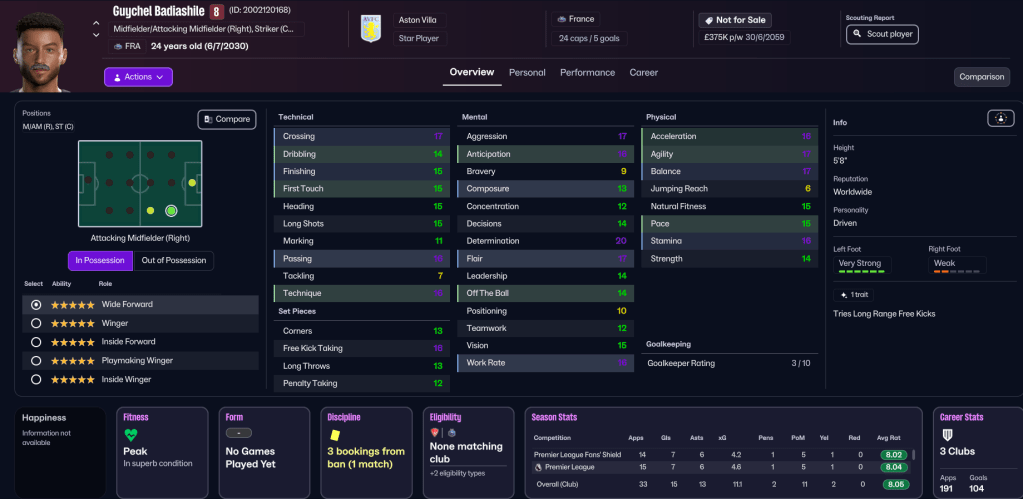
Finally, transfers have gone absolutely wild in the last 30 years. In the season just gone, Villa paid £309m for Milan winger Guychel Badiashile, who is absolutely world class. The nearest to that was Charlton paying £128m for Sporting striker Lassane Silva. In previous seasons, Villa paid Cardiff £219m for striker Antonio Junqueira in January 2053, Derby paid West Brom £245m for striker Jacobo in January 2051, Stoke paid Fylde £197m for striker Kortney Esse in January 2048, and there’s an absolute mass of players going for between £60m and £100m every season.
What do you make of this random database switching to the American league style? We’ll be back with more random experiments throughout the FM26 lifecycle!


 Football Manager Addict
Leave a comment