

This blog is the 1,000th article published on Football Manager Addict since we started the website back in 2018. From humble beginnings in our very first blog series, Atalanta Avventura, which began with this post in December 2018, we’ve been on all manner of adventures all over the world of Football Manager, from ridiculous challenges and one-club saves to silly experiments and FM guides. We passed 400,000 all-time views earlier this week and we’ve racked up 230,000 visitors in that time, so thanks for the support and here’s to much more FM blogging! And we’ll celebrate 1,000 blogs with a classic FM Addict post led by a potential Japanese superstar and a mass of youngsters being thrown into the first team.
After enjoying several seasons of success, Thespakusatsu Gunma and Robaato Rasamu came down to earth with a thump as they got drawn into a J1 League relegation battle in 2034. But, 12 months on from a title challenge, they finished the season well to maintain their top-flight status.
Rasamu decided to shake things up in the summer, selling Tomoyuki Koyama, who’d been his first choice keeper every season, had played 331 games for the club but was really poor and trained horribly last campaign, to Sharjah for £600k. He also moved on backup foreign players Massamba Sagna, Amara Kouakou and Badra Kodjo, who didn’t play a game after joining for £15k in February, to Génération Foot for £550k, Hiroshima for £400k and Ivorian side San Pedro for £675k. While ineffective midfielder Juan Garrido, who scored 0 goals and 2 assists in 54 games and had a poor personality, went to Gifu for £500k and backup full back Keita Hatano, who couldn’t tackle, joined Gamba for £1.2m, while troublemaking right back Tenshiro Myogan was among six players to leave at the end of their contracts.
As a result, Gunma had £23.3m in the bank, £18m in the transfer kitty and was only spending £59k of the £98k wage budget. But Rasamu resisted the urge to spend the money he’d accrued, largely as his recruiting focuses hadn’t delivered anything worthwhile. Instead, he promoted wingback Yoshiki Tanaka, who impressed in the youth team last season, striker Yuto Korimoto, midfielder Nobuhiro Yoshida, full back Michiteru Masushima and goalkeeper Shoi Yamamoto.
Rasamu decided to stick with a 3-5-2 approach that delivered some improvement at the end of last season. 19-year-old Daiki Honda takes over in goal and Endrit Jusufi continues to retrain at centre back. Takaya Kawashima comes into midfield with Yoshimitsu Mito taking his place at left wingback and Tanaka on the right. Mamadou Diallo has become a key player at the heart of the midfield, and Peter Tweh continues in behind the homegrown front two of record scorer Masaya Nishi and Yusuke Ishii, who’s fresh from breaking his record for most goals in a season with 29. However, Rasamu later experimented with dropping Nishi deeper alongside Tweh.
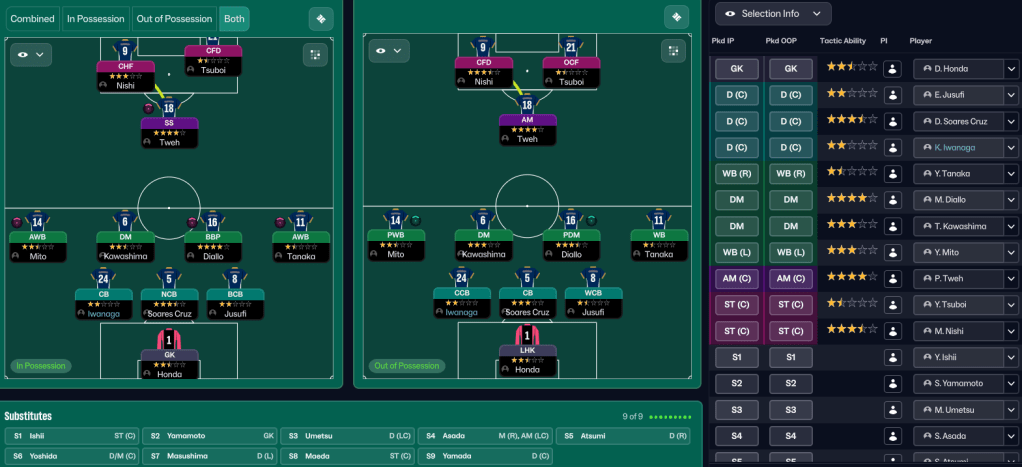
Ishii Fires Gunma Back Into J1 League Form
The bookies didn’t rate Gunma’s chances again, predicting them to finish 14th with 300/1 title odds. Gamba are 2/1 favourites, along with FC Tokyo (4/1), Kashima Antlers and holders Kashiwa Reysol (13/2), Kawasaki Frontale (11/1) and Sanfrecce Hiroshima (12/1).
Gunma began the season with a dominant display as Diallo, Nishi and Asada downed promoted Kofu 3-1, which they backed up with Ishii hitting four in a 5-1 domination of Ehime and Mito and Tweh earning a comeback 2-1 win at home to Hiroshima. However, the good start was disrupted by five players, including Honda and Ishii, being called up to the Olympics for a month. That saw a bit of an up-and-down spell, which left Gunma in a much more solid mid-table position than last season after 10 games.
Ishii returned to score another four-goal haul in a 6-1 hammering of Fukuoka. And Gunma went into a winter break sitting in 6th place on 36 points, only 11 fewer than they managed all of last season.

Moving into 2035, Rasamu allowed defender Masahiro Umetsu, who barely got a game this season, to join Kashima Antlers for £1.5m. And he used that money to sign winger Yujiro Urakami, who’d retrain to play centrally, from Cerezo for a club-record £900k rising to £1.4m.
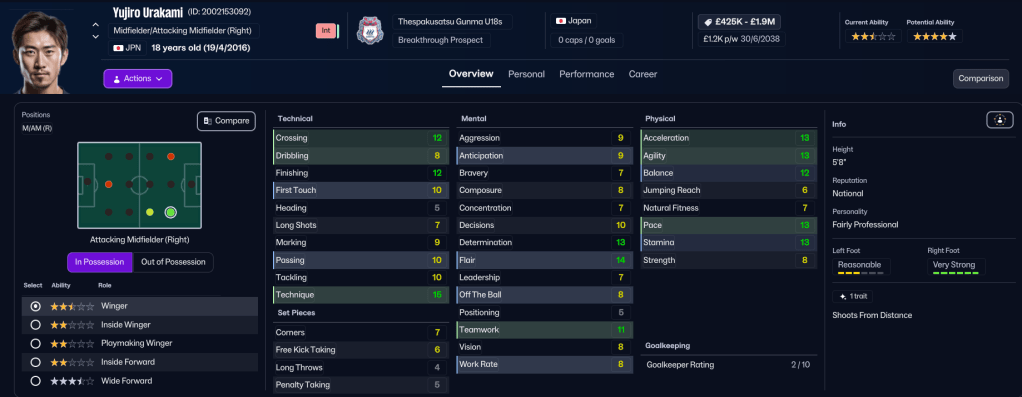
Gunma began 2035 in pretty iffy form as a flurry of injuries led to a seven-game winless streak, before Ishii and Urakami’s first goal earned their first win of the year in late March. That sent them onto a six-game unbeaten run and into the top eight. And, despite losing three of the last four, Gunma held on to finish in 8th on 56 points (9 more than last season) after 15 wins, 11 draws and 12 defeats, scoring 61 (11 more) and conceding 51. However, Ishii was the top scorer in J1 with a new club-record 22 goals and the second-best player with a 7.37 rating. While Tweh’s 11 assists was the 5th best in the league and Honda made the 4th-most saves (141).
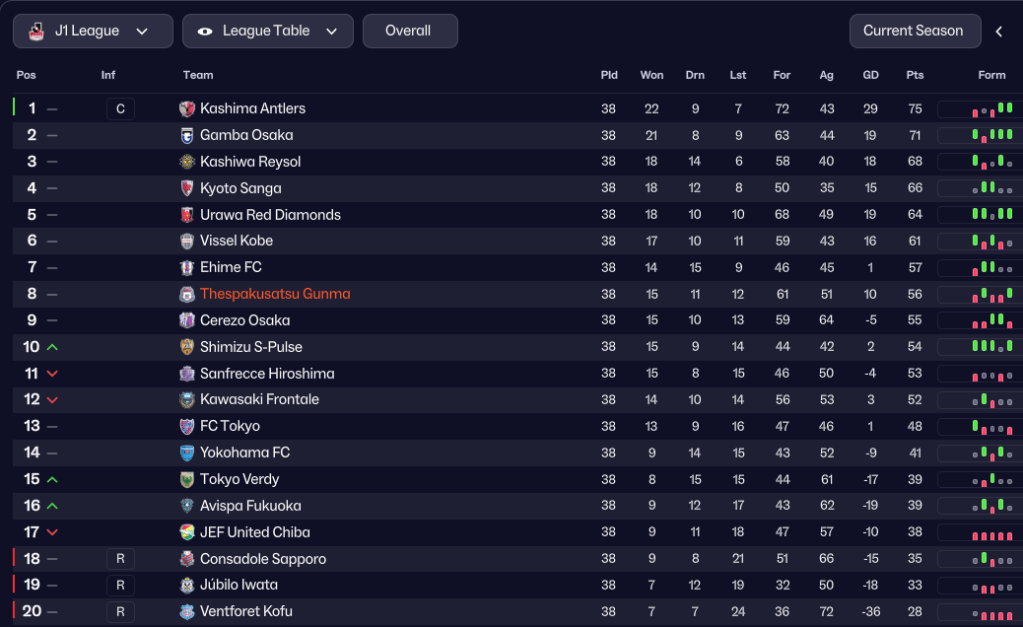
A Season of Improvement
Rasamu was pleased that his decision to stick with youth had paid off as Gunma enjoyed a much better season. Ishii was again the main man with 23 goals and 8 assists in 33 games. Shota Asada and Tweh scored 8 apiece, followed by Nishi (7), Diallo (5) and Mito (4), while Tweh led the assists with 11, followed by the impressive wingback pairing of Tanaka (10) and Mito (9).
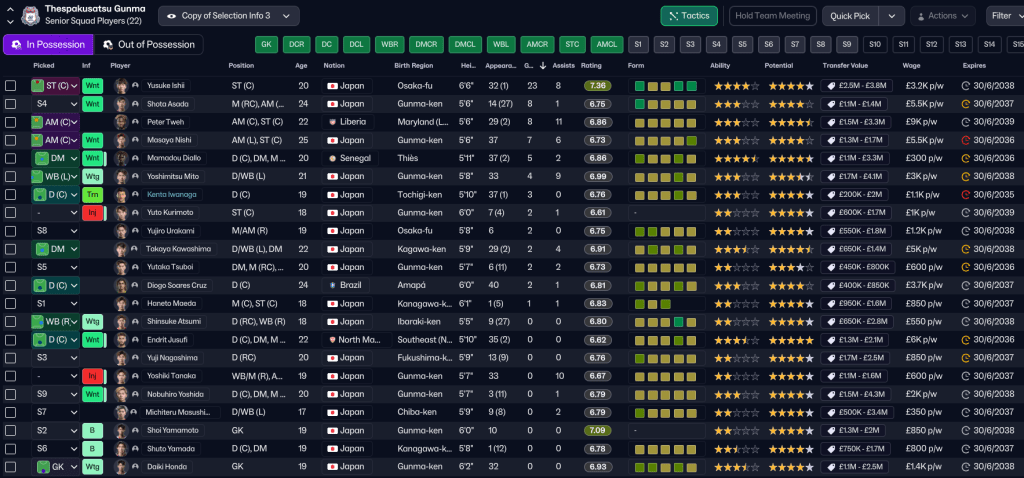
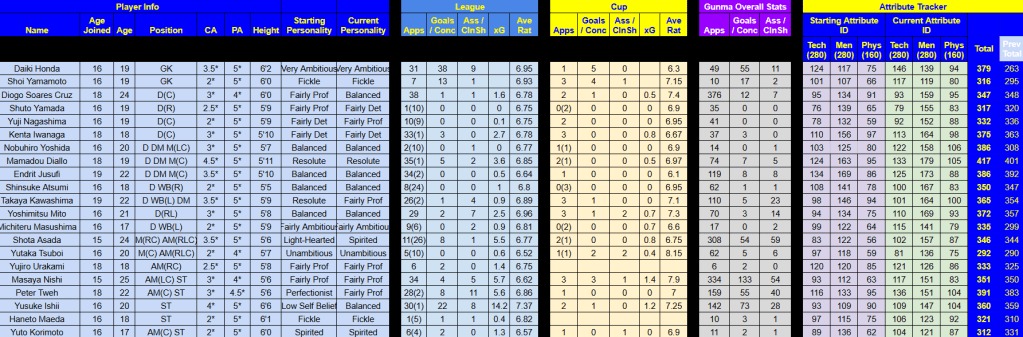
Below is an overview of the players’ progression this season, with Diallo remaining the best player at the club, according to Rasamu’s attribute ID system. While the likes of Honda, who’d gone from 1.5-star to 4-star ability in 12 months, and left back Mito had made really impressive progress. Click the table below to explore further.
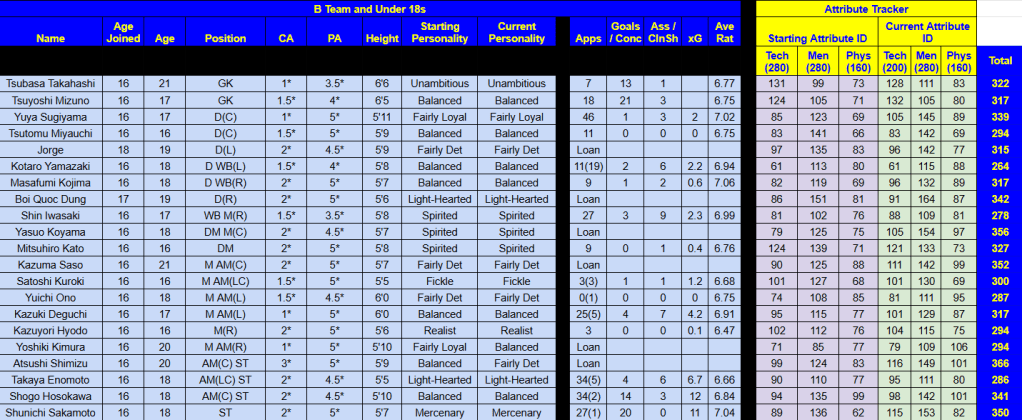
Some of the youth players had made pleasing progress, led by striker Shunichi Sakamoto who, despite the worry of a ‘Mercenary’ personality, had scored 20 in 28 and was due a first-team promotion. While the likes of Shogo Hosokawa and Yuya Sugiyama were close to joining him in the first team.
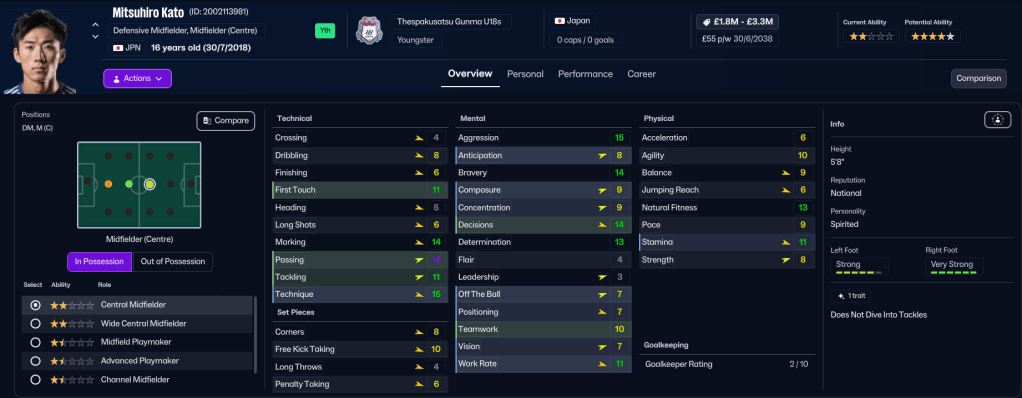
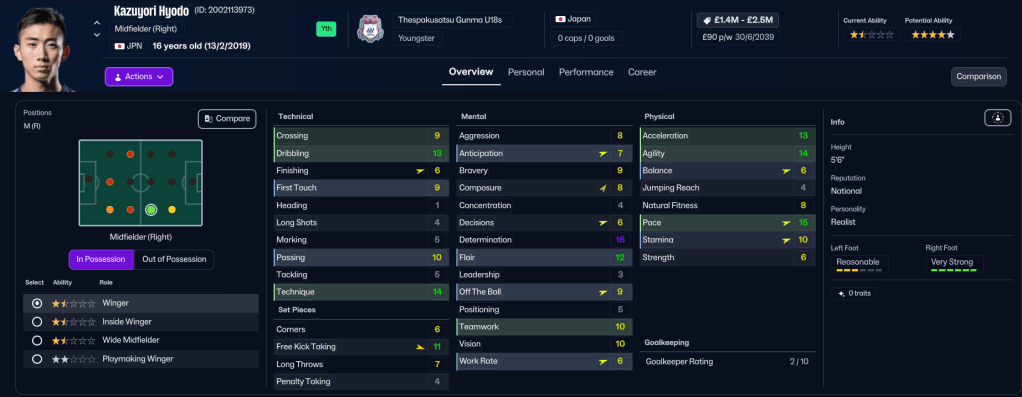
A big step in Gunma’s growth saw Ishii win his first international call-up in March, and he became the club’s first player to represent Japan when he started a 3-1 friendly win against Hong Kong on 2 April. However, very predictably, he got too big for his boots and announced he wanted to move to a bigger club at the end of the season. Gunma also had their first player named on NxGn as Diallo was number 14 on the 2035 list. And their potential was boosted by another strong youth intake with four elite prospects, led by midfielder Mitsuhiro Kato and winger Kazuyori Hyodo, along with winger Satoshi Kuroki and centre back Tsutomi Miyauchi.
Gunma had made good progress this season, jumping back into the top half of J1 League. The big challenge now was for the club to go to the next level and begin competing with Japan’s best clubs again. Join us next Friday to find out if they can next season!


 Football Manager Addict
Leave a comment