
Thespakusatsu Gunma recorded a fifth successive record high finish under the tutelage of Robaato Rasamu, who led the club into the Asian Champions League for the first time by finishing 2nd in J1 League in 2033. However, Rasamu was a little concerned about how well his youthful homegrown team would cope with domestic and continental matters.
A 12-month profit of £8.6m saw Gunma’s bank balance jump to £17.7m. That was boosted by selling backup striker Antony Mariani to Hiroshima, who, for some reason, paid £1.5m, and eight players were released at the end of their contracts. The squad now has 20 players with at least 4.5-star potential and 16 with 5-star potential, and every single player at the club counts as homegrown, having arrived at Gunma at 19 or younger.
So Rasamu didn’t see too much need for new recruits. Instead, he promoted Senegalese midfielder Massamba Sagna, who joined from Coton Sports in January and was retraining to play centre back, along with fellow Senegalese midfielder Mamadou Diallo, plus goalkeeper Daiki Honda and wingbacks Yoshimitsu Mito and Shinsuke Atsumi, who are the three highest-potential players at the club.
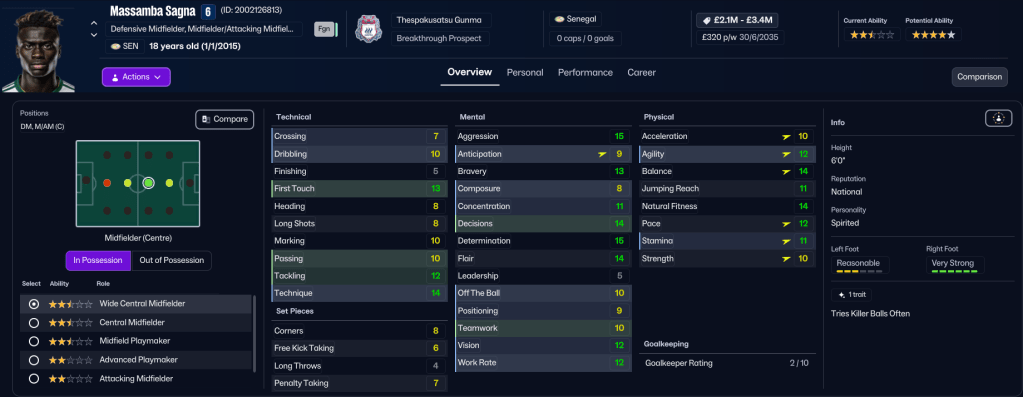
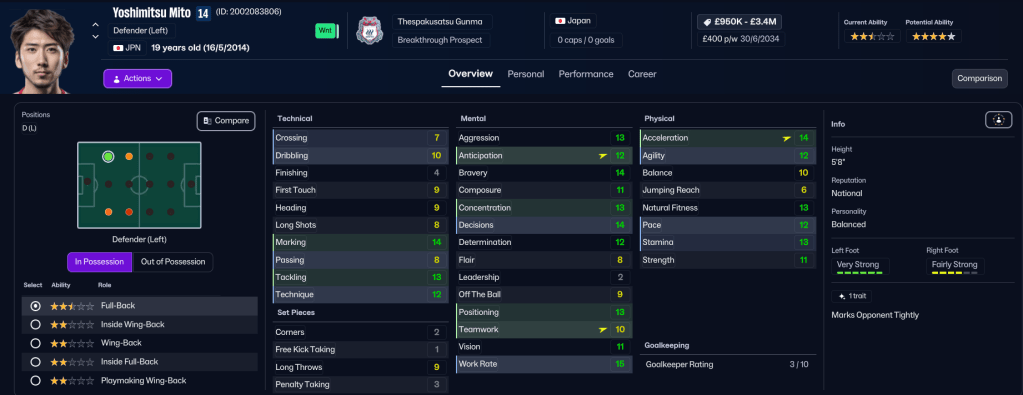
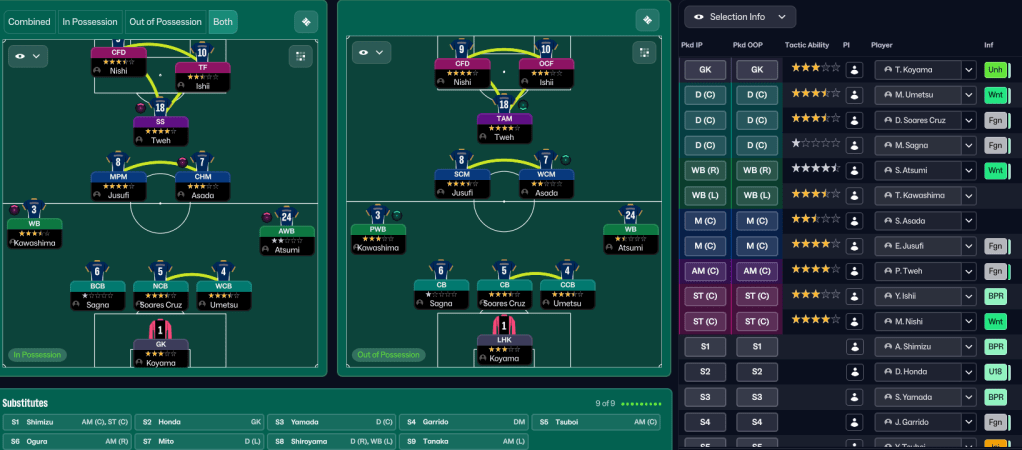
Rasamu saw no need to change from the 3-5-2 that worked last season. Sagna comes in to learn playing at centre back, while the likes of Mito and Atsumi should get plenty of gametime this season.
Tough Start to Third J1 League Campaign
The Japanese bookies still don’t fancy Gunma’s chances, predicting them to finish 15th with title odds of 300/1. Kashima Antlers, Sanfrecce Hiroshima and FC Tokyo are joint 7/2 favourites, along with Kawasaki Frontale, Kashiwa Reysol (10/1) and Gamba Osaka (12/1). Holders Kyoto Sanga are predicted to finish 10th at 50/1 while newly promoted Machida Zelvia are predicted 7th at 25/1.
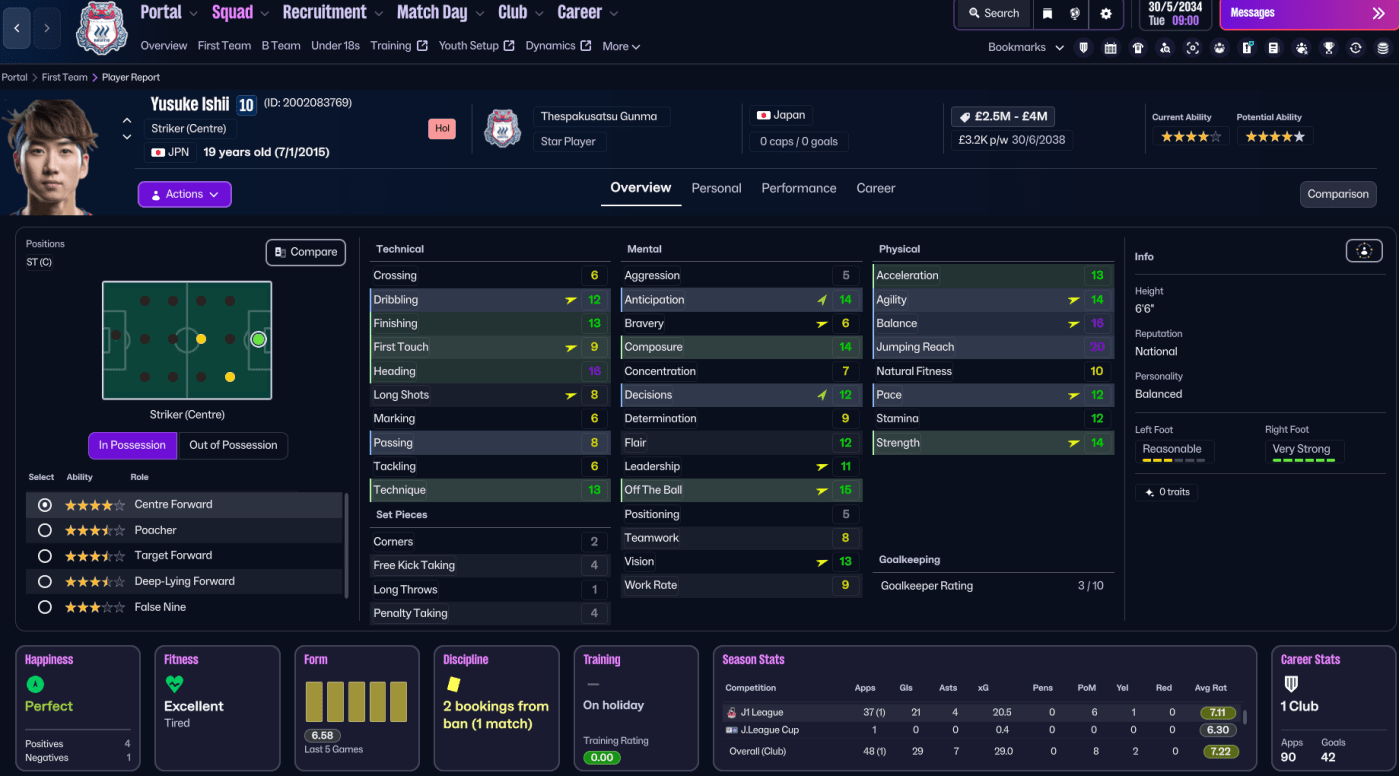
Gunma began the season with a tricky day out at Hiroshima, who won 4-2 despite a late double by 6ft 6in academy product striker Yusuke Ishii. It didn’t get much easier at home to Kawasaki, and they lost 3-2 before losing 3-0 at home to Gamba and 2-0 at Kobe, leaving them with four defeats from four. Tweh’s equaliser rescued a point at home to Vegalta Sendai, but they lost again 2-0 at Consadole Sapporo.
That forced Rasamu to abandon his 3-5-2 and switch to a 4-2-3-1, which worked well as Ishii scored twice in a 3-1 home victory over FC Tokyo. The form improved enough to escape the relegation zone after 12 games, only to drop back into it before Ishii and Shota Asada braces led a 5-1 win over JEF United to escape it again. However, Gunma went into the mid-season break in 16th on 20 points, just 6 above the dropzone but only 9 off the top six.
Thespa Gunma in the Champions League!
Gunma stepping up to the Champions League for the first time sounded like the stuff of fantasy, considering they finished 4th in J3 League just six years ago. The Asian Champions League has a similar format to the new European one, but it’s split into two groups of 12 teams, East and West. Gunma are one of four Japanese sides in the East group, in which they play eight games against all the non-Japanese clubs.
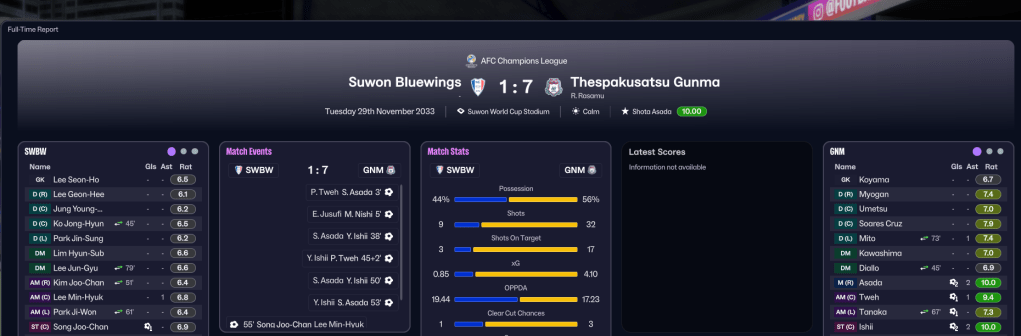
Gunma’s first taste of continental football was a tough trip to FC Seoul, but they bucked the poor league start with striker Masaya Nishi’s early strike and an Ishii double securing a 3-1 victory. The same result followed at home to Shanghai Shenhua thanks to goals by Tweh, Ishii and Asada. A tired team got dominated 4-1 at Western Sydney Wanderers, but young attacker Yutaka Tsuboi and Nishi earned a 2-0 win over Buriram United before an Ishii double led a 3-2 win at home to Jeonbuk. And they secured qualification with a superb performance to win 7-1 at Suwon Bluewings, led by Asada and Ishii braces. Tweh scored twice to down Perth Glory 4-2 in the new year, before signing off with a fully rotated team losing at Gresik in Indonesia to qualify in 4th place.
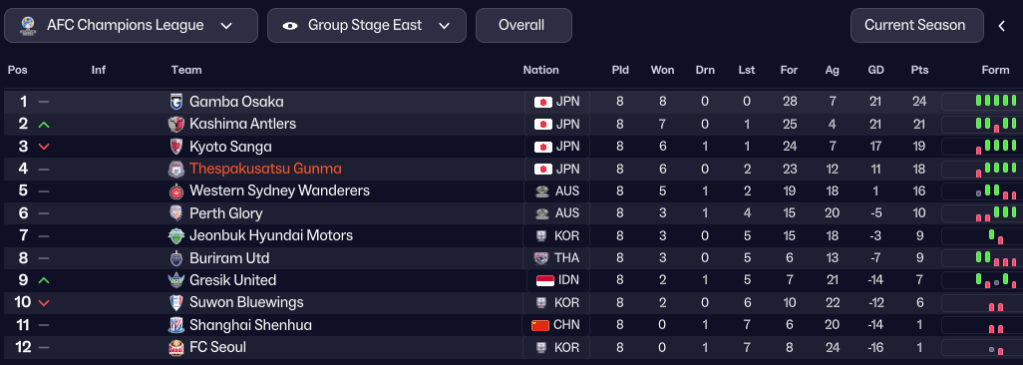
That sent Gunma into the round of 16, where they faced Western Sydney Wanderers. They conceded late to lose 3-2 in Australia, but rare goals by Diallo and fellow midfielder Jusufi earned a 2-0 home win. That teed up a quarter-final against Saudi side and 2032 winners Al-Ahli, who Rasamu didn’t realise they could play at this stage in the tournament and was oddly a one-off game at a neutral venue in Taiwan. And, considering the Saudis have 11 players earning more than Gunma’s entire wage bill, the run unsurprisingly ended with a hard-fought 3-2 defeat in which Mito laid on goals for Atsumi and Peter Tweh. Al-Hilal went on to reach the final, where they lost 2-0 to Gamba Osaka.
In the Thick of a Relegation Battle
Gunma began 2034 with a dire 3-0 defeat at Gamba, then lost 1-0 at home to leaders Kobe, before a first win in six as Ishii’s hat trick secured a 3-0 victory over Sapporo. The Champions League activity meant Gunma had up to four games in hand on the teams around them, but failed to win any. That prompted Rasamu to revert to a three-man defence system and drop long-term goalkeeper Tomoyuki Koyama, which worked as Ishii led a 2-0 win at home to Hiroshima before he scored again in a 2-1 victory at JEF United, lifting Gunma 8 points clear of danger with 7 games remaining.
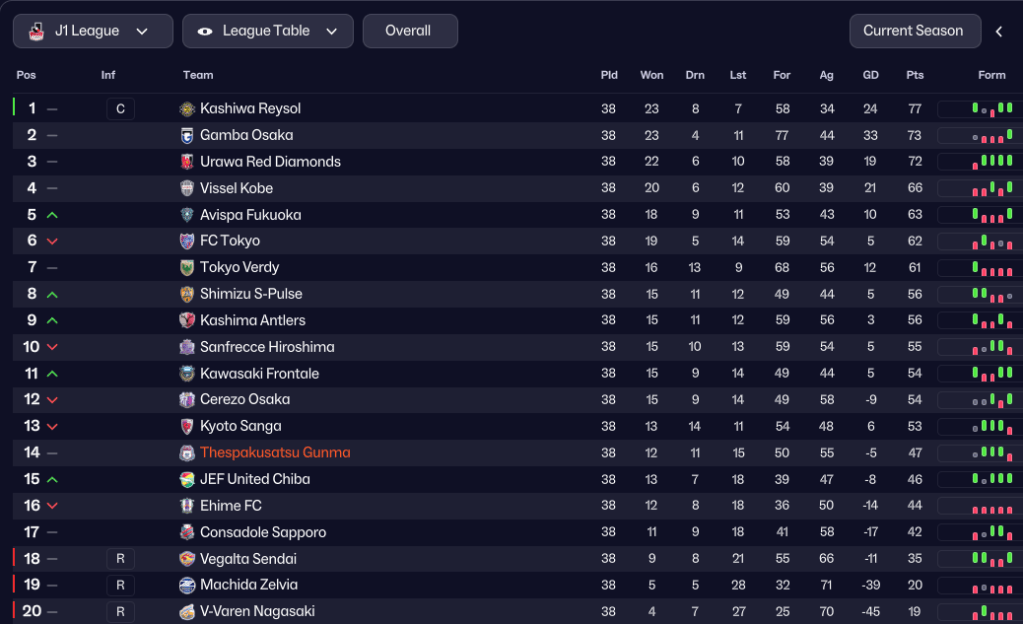
Gunma lost the next two, but young striker Haneto Maeda’s first senior goal secured a 2-1 win at relegated Nagasaki and confirmed survival with three games remaining. They somehow managed to beat leaders Kashiwa Reysol 1-0 amid a strong finish to a poor campaign. And those results were enough to climb to 14th place, finishing on 47 points after 12 wins, 11 draws and 15 defeats, scoring 50 and conceding 55. That represents a huge dropoff from last season, with 23 fewer points, 9 fewer wins, 5 more defeats and 14 fewer goals scored. However, Ishii was the 2nd top scorer in the league with 21 in 38, only behind Gamba’s Allen Obando with 24, and had the most shots (143, 36 more than Obando).
Surprise Season of Struggle
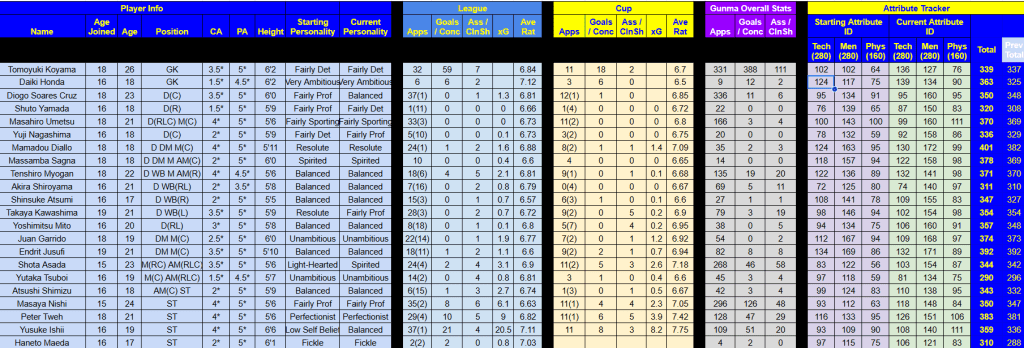
This was the first season that Gunma had really taken a step backwards during Rasamu’s reign, and he was at a loss to explain what had happened. The shining light of this season was Ishii, who smashed the club record for most goals in a season with 29, usurping Nishi’s 20 in 2032. Tweh was solid with 16 goals and 10 assists, Nishi improved at the end of the season to finish with 12 goals and 10 assists, and Asada chipped in with 7 goals and 7 assists.
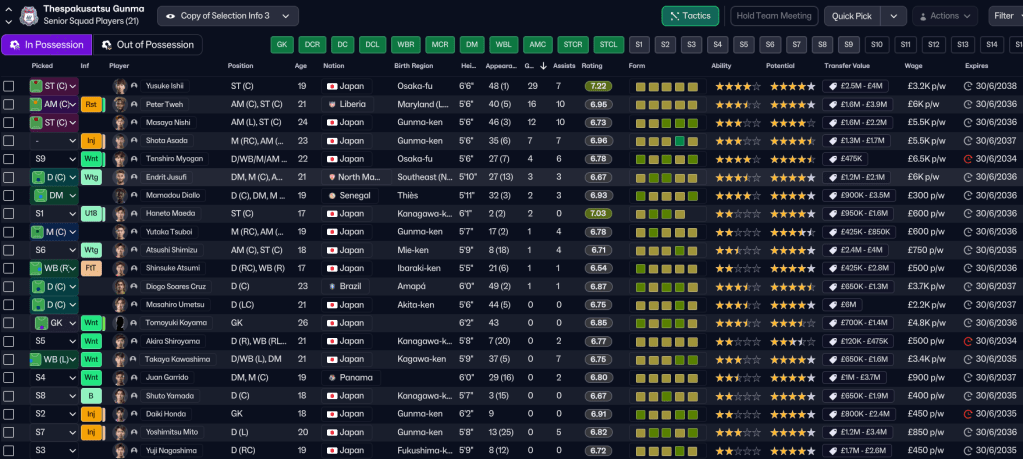
And here’s our annual look at how players developed over the last 12 months. Rasamu’s attribute ID system shows that Diallo is now the best player at the club, followed by Endrit Jusufi, Tweh and Juan Garrido, which maybe goes to show you that attributes aren’t everything in FM. Click the chart below to expand it.
Several youngsters had made positive development in the youth teams, including wing back Yoshiki Tanaka getting 17 assists and striker Yuto Korimoto scoring 17 goals. Click the image below to see the young players’ progression.

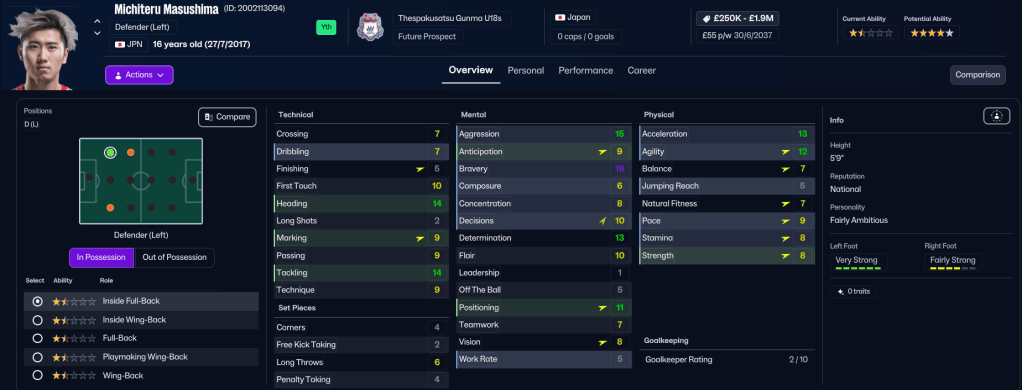
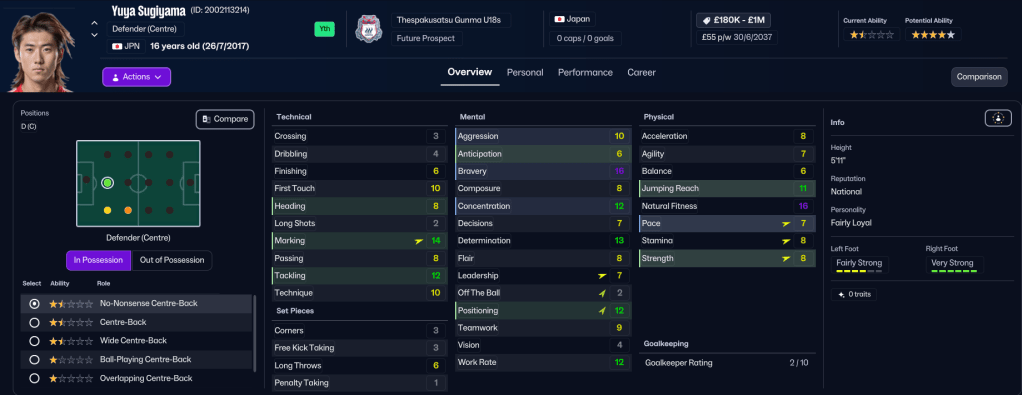
The one positive at the club is the quality of youth that continues to come through the ranks. Gunma had another solid youth intake led by left back Michiteru Masushima, along with centre back Yuya Sugiyama, who didn’t look far off the first team attributes-wise, winger Kazuki Deguchi, full backs Kotaro Yamazaki and Shin Iwasaki and goalkeeper Tsuyoshi Mizuno.
Rasamu would likely need to shake things up in the summer to put a season of relative disappointment behind them. That said, the board and supporters were happy that the club finished in mid-table in J1, so Rasamu didn’t have too much to worry about yet.
Could Gunma put the relegation battle behind them and push higher in J1 next season? Join us next Wednesday to find out!


 Football Manager Addict
Leave a comment