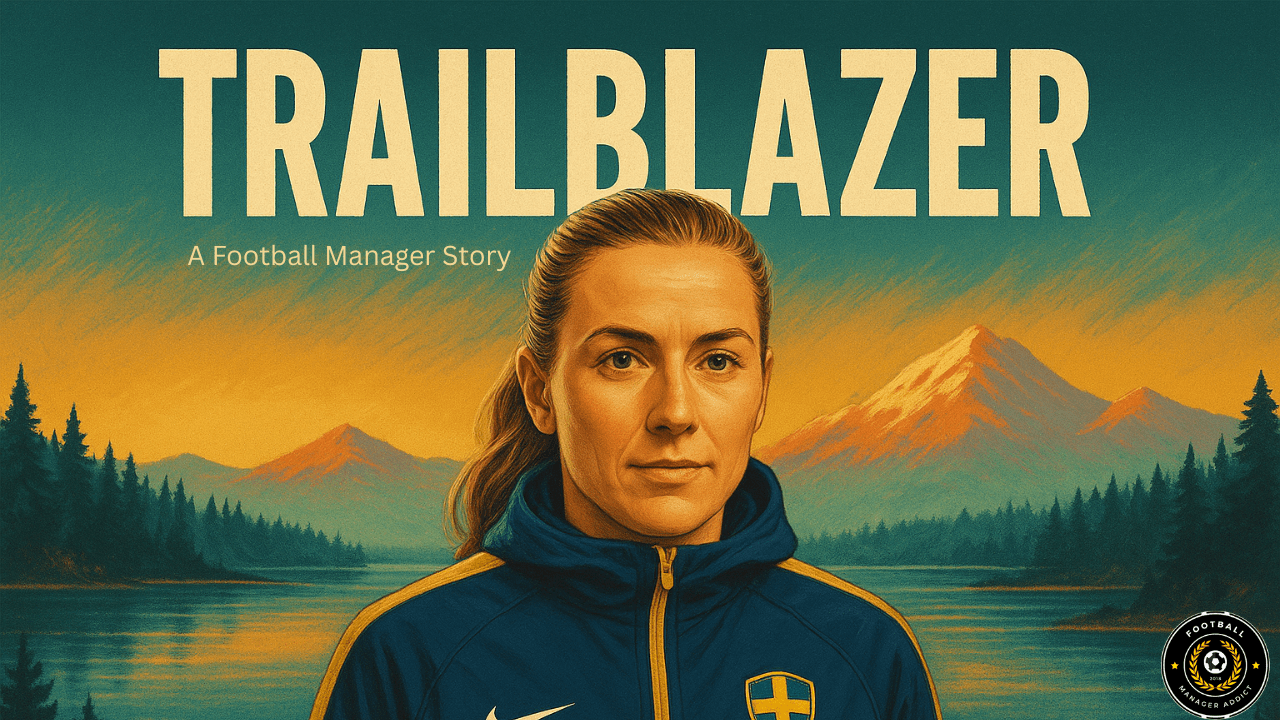
For as long as she could remember, football had been the heartbeat of Freja Holm’s life. Growing up in Umeå, the largest city in northern Sweden, in the late 1990s, Freja spent every waking second of every weekend playing football with her brothers and their friends.
Freja’s love of football was inspired at a young age, watching live matches from Damallsvenskan, the world’s first female football league to turn professional in 1988, on her father’s knee. She had fond memories watching the likes of Marta, the greatest-ever female footballer, take to the pitch at her hometown club Umeå IK, and even met Rainha on several occasions as a ballgirl at Umeå Energi Arena.
Freja’s talent saw her play predominantly on boys’ teams, attracting scouts from across Sweden and beyond as she rewrote all the record books with a prodigious goalscoring record. However, aged 17 and with a professional contract ready to be inked with Umeå IK, disaster struck. Playing a final against another local side, Freja had scored twice to put her team 2-0 up, but a heavy challenge saw her studs get caught in the turf, and she suffered an ACL injury that ruined her playing career before it had even begun.
Freja was understandably devastated, but never gave up on her football dream. So, while she supported her brothers and former teammates from the sidelines, she studied, worked, wrote and analysed. Her playing ability carried over to data insight and coaching excellence, and she began working with the male and female Umeå youth teams while earning her initial coaching badges.
Freja’s rise was driven by her determination to be involved in the beautiful game. She’d delighted in seeing the transformation of women’s football in recent years and had become well-known on social media, TV and radio shows across Sweden as a commentator on the sport’s growth. For example, Freja’s research unearthed that, in 2024, football became the world’s most valuable women’s sport – with an estimated €500 million annual revenue accounting for over 45% of global revenue in women’s sports. Furthermore, women’s sport had seen global revenues increase by 300% since 2021, compared to a 24% increase in the men’s European football market in the same period.
With Football Manager 26 opening up a world of opportunities in women’s football, Freja Holm decided to swap media work and research for a shot at professional coaching. She embarked on a mission to cross borders, learn languages and embrace new cultures, while spreading her vision of the beautiful game across the world of women’s football.
This is no normal Football Manager save. This is Trailblazer: our bid to win every top-tier women’s league available in FM26.
A Short History of Women’s Football
Football has been played by women since England’s Association Football was established in 1863. The the first recorded women’s football match took place in Edinburgh in 1881 in front of 2,000 people and, four years later, one of the first women’s clubs, the British Ladies’ Football Club, was founded. Perceptions of female footballers shifted during the war as women were hired in factories and played in matches that attracted tens of thousands of supporters. Popularity grew, and over 150 women’s teams had been formed in the UK, leagues were created across Europe, and Australia hosted the first women’s match to attract a crowd of over 10,000 people.
However, in December 1921, that progress was halted as the English FA banned women’s football matches from taking place at professional grounds and pitches, stating: “The game of football is quite unsuitable for females and ought not to be encouraged.” But the UK wasn’t alone, as FIFA and UEFA followed suit. Australia banned professional women’s games the same year, followed by France in 1933, Spain in 1936 and West Germany in 1955. Ridiculously, that ban lasted all the way through to 1970 in Germany and France, and 1971 in Australia, Spain and the UK. The only major market that didn’t ban women’s football was the USA.
The bans lifted through the 70s and 80s, and the first FIA Women’s World Cup was held in China in 1991. Popularity began to snowball, with the first big global boom ushered in by the 1999 Women’s World Cup in the USA, which saw games attended by over 1.1 million people with an average attendance of 37,319. Those numbers have only increased, with 556 million people tuning in to the 2011 World Cup, over two billion people watching the most recent World Cup in 2023 and a new UEFA record of 87,192 people attending the Euros final at Wembley in 2022. Furthermore, finances have gone through the roof, with the 2023 World Cup offering nearly four times the prize money of the previous event in 2019.
The rise of women’s football sees it come to Football Manager for the first time in FM26, which should only increase exposure of the teams and players in the available leagues and beyond. And that’s exactly what we’ll be doing in our first long-term save of FM26. So welcome to the Trailblazer!
Getting Started in Trailblazer
Our new protagonist, 35-year-old Freja Holm, comes into FM26 as an inexperienced manager with a background in youth coaching, in which she progressed to the National A Licence, and as a well-known commentator in the Swedish media. Her coaching style leans on being an entertainer and a developer who encourages attacking football, with a driven and inspirational personality. And Holm begins her career as an unemployed manager with all 14 women’s divisions across 11 nations selected.


Holm’s first task will be to find a club with a managerial vacancy and is willing to take on an untested manager. From there, her mission will be to win the top-tier leagues in Australia, Denmark, England, France, Germany, Italy, Japan, Spain, Sweden, the USA and Wales.
However, upon loading up those nations, there were no jobs available in the world of women’s football. So Freja could well be in for a long wait!
Where would Freja Holm end up on the first leg of her Trailblazer journey? Join us at 2pm this afternoon to find out!
Information on the history of women’s football was sourced from SPORTFIVE’s whitepaper The Commercial Landscape of Women’s Football. If you want to find out more about the rise of the sport, I recommend downloading it for free.


 Football Manager Addict