
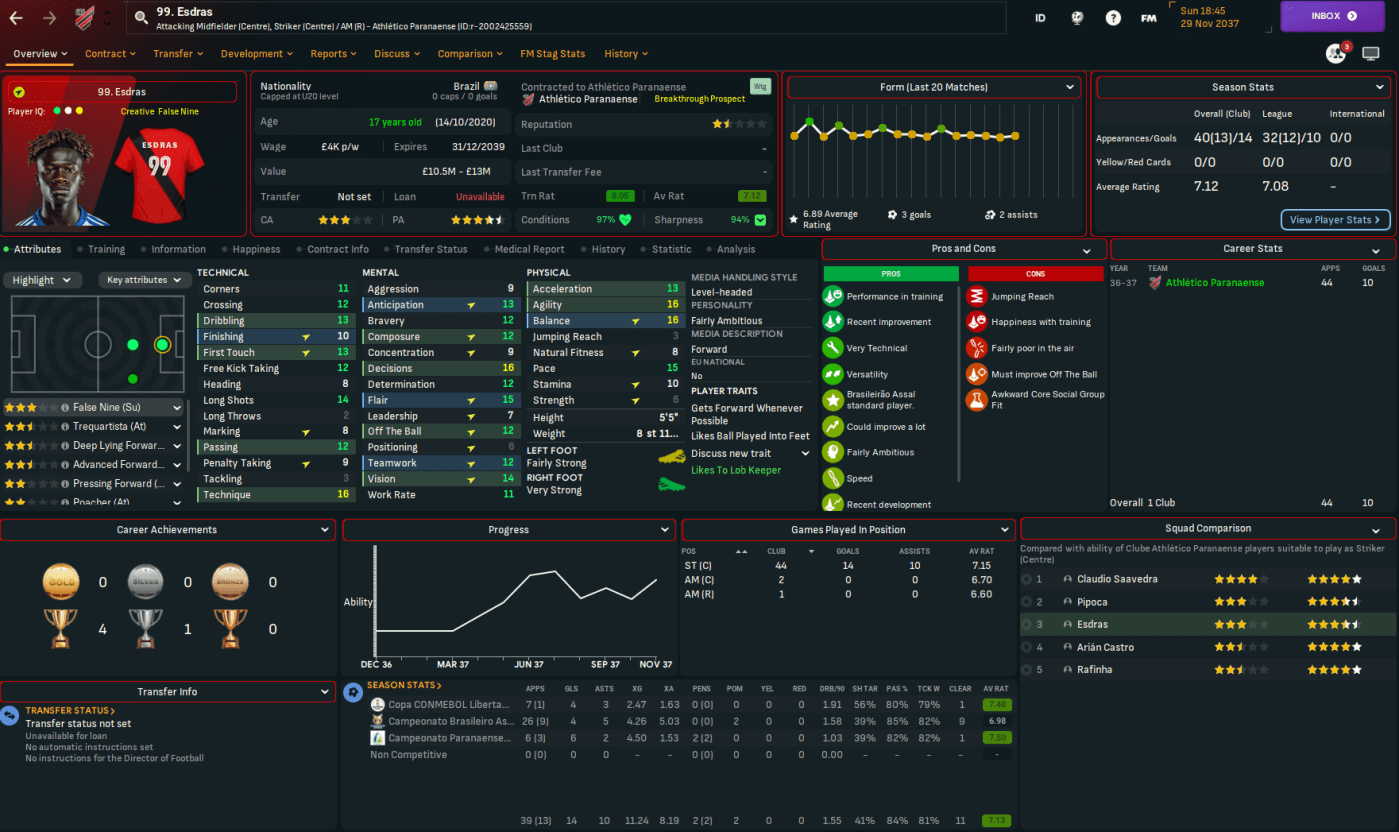
The phrase “golden generation” is all-too-often overused in football circles, but Robaato Rasamu believed he’d absolutely inherited one at Athlético Paranaense. His squad contained 11 players considered to have 5-star potential which, according to his staff, constituted “world class,” and an additional 17 with at least 4-star potential.
Given that mass of potential, Rasamu had turned to youth in the first half of the 2037 campaign. And he’d been rewarded by 18-year-old striker Pipoca already scoring 31 goals, 16-year-old striker Esdras scoring 11 with eight assists, 20-year-old winger Carlos Eduardo scoring 11 with 12 assists and 18-year-old winger Paulo Roberto Aal scoring eight goals and getting 17 assists.
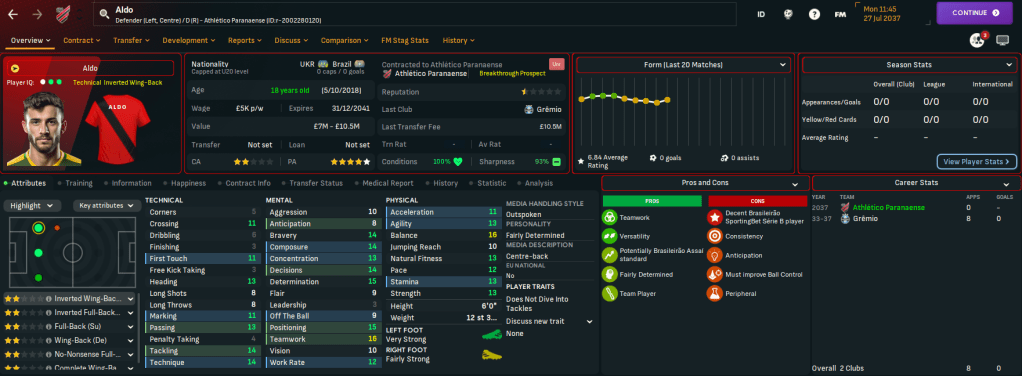
The manager further focused on youth by selling defender Fransuar and underperforming striker Alejandro Villamayor to Saudi for £5m and £19m. Unfortunately, Real Madrid came in for 29-year-old goalkeeper Elivélton Colaco and Lazaró was forced to negotiate them up to £23.5m, which saw the club’s bank balance move past £100m for the first time. Those sales forced Rasamu into the transfer market, signing two 18-year-olds in centre back Aldo, who isn’t eligible until next season, for up to £10.5m from Gremio and “the next Taffarel” Guilherme de Moraes for up to £8m from Clube de Regatas, where he’d already played 100 league games.

Euro/SAM Club Challenge
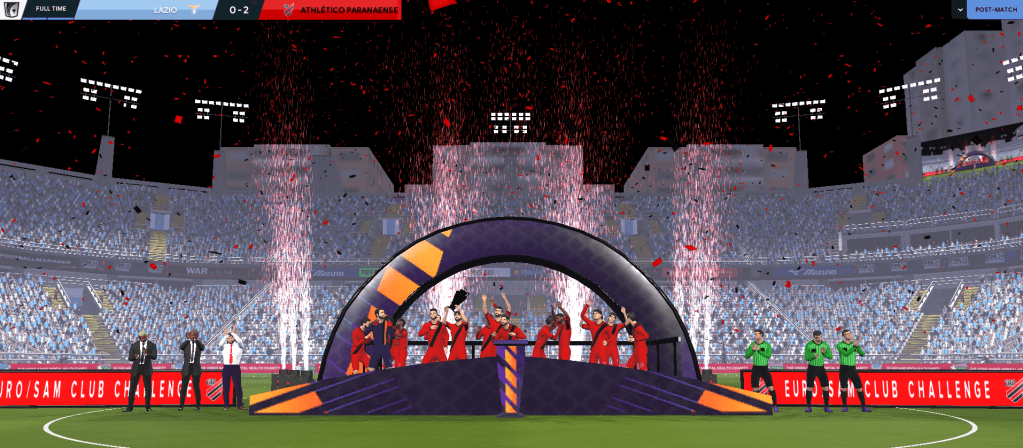
Rasamu got an opportunity to see just how good his young players were as Paranaense’s Copa Sudamericana success took them into the European/South American Club Challenge against Europa League winners Lazio. That meant a trip over to Spain and Sevilla’s Estadio Ramón Sánchez-Pizjuan.
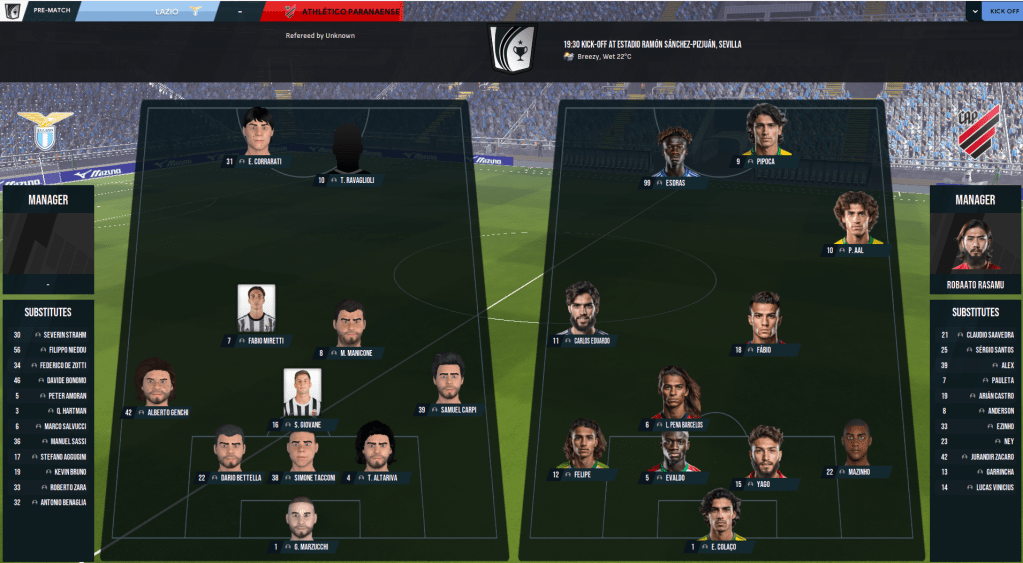
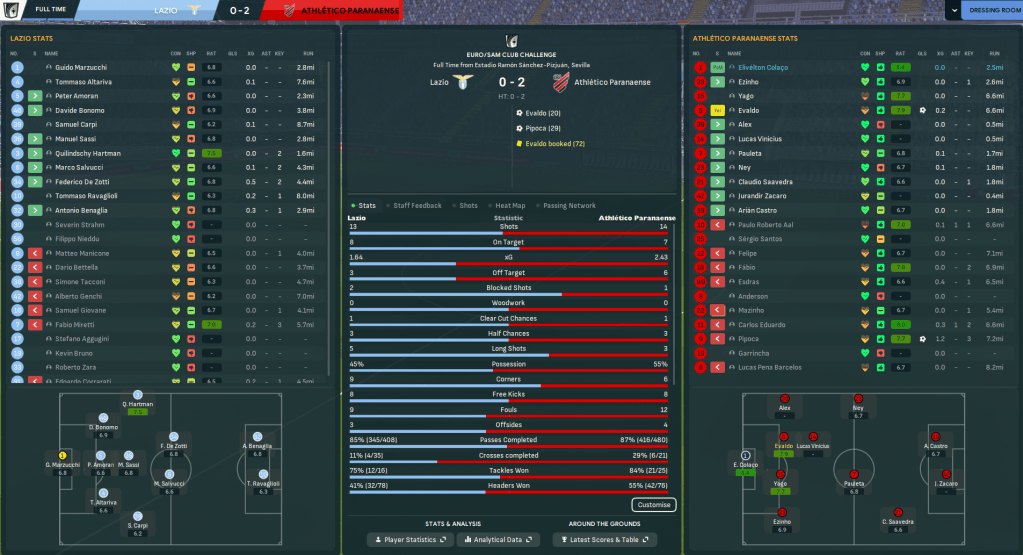
Paranaense started very well as Aal shot just over then swung a far post corner onto the head of centre back Evaldo. Pipoca had a shot superbly saved but made sure five minutes later as Eduardo’s shot was parried into his path. Lazio grew into the game after the break but found Colaco in fine form, making nine saves to inspire his side to a 2-0 victory and attract Madrid’s attention.
Tricky Copa Libertadores Draw
Despite winning their Copa Libertadores group at a canter, Paranaense got a tough second round draw against Flamengo. They began with a trip to the Maracana, just three days after playing Lazio. They started superbly as Anderson robbed a midfielder dallying on the ball and sent Pipoca through to coolly finish. But Flamengo levelled with a screamer, scored again 90 seconds after half time and Paranaense fell apart to lose 4-1. That momentum carried straight into the second leg as Flamengo scored after 27 seconds. Esdras levelled and Eduardo made it 2-1 inside 16 minutes only to allow Flamengo to make it two goals from two shots. Evaldo made it interesting and forward Ney missed a huge chance to make it even more so, but it proved too little and the Libertadores dream was over for this season.


Battling Brazil’s Big Boys
Paranaense began the second half of Série A by drawing with Fluminense, getting thumped 6-1 at reigning champions Flamengo and a dire 1-0 loss at rivals and bottom-of-the-league Coritiba. Esdras nicked a point at Flamengo with a 97th-minute equaliser and Pipoca did the same at Internacional, leaving Paranaense seven points off leaders Palmeiras.
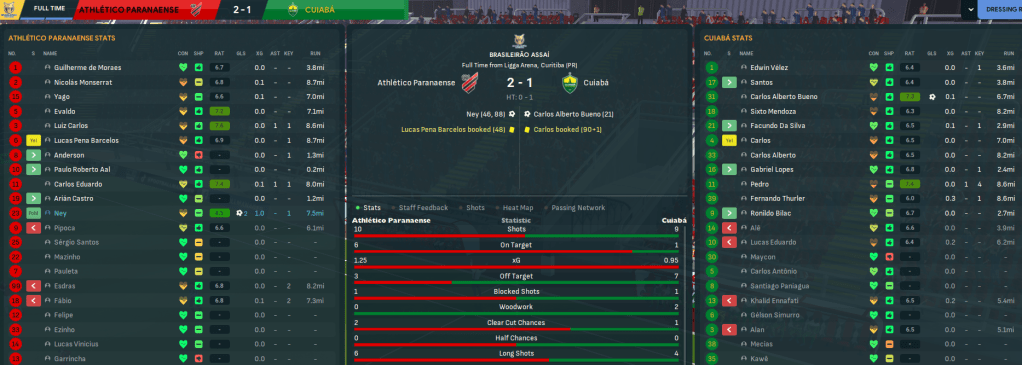
Rasamu’s exhausted squad, many of whom had already played 40 games in six months, finally got a 15 day break between matches so the manager gave them all a week off. And it looked like they’d relaxed a little too much as Cuiabá scored a total fluke and led with, no surprise to anyone, their only shot on target. But a half time talking to inspired a comeback led by striker Ney’s brace.
Rasamu was hopeful that would be a catalyst but they were wasteful again in a 1-1 at home to Botafogo then lost 2-0 at Bragantino before welcoming leaders Palmeiras to Ligga Arena. They started well as Aal won a penalty that Fábio converted but, as seemingly always, allowed the visitors to score from their first attack. The exciting Esdras finished superbly to put them back in front before Pipoca won another penalty that Fábio again converted. But a shaky defence threw it away by conceding twice late on.

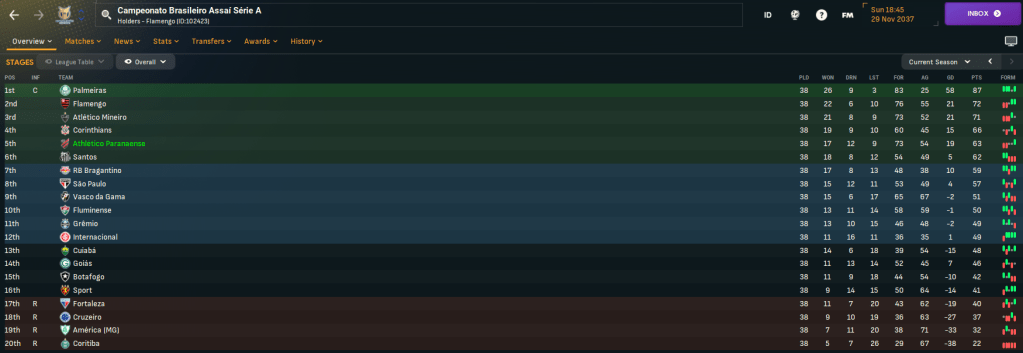
Those results meant any outside hopes of a title charge were out of the question with 10 games remaining. The disappointing form continued, with the high points being Pipoca and Fábio earning a 2-2 at 2nd-place Mineiro and Eduardo a 1-1 with Corinthians. But they just about stumbled into the Libertadores qualification places with a final day 5-2 win over Vasco snapping a six-game winless streak and securing 5th. They finished on 63 points, nine worse off than last season, with 17 wins, 12 draws and nine defeats. Flamengo relinquished their crown after six successive titles as Palmeiras stormed to their first title in 15 years. And Flamengo sacked their manager as a result!
Analysing An Up And Down Season
Paranaense’s attacking threat remained as only Palmeiras and Flamengo (83 and 76) scored more than their 73 goals. They also had the most penalties, scoring 10 out of 14, and the 3rd-best conversion rate (15%) but only scored 7 goals from set pieces, 4 of which were corners (4th worst). But the defence remained a huge concern, conceding the 9th-most goals (54), including the most from corners (9), 3rd-most from indirect free kicks (4) but 0 from direct free kicks, and keeping the fewest clean sheets (5).
Worryingly, despite trying to play wide possession football, Paranaense completed the 6th-fewest crosses (133), made the 5th-fewest dribbles (406) and had the 3rd-worst cross completion (14%) and 10th-best possession (49%). But they completed the most high intensity sprints (5,224 and 400 more than anyone else). However, it’s worth keeping in mind that the club has the 4th-lowest wage spend in the league of just £14.05m compared to Flamengo’s £111m and Palmeiras’ £71.8m.
Pipoca led the way with 41 goals in 53 games followed by Fábio and Eduardo (18), Esdras (14), Claudio Saavedra (12), Ney (11) and Rafinha, who’s been injured for six months, and Aal (10). Aal topped the assists with 21 followed by Eduardo (19), Pauleta and Saavedra (11) and Esdras (10). Pipoca was of course their man man, but Rasamu was relatively impressed with 17-year-old Esdras getting double figures for goals and assists despite a poor conclusion to the season. However, he was looking for much more from the likes of right back Nicolás Monserrat, who was supposed to be their best player, and Saavedra and knew he needed to try and address their dodgy defence.
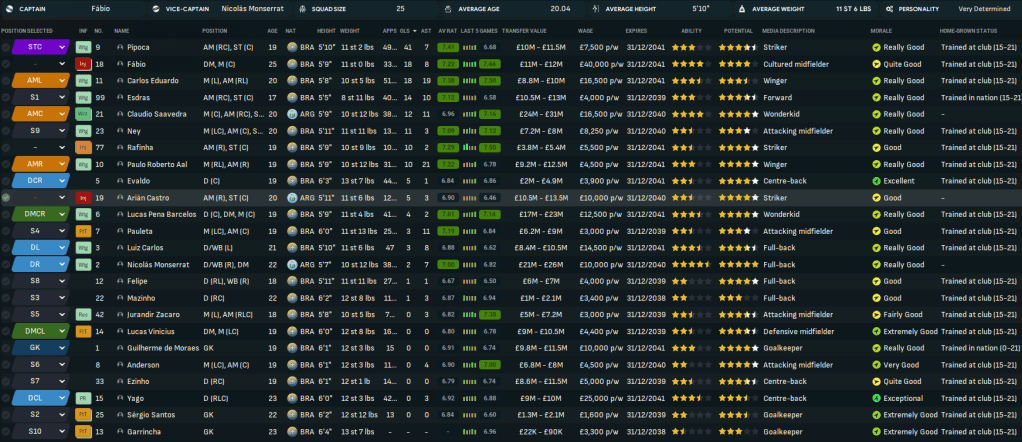
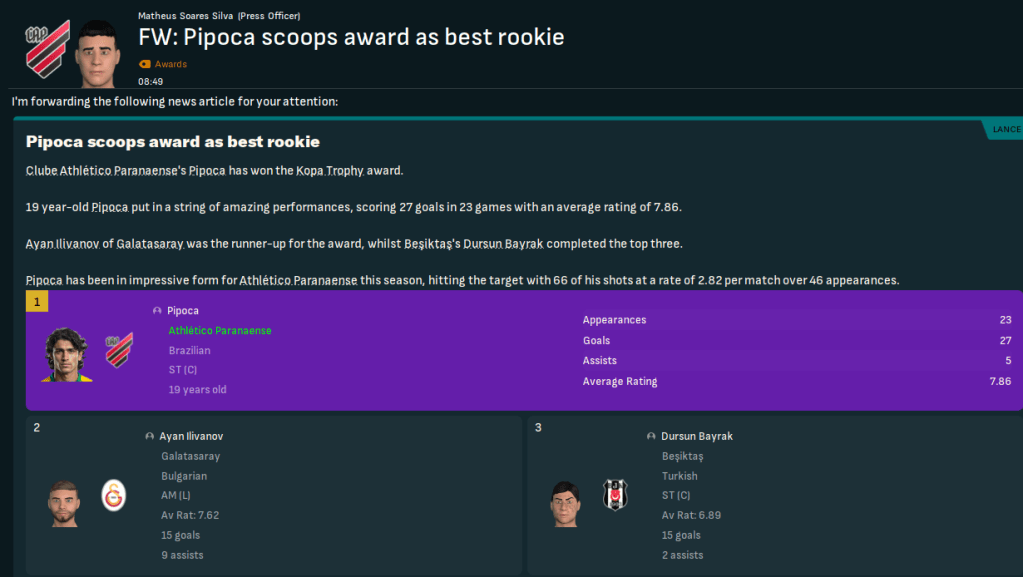
Despite the continental disappointment and falling away a little in Série A, Rasamu was loving life working with the exciting young talents at Paranaense. His personal favourite was Pipoca, whose potential was highlighted by winning the Kopa Trophy 2037, aka U21 World Player of the Year.
Could Rasamu get more out of his potential-laden Paranaense squad next season? Join us on Monday to find out!


 Football Manager Addict
Leave a comment