
Albirex Niigata were off to an absolute flyer in Robaato Rasamu’s first season of top-flight football. They found themselves 2nd in J1 League after 18 games but, with injuries and a heavy schedule stacking up, it would be a major challenge to maintain that form.
They were mid-way through a tough schedule of eight matches in 27 days through May, which continued against several teams in the top half. First up, they welcomed 9th-place FC-Tokyo and fell behind on 34 minutes, but showed their resilience as attacker Vusi More equalised and Jarl-Emil Nesland whipped in a free-kick to nick a win. Next was a trip to 4th-place Yokohama FC, who scored in first-half injury time and Niigata’s players didn’t have anything in the tank to fight back. A busy month ended with a 2-2 at home to 3rd-place Gamba Osaka, in which Niigata were the better side even with an exhausted team. But despite the busy schedule, More won Niigata’s first Monthly MVP award in J1 League.
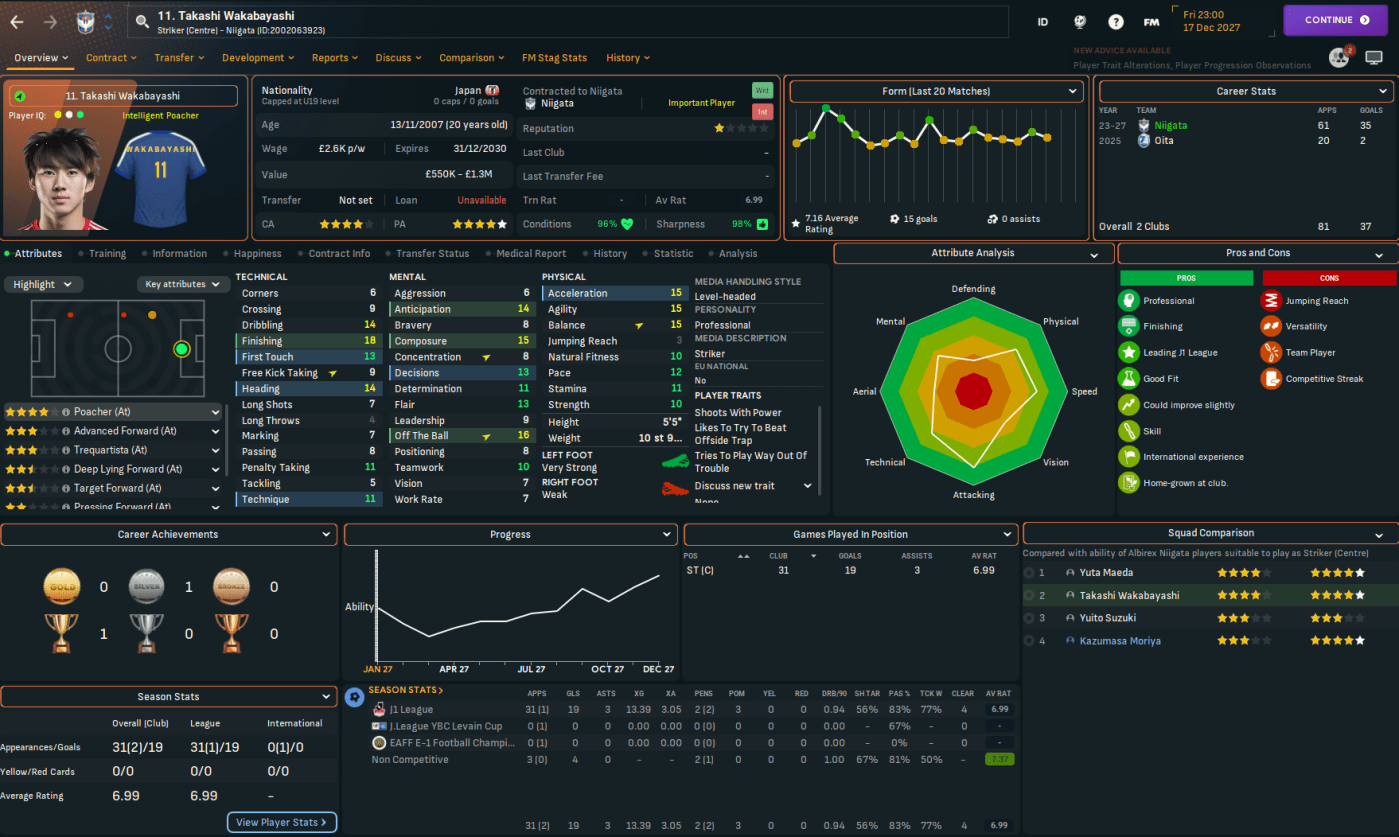
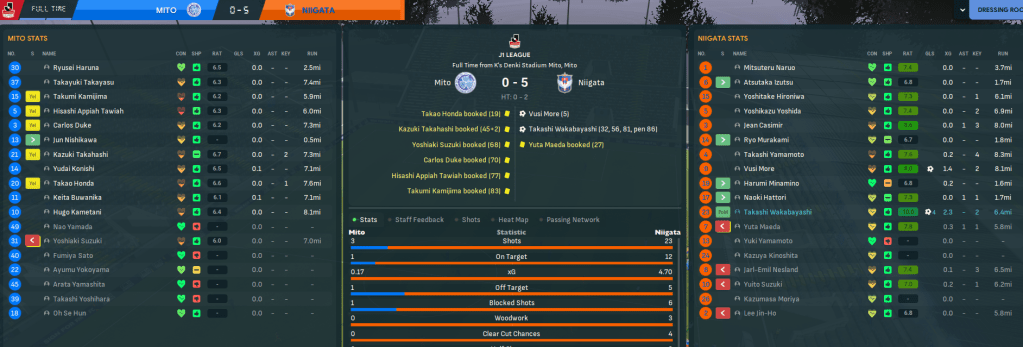
Rasamu gave the lads a couple of days off, which worked a treat as striker Takashi Wakabayashi and last season’s star man Yuito Suzuki sealed a 2-0 win over 6th-place Nagoya. They kicked on from that as More and Wakabayashi’s new club record four-goal haul inspired a 5-0 thrashing of struggling Mito. They were equally dominant at home to Tokushima, having 20 shots to two and winning 4-1 with a Wakabayashi double. That set up a huge game at home to title favourites Urawa Reds, who showed why in a dominant 2-0 win.
New Club Record Sale
The mid-season transfer window saw Saudi side Al-Fayha bid for More, who revealed he’d be unhappy if it was rejected. Rasamu negotiated their pathetic £1m bid up to a new club record £4m. In theory, the sale was a blessing in disguise as it allowed Yuito to move back to his preferred shadow striker role with Naoki Hattori and Ryutaro Ito competing on the left. But Rasamu did do one deal, bringing in midfielder Mitsuaki Hara, who looks like a decent playmaker, for £775k from Omiya.
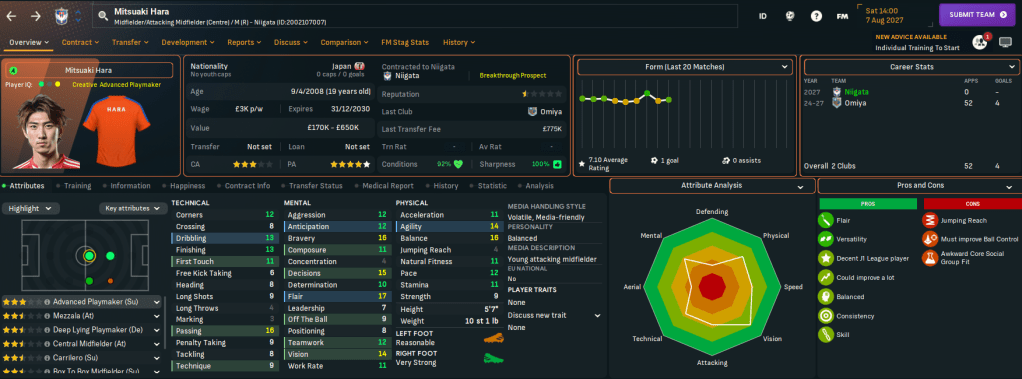
Life without More began with a 1-0 defeat at Yokohama F-M. But his former teammates were up and running after 16 seconds at home to Kobe as Wakabayashi smashed a volley into the top corner for the fastest goal in club history. Hattori and on-loan midfielder Kazumasa Moriya wrapped the game up before debutant Hara wrapped up a 4-1 win. A 2-0 loss followed at Kashima but a 3-0 defeat of Kyoto saw Rasamu pass the objective to become an established J1 League team three years ahead of schedule.
Continental Qualification Fight Heats Up
That good form set up a tight battle for continental qualification. Niigata were 4th on 60 points with six games remaining, but 2nd and 6th places were separated by just five points when football resumed following a month-long break before the season finale.
That break suited Niigata very nicely indeed as they came out flying at Hiroshima. Holding midfielders Hara and Takashi Yamamoto had them 2-0 up then Yuito, Hara’s second and Wakabayashi wrapped up a 5-3 thriller. And that took them into what the Japanese media was billing as a seven-way fight for the title, in which Urawa’s sudden drop in form left Niigata just 4 points off the top with five games remaining.
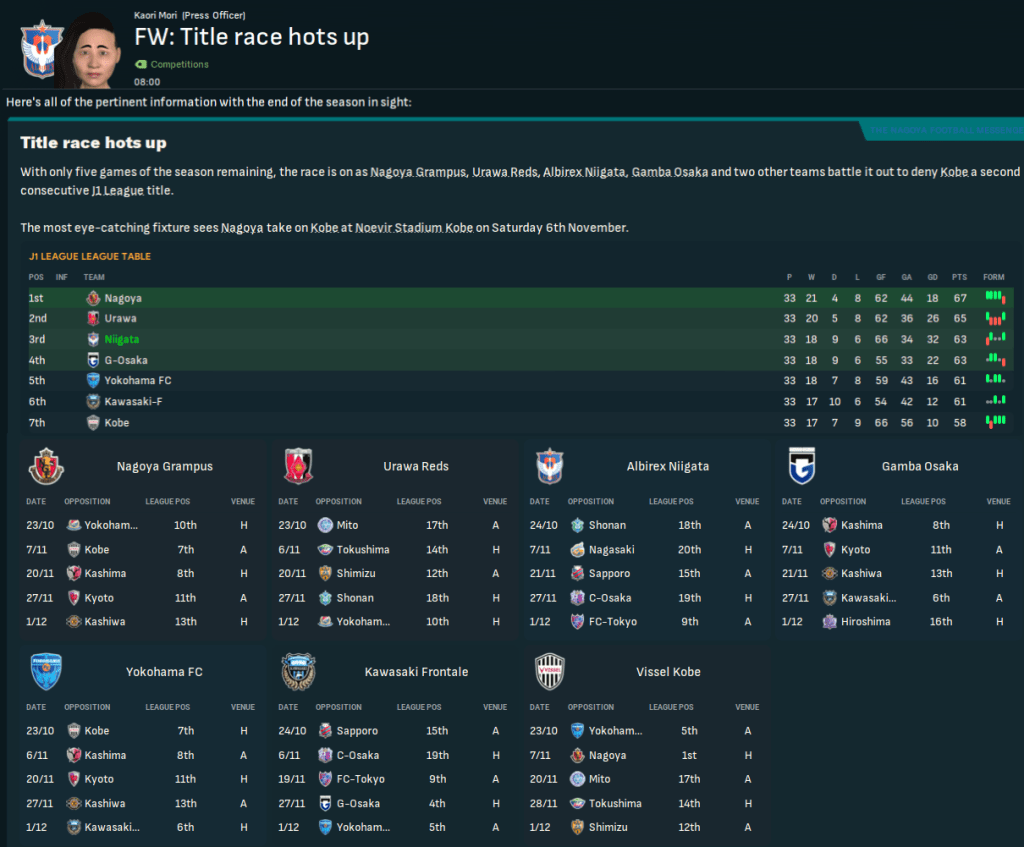
Game 1: Shonan (18th, away): Niigata’s run-in began terribly as they conceded the first shot and lost 3-1 while every team around them won so they dropped from 3rd to 6th.
Game 2 – Narasaki (20th, home): They got back on track at home to bottom side Nagasaki courtesy of Yuito scoring a 30-yard free-kick. The midfielder teed up centre-back Yoshikazu Yoshida from a cheeky short free-kick routine before homegrown midfielder Ryo Murakami bagged a late third. Strangely, the teams around them all lost so Niigata jumped back up to 3rd!
Game 3 – Sapporo (15th, away): Niigata started well at Sapporo and Yuito finished off a lovely move just before half time. Sapporo equalised but swiftly gifted Niigata the winner as the keeper under hit a pass and Moriya steered into the empty net from 25 yards (which had Declan Rice v Chelsea vibes about it). Gamba lost so Niigata opened up a three-point gap to 5th with two games remaining.
Game 4 – Cerezo Osaka (17th, home): A win in their final home game could wrap up Rasamu’s first taste of continental football. And they started well as Yoshida fired home from 25 yards after eight minutes. But out of nowhere, Osaka scored either side of half time and looked to be claiming a completely undeserved win until Wakabayashi struck in the 88th minute. He then had a goal dubiously chalked off by VAR deep into injury time – and it looked well onside! However, Gamba lost 2-0 at Kawasaki, so Niigata were guaranteed at least 4th place.
Game 5 – FC Tokyo (9th, away): Niigata again started brightly at Tokyo as Ito crossed for Wakabayashi to tap home. Tokyo scored their first shot (because why wouldn’t they?), Niigata continued to dominate and retook the lead through Ito only for Tokyo to score their second shot on target (obviously). Moriya scored a wonderful solo goal but Tokyo won a dodgy penalty (three goals from three shots on target) and it somehow finished 3-3.
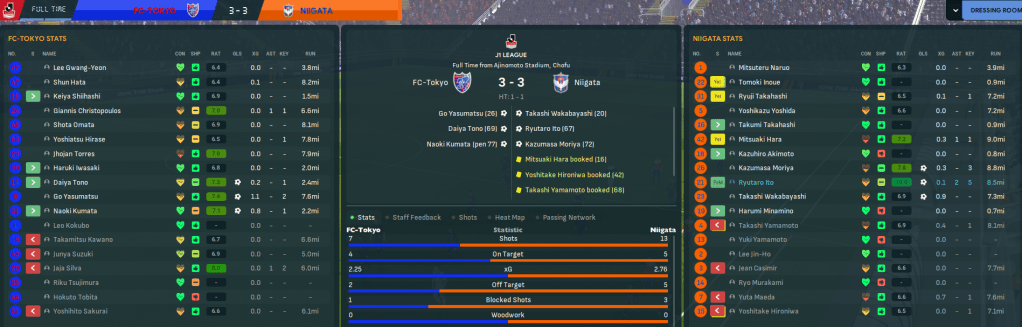
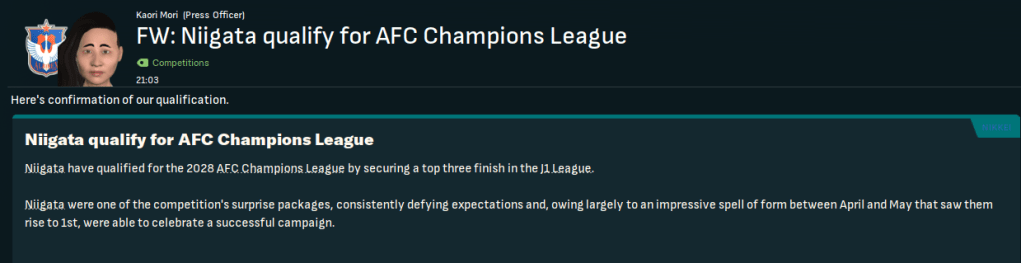
Elsewhere, Kawasaki drew at Yohohama FC and Gamba drew with Hiroshima so Niigata wrapped up a 3rd place finish in their first season back in J1 League. And that meant they qualified for the AFC Champions League! They also recorded a new record high finish in Niigata club history, usurping the 6th place finish achieved in 2007.
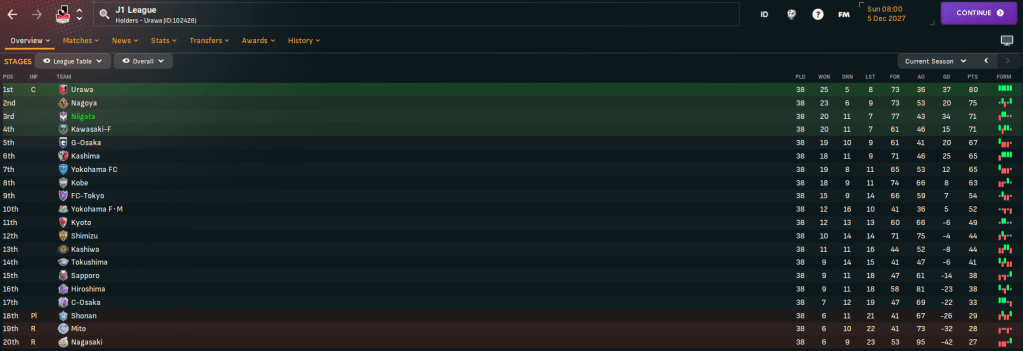
Niigata finished in 3rd with 71 points, level with Kawasaki, four behind Nagoya and nine behind champions Urawa. They won 20 games, drew 11 and only lost seven, but the only player in the end-of-season player rankings was Moriya with the league’s second-best average rating of 7.39.
Analysing More Niigata Overachievement
Niigata’s exciting attack was the driving force behind their success as they led the way with 77 goals, three more than Kobe. They were the only side to average more than two goals per game (2.03) and had the 2nd-best xG overperformance of 15.57. They only had two penalties, eight goals from corners, one from indirect free-kicks and scored a league-high two direct free-kicks, so only 13 of their 77 goals were from set pieces. Niigata only created the 10th-most chances (158) but had the 3rd-most shots (461, 39 behind Urawa) and shots on target (189, 34 behind Urawa), the 3rd-worst shots on target ratio (40%) and 10th-best conversion rate (20%).
Interestingly, Niigata made the 2nd-most dribbles (588) and by far the most high-intensity sprints (4,607, which was 600 more than anyone else). But they only had the 11th-best pass completion ratio (89%) and completed the 13th-most passes (18,931, nearly 7,000 fewer than Yokohama F-M).
Niigata also had the 4th-best defence, conceding 43 to Urawa’s 36, the 6th-best xGA (45.31) and kept the joint-2nd most clean sheets (13). However, they conceded the 3rd-most goals from corners (10), the joint-most from indirect free-kicks (5) and the 4th-most penalties (6). So in other words, half the goals Niigata conceded (21 out of 43) were from set pieces. There were more concerning defensive statistics, such as making the fewest blocks (98) and clearances (287), the 2nd-fewest headers won ratio (39%), the 4th-fewest interceptions (690) and tackles won (718) but the 5th-most fouls (451), receiving the 2nd-most yellow cards (56) and losing the 7th-most headers (912).
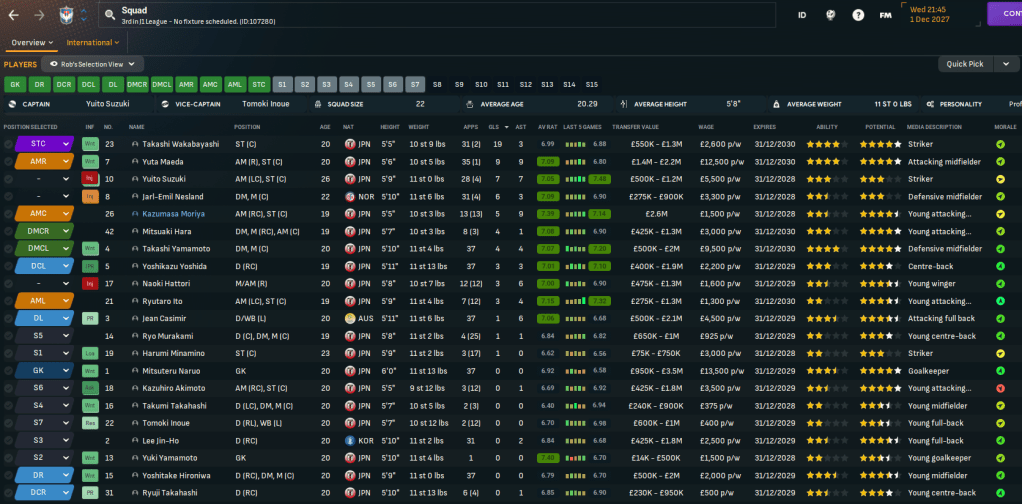
That said, Niigata’s success was achieved with the lowest salary spend in J1 of just £4.36m – £1m less than bottom side Nagasaki, one-fifth of 6th-place Kashima’s £20.2m and less than five J2 League teams. And it’s worth remembering they finished the season with an average age of just 20.29 with only three players aged over 20.
The increasingly impressive Wakabayashi topped Niigata’s goalscoring charts with a new club record 19 in 33 followed by Maeda (9), Yuito (7), Nesland (6) and Moriya (5). Maeda and Moriya led the assists with nine (the latter from just 13 starts) followed by Yuito (7) and left-back Jean Casimir and Hattori (6). While over half the squad averaged over a 7.00 led by Moriya’s 7.39.
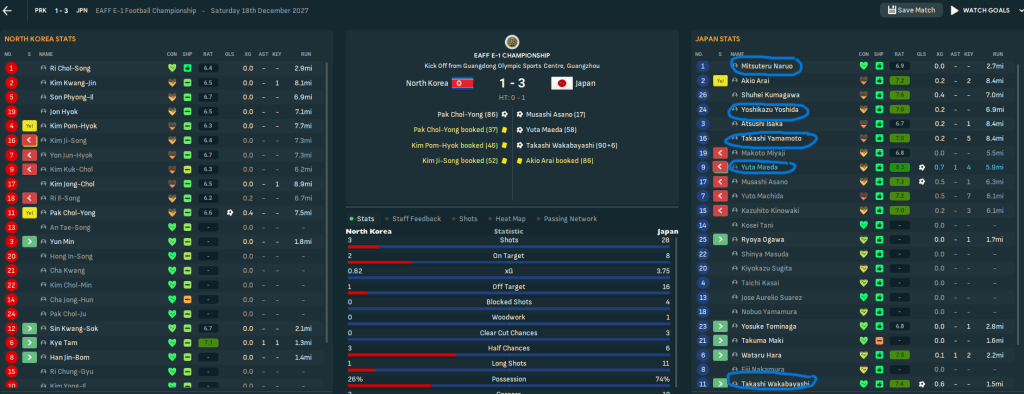
There’s plenty of promise at Niigata, proven by five of their young stars making their Japan debuts this season. Goalkeeper Mitsuteru Naruo played in a 4-1 friendly win over Morocco, midfielder Yamamoto and centre-back Yoshida debuted in a 3-1 defeat at Saudi Arabia then Maeda and Wakabayashi both scored on debut in a 3-1 win over North Korea. However, as a result, they were now facing massive interest from Saudi clubs.
Could Rasamu strengthen his Niigata to challenge for the Japanese title and how would he fare in his first continental campaign? Join us on Friday to find out!


 Football Manager Addict
Leave a comment