
Football management was supposed to be a really challenging job, but Robaato Rasamu was absolutely loving life as manager of Japanese J3 League side Kamatamare Sanuki. His first half-season had been a bit of a challenge, but season two had been a flying success to date.
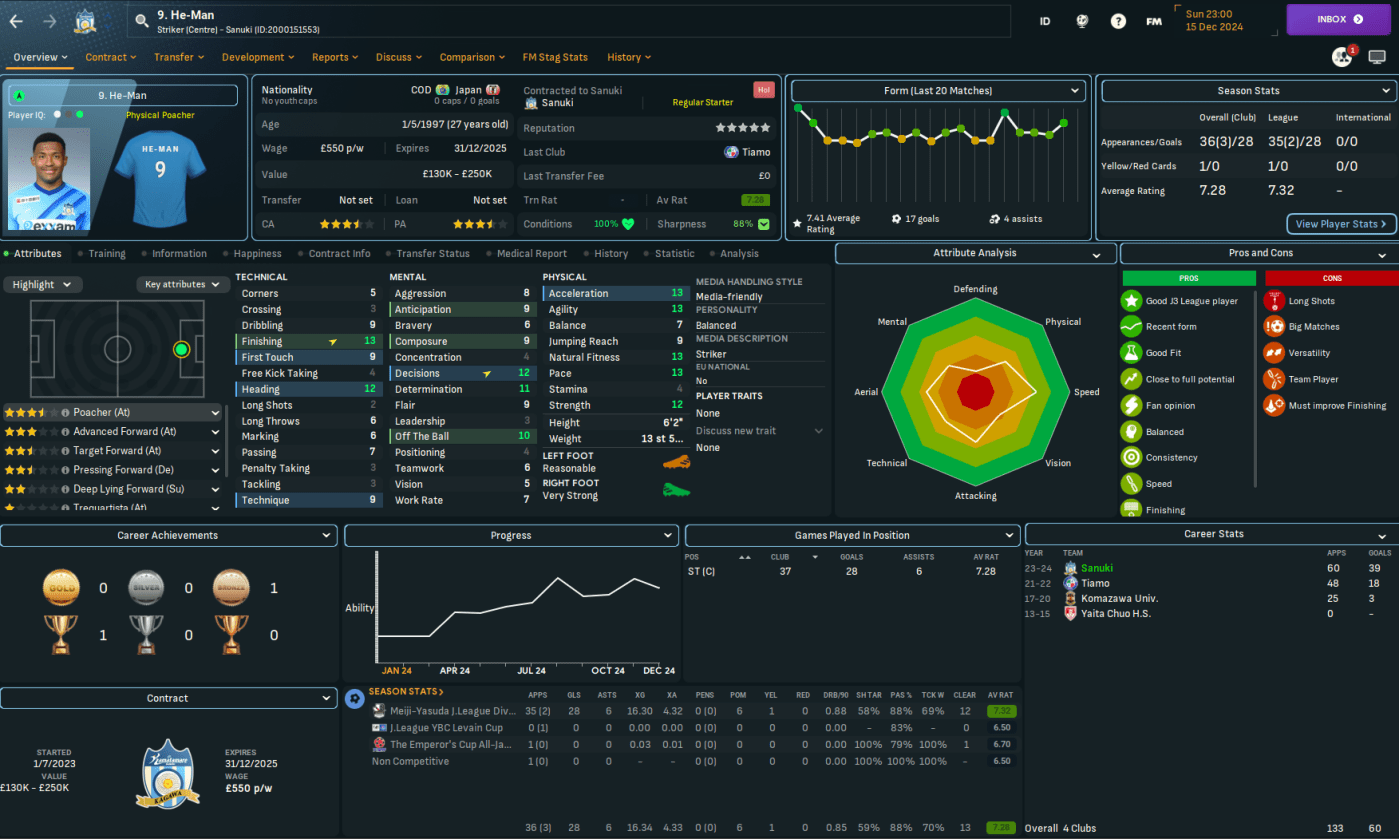
Sanuki found themselves defying the odds to be top of the league at the halfway point of J3 League 2024, with a six-point buffer over the playoff places. And the Sanuki faithful had a new cult hero in Himan “He-Man” Morimoto, who was challenging the league’s top scorers and delighting fans with his “By The Power of Greyskull” celebration.
Club Record Unbeaten Streak
The second half of the season began with He-Man’s iconic celebration coming out twice as he earned a 2-2 at Osaka, and he became the first Sanuki player to win the J3 League Monthly MVP award. But having been full of goals and exciting matches, that suddenly stopped. Winger Go Jun-Young earned a 1-0 win over 5th-place Yamaguchi before a 1-1 with 6th-place FC Gifu, narrow wins over Iwaki, Tottori and Sagamihara, in which 4ft 11in right-back Atsushi Inagaki scored the winner, and the first 0-0 in Rasamu’s 50th game in charge against Miyazaki.
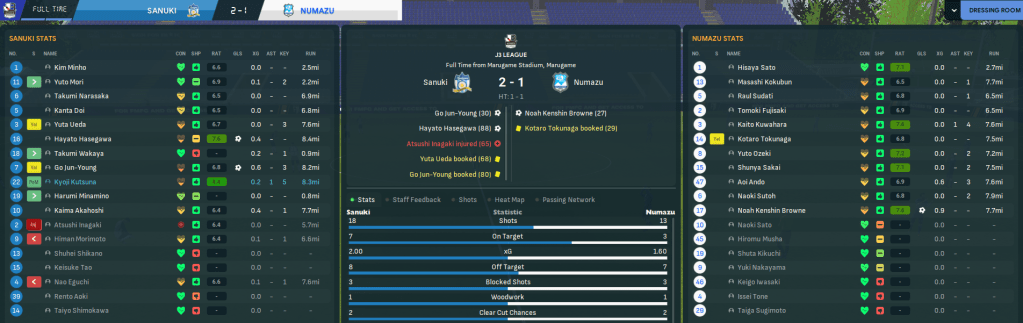
The tight games continued with a 1-1 at Nagano, which set a new club record of 13 games unbeaten, usurping the previous record from 2013. A massive test of Sanuki’s promotion credentials saw them entertain 3rd-place Nazunu, who took the lead on 27 minutes only for Go to quickly equalise. It looked to be edging towards a draw until midfielder Hayato Hasegawa poked home an 88th-minute winner.
10 Games From Promotion?
The unbeaten run moved Rasamu’s side 11 points clear of Nazunu with 10 games remaining. A trip to rivals Ehime followed and they gifted He-Man his 20th goal of the season but came back to get a deserved draw. The goals flowed more freely at home to 9th-place Fukushima as a Nao Eguchi penalty, He-Man and on-loan striker Harumi Minamino earned a clinical 3-0 win.
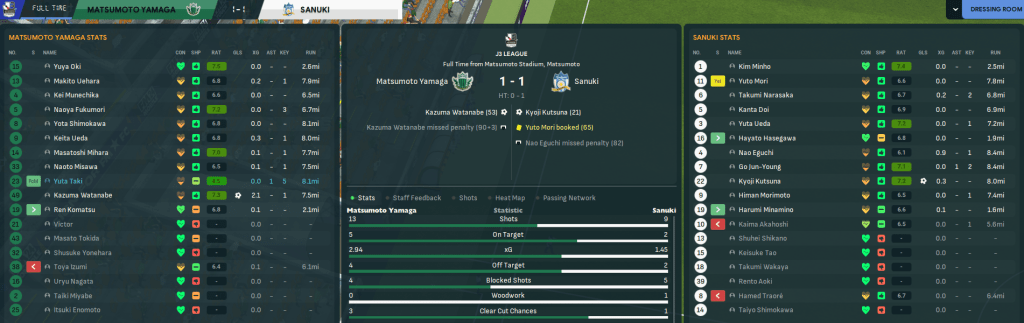
That teed up a massive top-of-the-table clash as Sanuki visited 2nd-place Matsumoto Yamaga, who trailed them by five points. The hosts had an early goal disallowed for a foul and Sanuki took advantage as Go crossed for left-winger Kyoji Kutsuna to score his 10th of the season. But Matsumoto levelled up thanks to some awful defending by Mori. It looked to be drifting to a draw until He-Man won a penalty… but Eguchi missed. Then deep into injury time, the referee awarded a penalty for a foul but, with the last kick of the game, the league’s top-scorer Watanabe put it straight at Kim Minho.
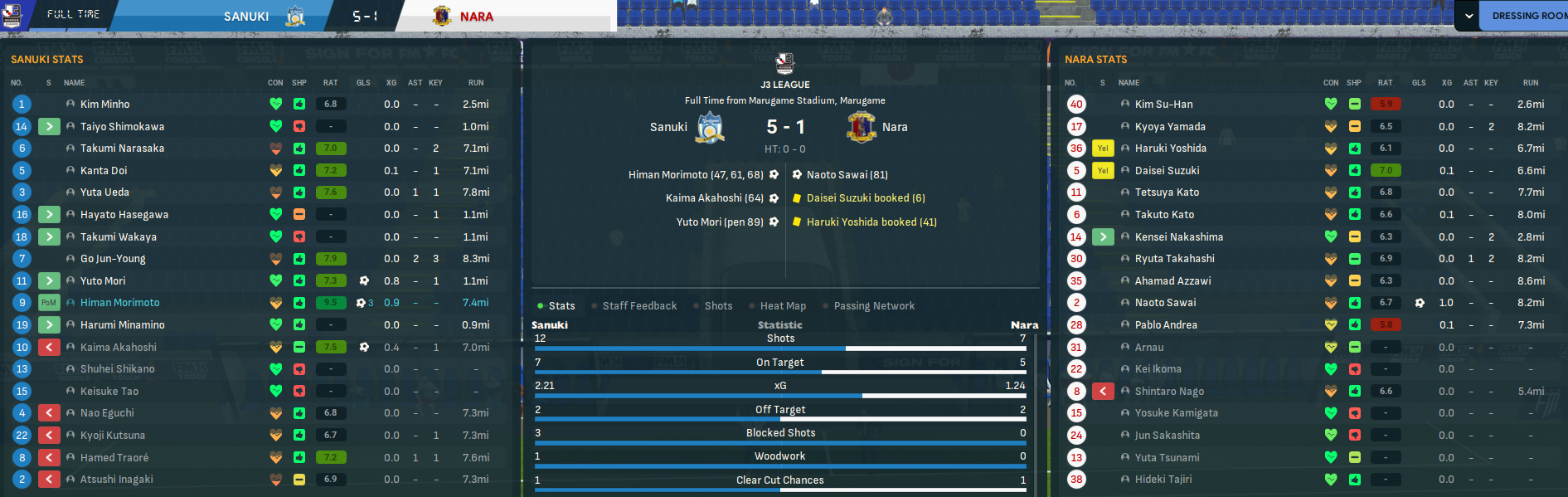
The long unbeaten run ended courtesy of a last-minute goal to fall to a 1-0 loss at 7th-place Kagoshima. They were also struggling at home to Nara but a stern teamtalk got the desired result as He-Man struck twice in the first 15 minutes of the second half then chipped the keeper from 25 yards to seal his hat-trick and – and the Sanuki stadium team unleashed some newly procured pyrotechnics in time with his customary celebration.
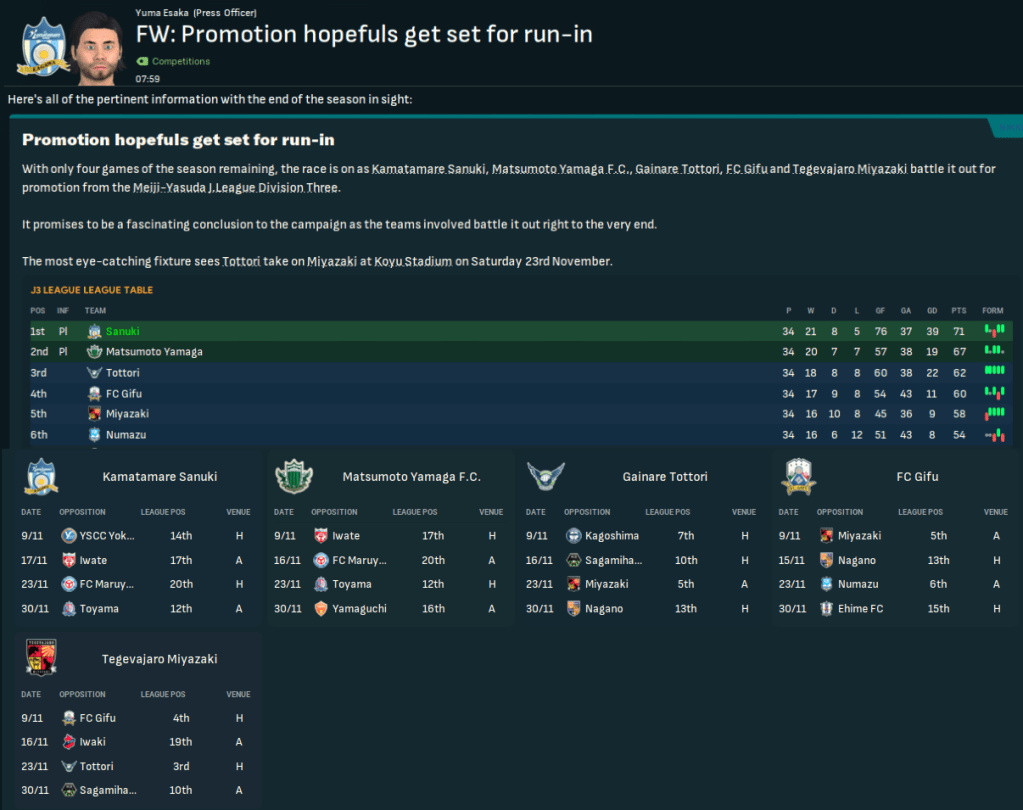
That left Sanuki two points clear of Matsumoto and with a six-point gap to Tottori, who’d played a game more, and an 11-point gap to Gifu going into the final five games.
Game 1 – Kitakyushu (11th, away): Sanuki started the run-in well as He-Man slammed home from 10 yards and Kutsuna doubled the lead just after half time. Kitakyushu got into it with a dodgy penalty and piled the pressure on, but Sanuki held in there and decided it with a late Yuto Mori header. That moved them nine points clear with four games to go, confirmed at least a playoff place and broke the all-time club record for most points in a season (71).
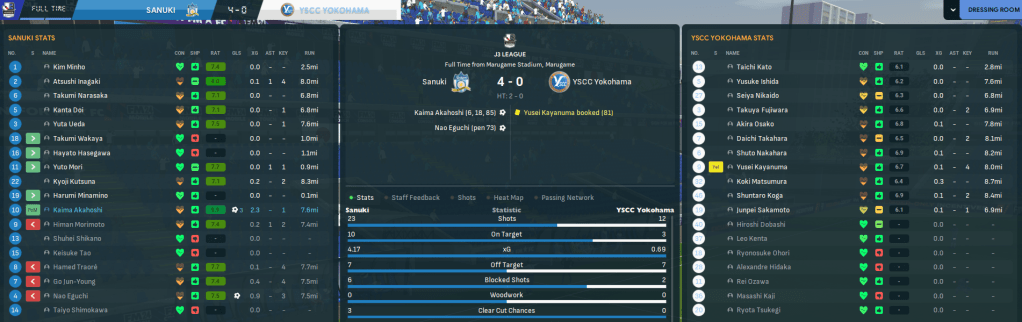
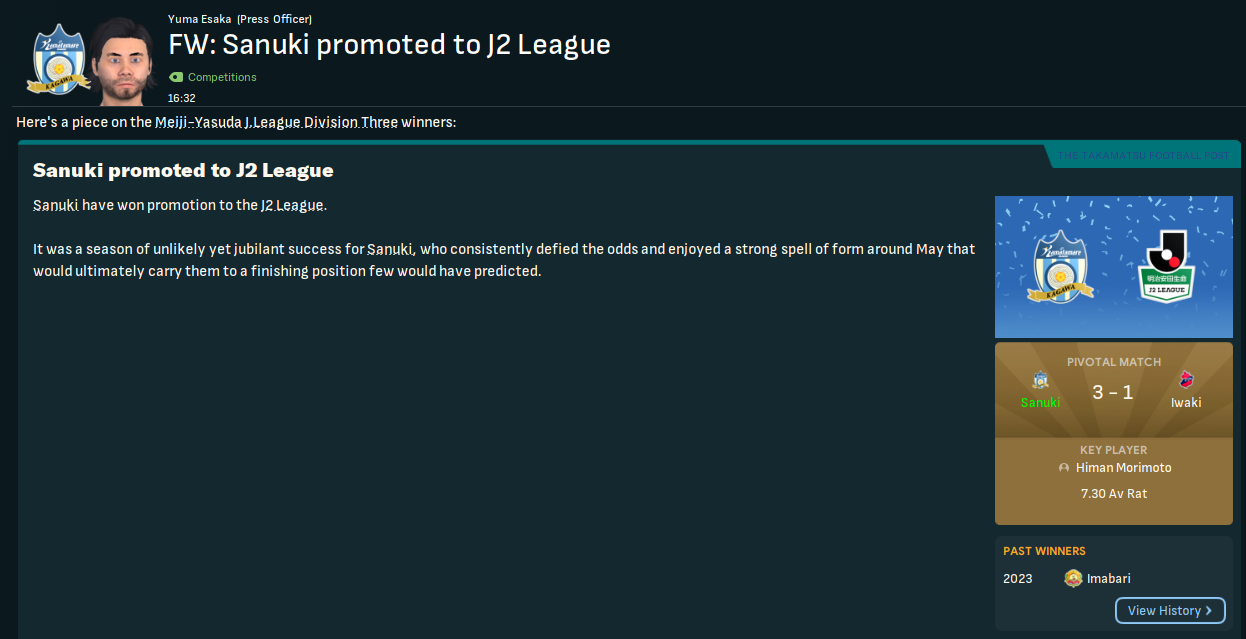
Game 2 – YSCC Yokohama (14th, home): Sanuki could be promoted if results their way, so Chairperson Yusuke Nakamura wisely selected the home game against Yokohama as a fan day that saw a bumper crowd of 3,088 (compared to the usual 2,400 or so). The fans had plenty to shout about after six minutes as He-Man chipped a ball into his strike partner Kaima Akahoshi, who took it down on his chest and calmly tapped home. Twelve minutes later diddy Inagaki swung in a cross for Akahoshi to jump above the keeper and head home his second. The points were wrapped up as a foul from a corner allowed Eguchi to slam home a penalty and there was still time for Akahoshi to wrap up his hat trick. Elsewhere, Tottori lost 3-2 at home to Kagoshima… so Sanuki and Rasamu were promoted!

The next task was to try and win Sanuki’s first major trophy and, without winning a game, that was also completed. Matsumoto played early and lost 3-2 at relegation-threatened Maruyasu, so Kamatamare Sanuki were Champions of J3 League!
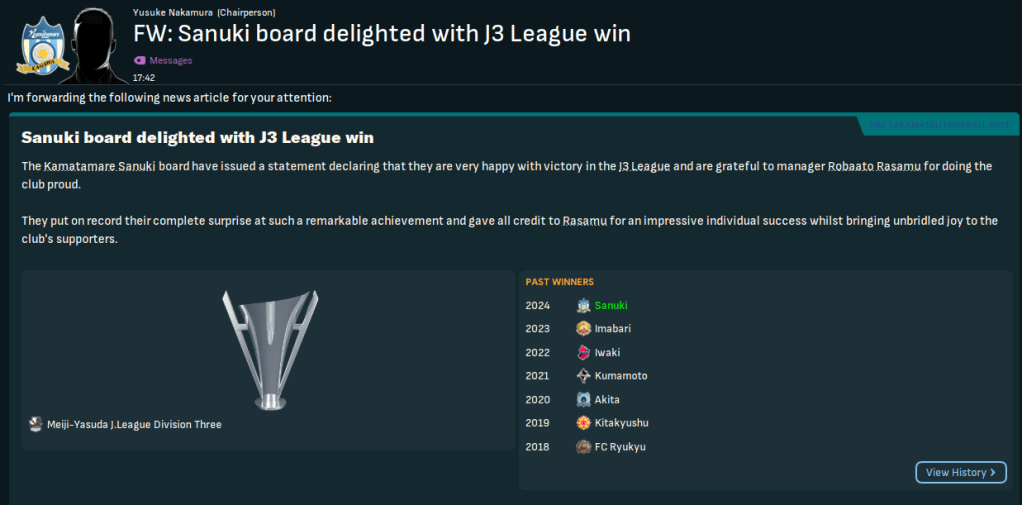
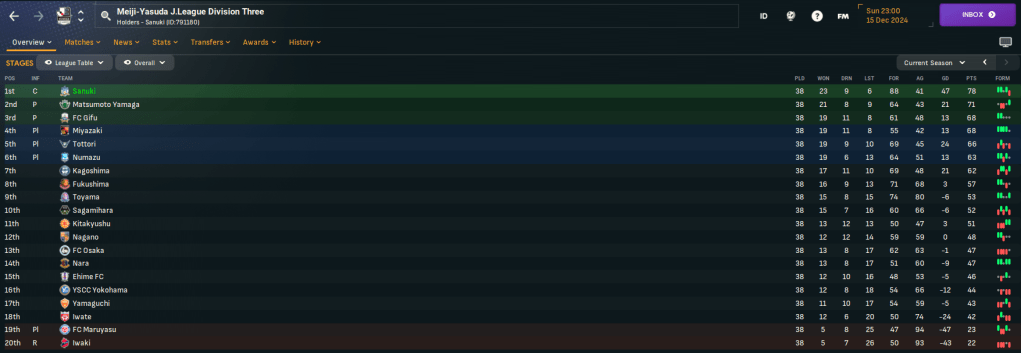
Sanuki celebrated their title with a 1-1 at Iwate, a 6-1 thrashing of Maruyasu led by a He-Man brace then lost 2-1 at Toyama. That saw Sanuki win the title with 78 points after 23 wins, nine draws and six losses, winning the title by seven points. He-Man was the 3rd-top scorer with 28 goals, Go topped the assists chart with 20 and Rasamu deservedly won the J3 Manager of the Year award.
Analysing Sanuki’s Unexpected Promotion
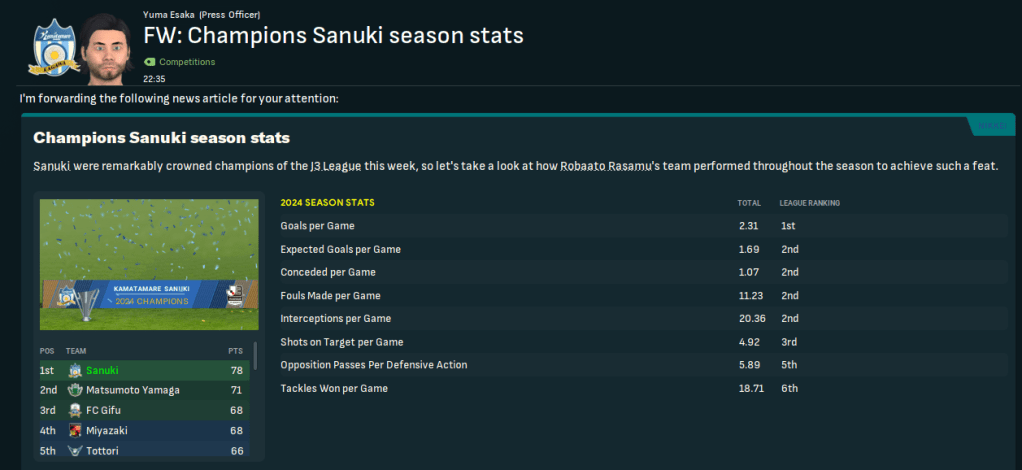
Sanuki’s attacking threat was the key ingredient to their success, leading J3 with 88 goals, 14 more than anyone else. They overperformed their xG by a massive 23.45 but were middle of the table in terms of set-piece goals. But they did take the 3rd-most shots (441), got the 3rd-most shots on target (187) and created the 5th-most chances (143) and had 400 more high-intensity sprints than any other team (3,807). Interestingly, they had the 2nd-fewest final third passes (2,037), completed the 3rd-fewest passes (15,596) and lost possession the 3rd-most (3,993).
Surprisingly, Sanuki also had the best defence in the league, conceding just 41 goals despite having the 8th-best xGA of 51.78 and only keeping seven clean sheets. They also committed the 7th-most fouls (427), won the 5th-most tackles (711), made the 2nd-most interceptions (774), won possession back more than any other side (3,656) and lost the most headers (1,300). And the title was achieved despite having the lowest salary spend in J3 (£781k compared to top-spending Yamaguchi’s £2.44m).
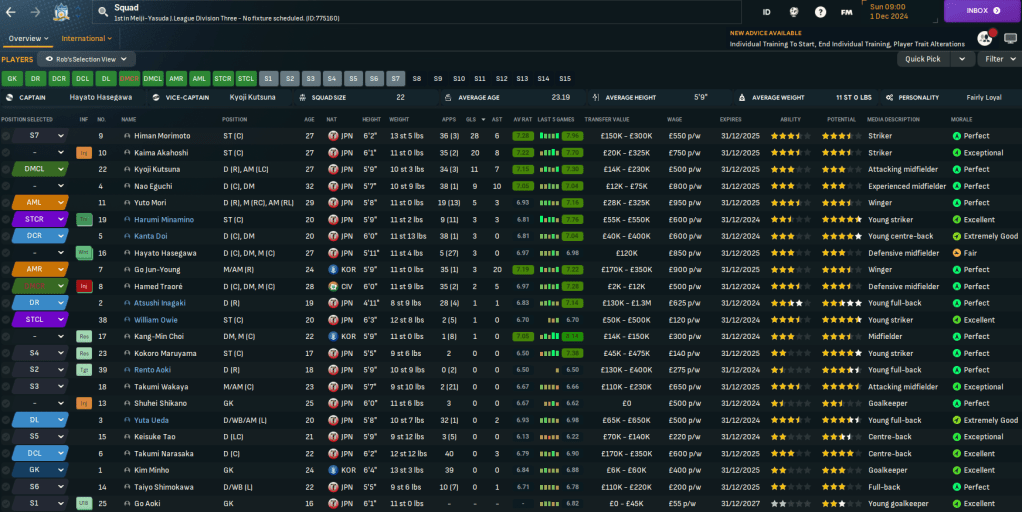
He-Man led the way with 28 goals in 39 games followed by Akahoshi (20), Kutsuna (11), Eguchi (9) and Mori (5). Go topped the assists chart with an impressive 20 followed by Eguchi (10), Akahoshi (8), Kutsuna (7) and Morimoto (6). Morimoto was also our best performer with a 7.28 average rating, boosted by 7.96 over the final five matches, followed by Akahoshi (7.22), Go (7.19) and Kutsuna (7.15).
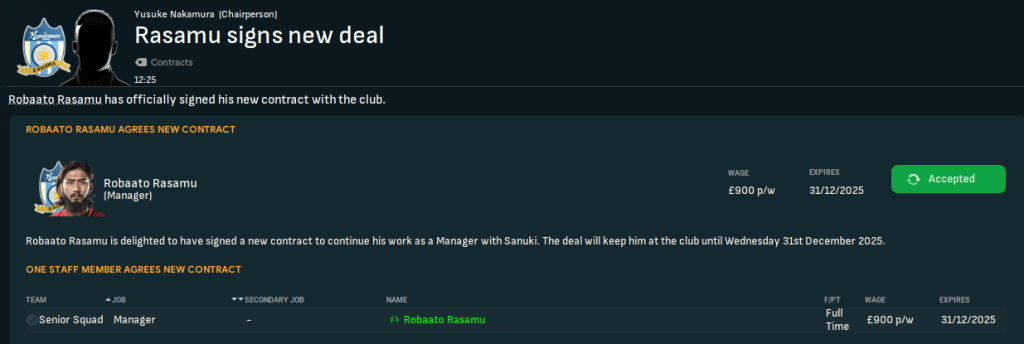
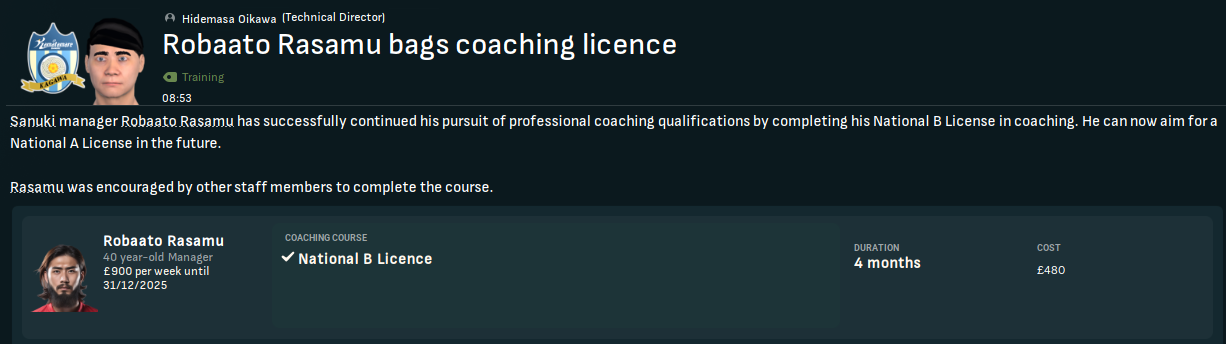
This season’s success found Rasamu very much in the good books of Chairperson Nakamura, who handed out a new one-year deal on £900 per week and allowed him to bag his National B Licence.
Rasamu now had a huge task on his hands to rebuild a squad with the lowest wage spend in J3 League to try and survive in the big step up to J2 League. Could he achieve it? Join us on Friday to find out!


 Football Manager Addict
Leave a comment