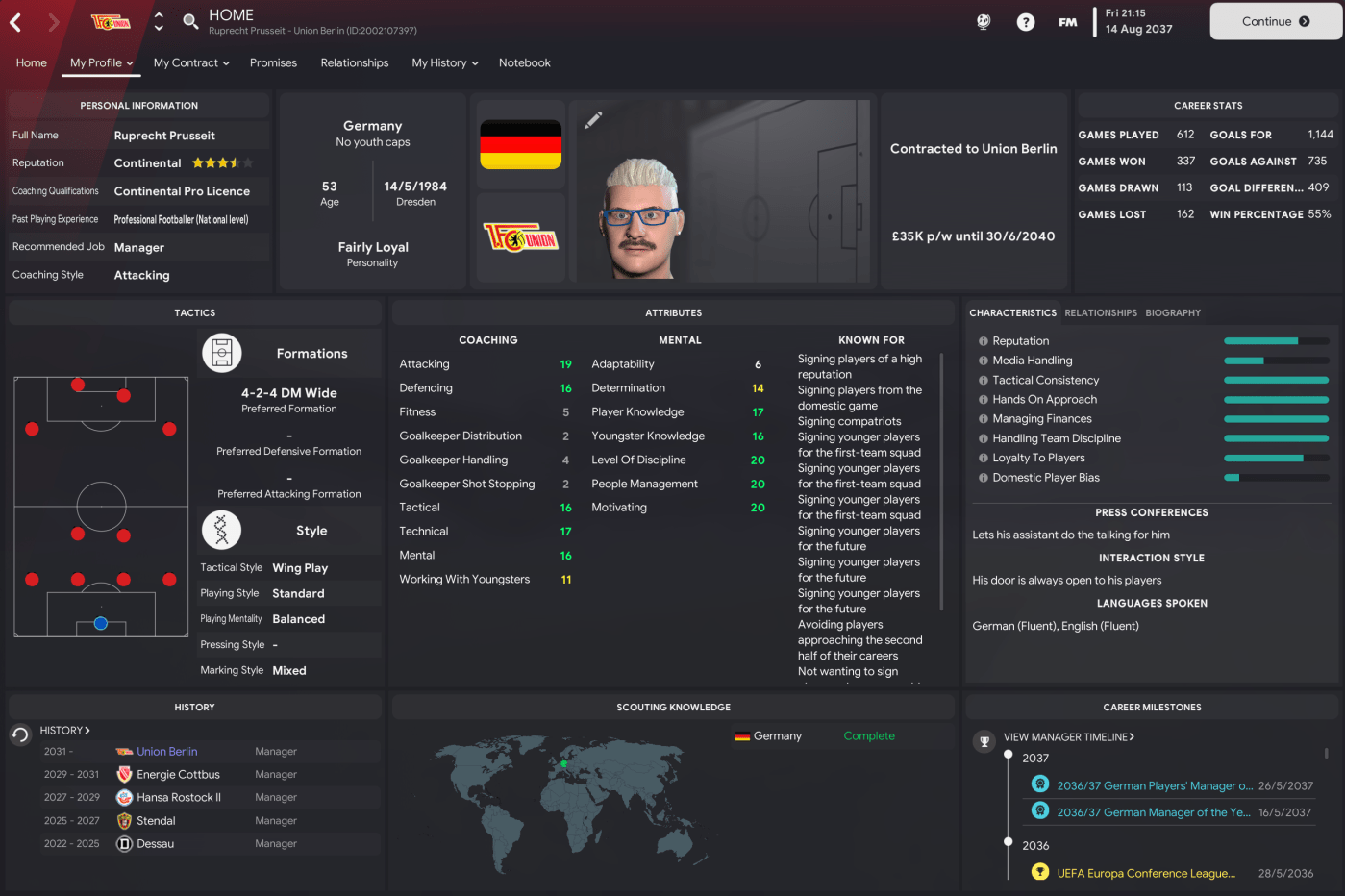
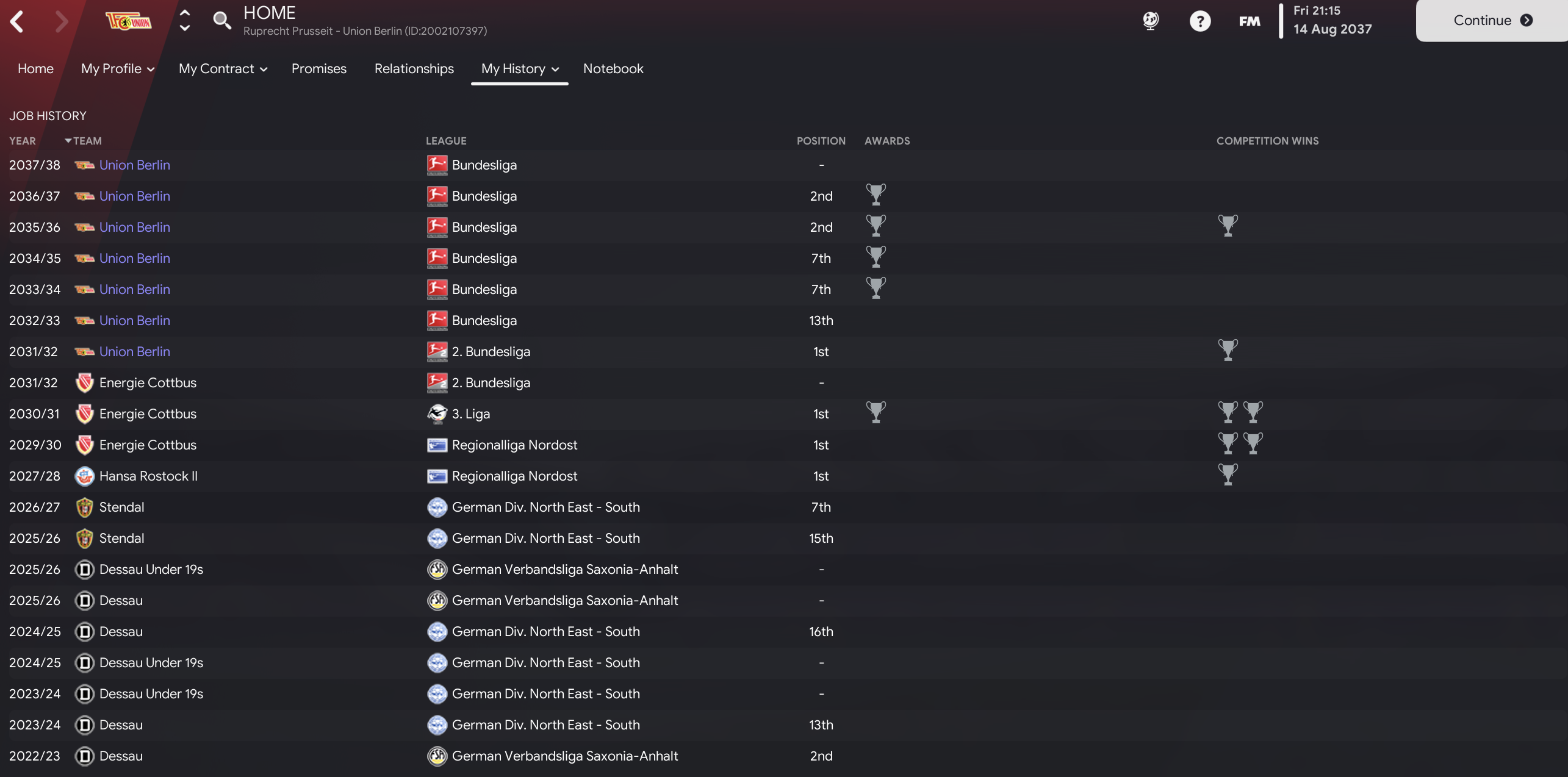
Fifteen years into life as a Football Manager, Ruprecht Prusseit had worked his way up from the sixth tier of German football to challenging at the top in the big time of the Bundesliga.
So the summer of 2037 feels like a good time to reflect on the manager’s progress and how other OstDeutscher sides are faring.
Prusseit’s Managerial Progress
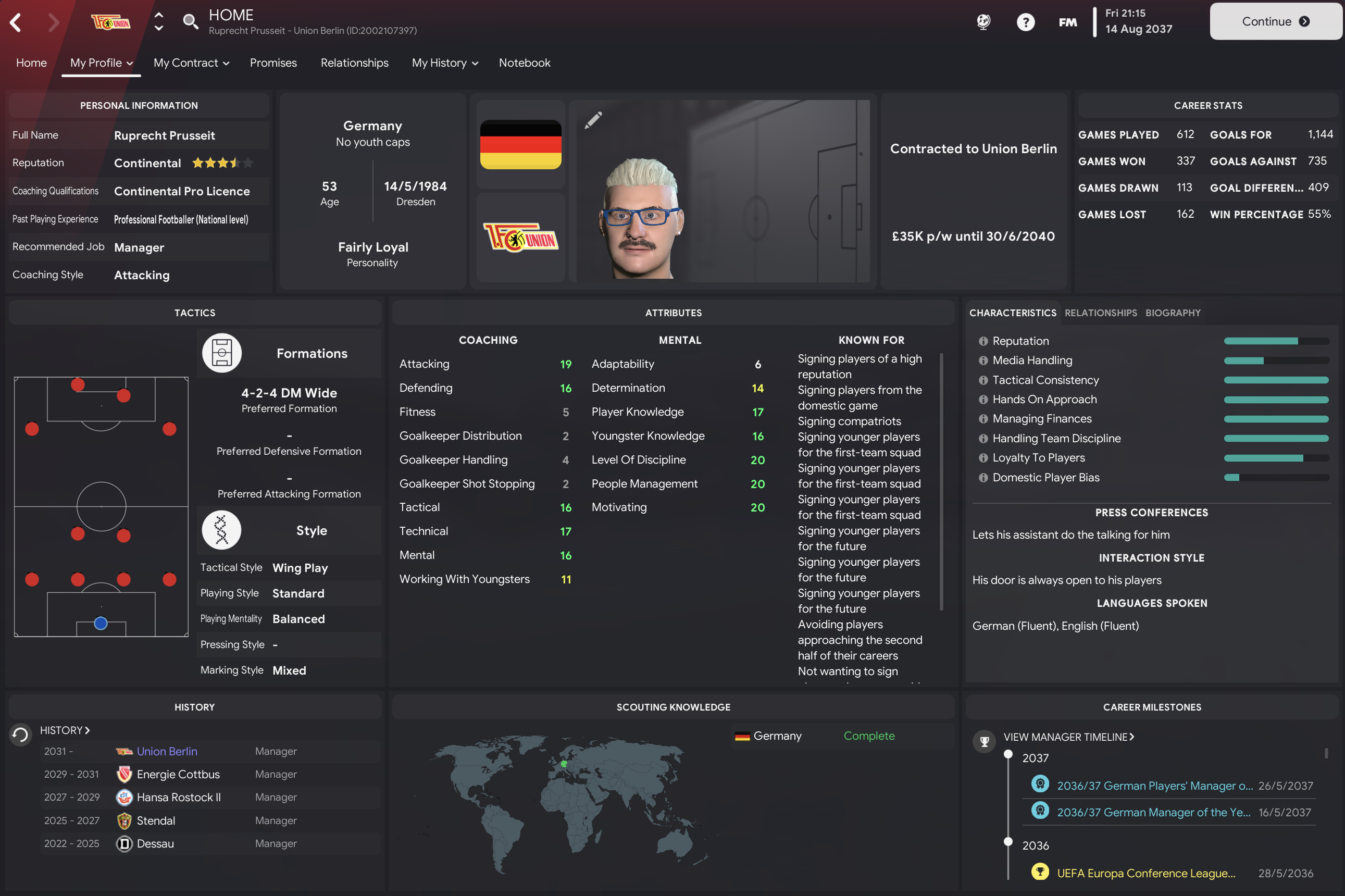
Over the last 15 years, Prusseit has racked up solid experience taking charge of 628 matches with five clubs: SV Dessau 05, 1. FC Lok Stendal, Hansa Rostock II, Energie Cottbus and Union Berlin. In those games, he has a 55% win percentage, with 337 wins, 162 defeats and 113 draws. While his teams have scored 1,144 goals and conceded 735.
During that time, Prusseit has gained five promotions, won four league titles, won three cup competitions and suffered one relegation. He spent no money until he joined Union, where he’s already spent £254m and made £314m in sales in six years. Now 53 years old, Prusseit has earned £6.75m over the last 15 years, which isn’t too shabby for a football-loving kid from Dresden.

OstDeutscher Sides’ Progress
Prusseit was keen to take a deep dive on where all the playable teams that began as options in his OstDeutscher adventure had fared over the last 15 years. So, sorted by their ranking at the start of the save, here’s how all the East German teams have progressed.
- Wismut Gera: Wismut Gera began in the sixth-tier German Thuringia League and won promotion to the German Division North-East. And they’ve been there ever since coming close to promotion with three second places, but they’ve dropped firmly back into mid-table.
- 1. FC Lok Stendal: Prusseit’s second club Stendal began the save in the sixth-tier German Verbandsliga Saxonia-Anhalt. He managed them up in the fifth-tier German Division North-East and, after spending a few seasons down in tier six, they returned to tier five in 2034 and remain there.
- Magdeburg II: Also began in tier six German Verbandsliga Saxonia-Anhalt and are currently in the fifth-tier North-East division with Stendal.
- SV Dessau 05: Prusseit started his career with Dessau and led them into tier five in his first season then suffered relegation after two seasons in tier five. Things have not gone well since. Dessau were relegated into non-league in 2028 and returned in 2030 but dropped back into non-league in 2034 and haven’t returned since. Bizarrely, they still have two of Prusseit’s first crop of players in winger Aluong Yaak and centre-back Karamoko Sylla, who’ve both played over 450 games for the club.
- VFC Plauen: An early rival of Prusseit’s in his Dessau and Stendal days, Plauen began in the fifth-tier German Division North-East South. They gained promotion to Regionalliga Nordost in season four and stayed there for four years before dropping down into tier five for four years. But they gained promotion in 2036 and remain in tier four.
- Hansa Rostock II: Prusseit’s third club began in the fifth-tier Oberliga Nordost. In 2028, Prusseit led them to win the fourth-tier Regionalliga, which they won again in 2033 but the B-team have since dropped back down into the fourth tier.
- Rostocker FC: Rostocker also began in the fifth-tier Oberliga Nordost, where they stayed for two seasons before being relegated to tier six. They stayed there for two years before dropping into non-league, where they remain now.
- 1. FC Frankfurt: Frankfurt were relegated from the fifth-tier Oberliga Nordost and stayed there for 14 years. But they suffered relegation from German Brandenburg-League last season, so are now a non-league club.
- SV Babelsburg 03: Began in the fourth-tier Regionalliga Nordost and stayed there for six years before relagation to Oberliga. They gained promotion in the second season and remained in Regionalliga for seven seasons but were relegated back to tier five last season.
- Berliner FC Dynamo: Started in the fourth-tier Regionalliga Nordost and remained there until 2035 when they were relegated to Oberliga, where they’ve finished 7th for the last two seasons.
- Carl Zeiss Jena: Jena also began in Regionalliga Nordost but have fared better than Babelsburg and Berliner. They won Regionalliga Nordost in the first two seasons and gained promotion in the playoff second time around. They spent five years in the bottom half of 3. Liga before being relegated to Regionalliga and remained there until winning the league to return to 3. Liga last season.
- Chemie Leipzig: Stayed in Regionalliga Nordost for 11 seasons before relegation to the fifth tier in 2033, where they remain now but are favourites to win the league.
- Chemnitzer: Chemnitzer are one of the biggest success stories in the region. They began in Regionalliga Nordost and stayed there until 2032 when they won the league to climb into 3. Liga. They were relegated in their first season then spent three seasons back in tier four. But they won Regionalliga again in 2036, then finished 6th in 3. Liga which, as a result of B teams, was enough to reach 2. Bundesliga this season!
- Energie Cottbus: But the big success story is Cottbus. Prusseit’s fourth club began down in tier four Regionalliga Nordost then got back-to-back promotions in 2026 and 2027. They swiftly dropped back down the leagues and Prusseit joined them back in tier four then led them to back-to-back promotions again in 2030 and 2031. They stayed in the second tier for two seasons, dropped back to 3. Liga but gained promotion in 2035. They finished 5th in 2. Bundesliga in 2036 before two mid-table finished.
- Lokomotive Leipzig: Lok Leipzig stayed in Regionalliga Nordost until 2034, when they won the league to reach 3. Liga. And they’ve recorded three mid-table finishes in tier three.
- Rot-Weiß Erfurt: Began in Regionalliga Nordost but were relegated in season two. They spent one season down in tier five and remain in Regionalliga Nordost now, frustratingly finishing second in the last three seasons.
- Dynamo Dresden: Dresden began in 3. Liga and were promoted to 2. Bundesliga in 2025. But they suffered back-to-back relegations and were one of Prusseit’s big rivals in tier four at Cottbus. They got back into tier three in 2031 and have twice been promoted back to 2. Bundesliga, from which they were relegated last season. And they’re huge favourites for 3. Liga.
- FC Erzgebirge Aue: Stayed in 3. Liga for six seasons before relegation in 2028 and they remain in Regionalliga Nordost.
- Hallescher FC: Hallescher were relegated from 3. Liga in the first season and remain in Regionalliga Nordost, where they’ve become a lower mid-table club.
- FSV Zwickau: Zwickau started the save well by finishing 3rd in 3. Liga and gaining promotion in the first season. They stayed in 2. Bundesliga for three seasons then spent five seasons back in 3. Liga. But they were relegated in 2031 and remain a mid-table side in tier four Regionalliga Nordost.
- 1. FC Magdeburg: Magdeburg were relegated from 2. Bundesliga in the first season then spent several years yo-yo-ing between tiers two and three. But they gained promotion in 2027 and have remained in the second tier since, establishing themselves as a mid-table side.
- Hansa Rostock: Rostock are the only OstDeutscher team that didn’t start in the top tier to have played in Bundesliga during this save. They spent the first seven seasons in 2. Bundesliga and gained promotion three times, only to be relegated in their first season in Bundesliga every single time. They finished 16th in Bundesliga last season but aren’t fancied for promotion this season.
- RasenBallsport Leipzig: Leipzig remain one of the better teams in Germany, now considered the second-favourites for Bundesliga behind Bayern. They’ve finished 2nd eight times during this save, most recently in 2035.
- 1. FC Union Berlin: Prusseit’s current club flirted with relegation from Bundesliga for many years before finally dropping into tier two in 2031. But their fortunes changed when they brought Prusseit in from Cottbus, winning 2. Bundesliga in 2032 then finishing 7th twice and 2nd twice in Bundesliga, plus winning the Europa Conference League in 2036.
So most East German sides have struggled through this save, but the likes of Rostock, Dresden, Cottbus and Chemnitzer, as well as Leipzig and Union, offer some semblance of hope for the region.
Join us on Friday as Ruprecht Prusseit begins season number 16 on his OstDeutscher Sieg!


 Football Manager Addict
Leave a comment